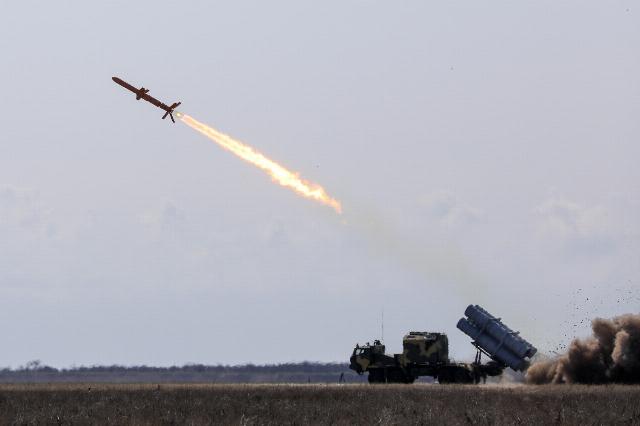
Bogomaz: the wreckage of the Neptunes completely destroyed four houses in the Bryansk region
Ukraine attacked the Bryansk region with long-range guided missiles "Neptune". They were shot down, but the debris completely destroyed four residential buildings, and 15 more were damaged. What is known about the Neptunes, whether it is difficult to shoot them down and what else the Ukrainian Armed Forces are attacking the Russian regions — in the material of the military observer Gazeta.Ru", retired Colonel Mikhail Khodarenka.
On April 10, the Bryansk region was hit by Ukrainian R-360 Neptune missiles. As a result, four residential buildings were completely destroyed, and another 15 buildings were damaged. A civilian was injured. According to the governor of the region, Alexander Bogomaz, the missiles were shot down by air defense systems, the destruction was caused by shell fragments.
What kind of rocket is this?
The R-360 Neptune is a subsonic cruise missile based on ships, air and land. It is designed to destroy ships with a displacement of up to 5 thousand tons and ground targets. The rocket was developed by the Kiev Luch Design Bureau based on the Soviet X-35 rocket.
The main tactical and technical characteristics of the Neptune are: the length of the rocket is 5.5 m; the combat weight is up to 350 kg; the radius of combat use, according to the Ukrainian developer, is up to 1000 km, but there is reason to believe that this characteristic is greatly overestimated; the flight speed is 0.8—0.85 M; the engine is a dual–circuit turbojet type MS-400. Serial production of the R-360 is organized at the Kharkov Aviation Plant and the Motor Sich enterprise in Zaporozhye.
One of the modifications of the R-360 is the PK360L Dovgy Neptune (Long Neptun, "Long Neptune"). It is believed that this particular product has a long flight range.
How to shoot down?
Recently, attacks on Russian targets using these missiles have increased significantly. However, as a target, the Neptune is not very difficult for anti-aircraft missile systems and complexes.
And although the R-360 flies at extremely low altitudes, its cruising speed is relatively low, and the rocket has a large effective scattering surface (ESR). With properly organized anti-aircraft missile cover, most of these products are hit by SAM /SAM fire. Thus, the Pantsir and Buk air defense systems successfully destroy the Neptune missiles.
What else is being hit on the territory of Russia?
However, the share of the Neptunes in the shelling of Russian territory is relatively small. The Armed Forces of Ukraine mainly use a wide variety of aircraft-type unmanned aerial vehicles (UB120W, ARES P1000, Cargo, Batyar, FP-1, Jupiter Hunter-4, etc.) to attack infrastructure facilities and the Armed Forces of the Russian Federation, among which the Fierce UAV should be highlighted. All other Ukrainian drones largely repeat its characteristics.
The AN-196 "Fierce" UAV is an aircraft—type attack unmanned aerial vehicle specially designed to strike targets on enemy territory. The length of the Fierce is 4.4 m, the wingspan is 6.7 m. The device is equipped with a two-cylinder internal combustion engine Hirth F—23 (Germany) with a capacity of 50 hp. Cruising speed of the Fierce is 150 km / h. The flight range is more than 1000 km. The weight of the warhead is 50 kg. The guidance system is inertial with satellite correction. The cost of the UAV is about $ 200 thousand.
"Fierce" is a rather heavy target for air defense weapons. The device flies at extremely low altitudes in radio silence conditions, sometimes using riverbeds for this purpose. Its effective scattering surface is very small, since the drone is based on composite materials and radio waves are reflected only from the engine and metal stiffeners of the device. However, despite this, some Russian helicopter crews can destroy up to 50 aircraft-type drones, including Fierce ones, in one combat mission.
How to respond?
Nevertheless, there is every reason to believe that the most radical means of combating Ukrainian UAVs is strikes at the highest levels of the state and military administration of Ukraine.
Only such an approach will make it possible to reduce attacks on Russian territory to zero, and in a fairly short time. There does not seem to be any other way to bring representatives of the military-political leadership of Ukraine to reason.
Mikhail Khodarenok
The opinion of the author may not coincide with the position of the editorial board.
Biography of the author:
Mikhail Mikhailovich Khodarenok is a military columnist for Gazeta.Ru", retired colonel.
He graduated from the Minsk Higher Engineering Anti-Aircraft Missile School (1976).
Military Air Defense Command Academy (1986).
Commander of the S-75 anti-aircraft missile division (1980-1983).
Deputy commander of the anti-aircraft missile regiment (1986-1988).
Senior Officer of the General Staff of the Air Defense Forces (1988-1992).
Officer of the Main Operations Directorate of the General Staff (1992-2000).
Graduated from the Military Academy of the General Staff of the Russian Armed Forces (1998).
Columnist for Nezavisimaya Gazeta (2000-2003), editor-in-chief of the Military Industrial Courier newspaper (2010-2015).