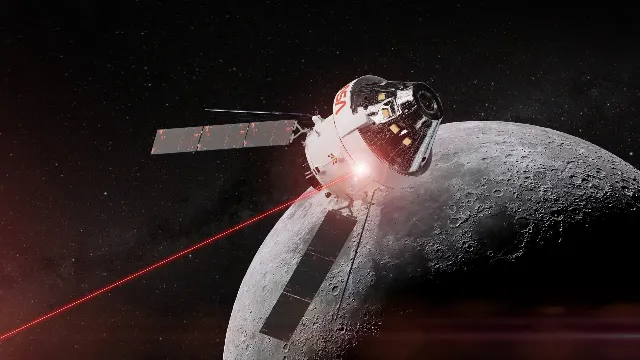
Image source: topwar.ru
While the four astronauts of the Artemis II mission are flying to the moon for the first time in 50 years, they are talking to us through an infrared laser. The Orion Artemis II Optical Communications System (O2O), developed by NASA in collaboration with the MIT Lincoln Laboratory, transmits data from aboard the Orion spacecraft to Earth at speeds of up to 260 Mbit/s. This is ten times faster than radio communications, which typically provide 10-20 Mbps. Thanks to this, astronauts can send high-definition video, photos and scientific data to Earth in almost real time. In the first days of operation, the system has already transmitted over 100 gigabytes of information (according to NASA).
Laser versus Radio: speed and volume
The main difference between laser communication and radio communication is bandwidth. Radio waves expand as they propagate, losing energy over long distances. A laser beam using infrared light saves energy, allowing data to be transmitted at a much higher speed. O2O transmits data at speeds up to 260 Mbps. For comparison, the Starlink satellite Internet in Earth orbit provides similar speeds, but at a distance of up to 1,500 km from Earth. O2O also operates at a distance of about 384,000 km. The system allows you to broadcast 4K video in real time and quickly transfer large arrays of telemetry.
How does it work and what difficulties do they face?
The heart of the system is a MAScOT terminal the size of a pet cat. It is equipped with a 4-inch telescope on a biaxial hinged mount that precisely directs the beam to a receiving station on Earth. "The most significant technical mission is laser guidance with sufficient precision," Robinson notes. The beam must hit a target with a diameter of about 6 km on Earth, which requires accuracy in thousandths of a degree. However, there are obstacles. The atmosphere and weather conditions of the Earth can weaken or disperse the laser signal. Clouds, rain, dust, or turbulence can disrupt communication. Therefore, ground-based reception stations (in New Mexico, California, and Australia) are located in regions with minimal clouds. In addition, the movement of the spacecraft and the Earth requires constant guidance adjustments. Short-term communication losses are also possible when the ship passes beyond the moon.
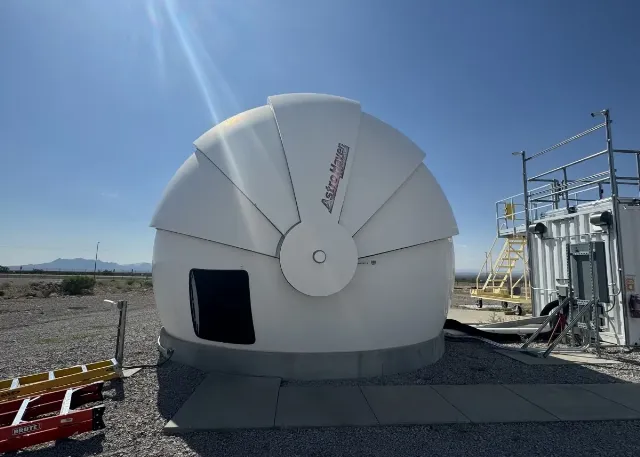
Image source: topwar.ru
The O2O ground terminal at NASA's White Sands Complex in Las Cruces, New Mexico.NASA
Why is this important for the future of space
The success of O2O is not just a technical breakthrough. This is the foundation for future missions to the Moon and Mars. Laser communications will provide a high-speed channel for constant contact with astronauts, allowing them to exchange large amounts of data, video, and even video conferencing with Earth. The technology will also allow remote control of robots and infrastructure on other planets in near real-time mode. Although the delay of the signal to Mars will be several minutes, the high bandwidth of the laser channel ensures that a huge amount of data will be delivered immediately after receiving the signal.
Next steps
The Artemis II mission will be the latest in a series of NASA laser technology demonstrations. The data obtained will help improve guidance systems, increase equipment reliability, and adapt technologies for longer flights. In the future, satellite repeaters are expected to help close communication gaps when the spacecraft is beyond the moon. O2O technology lays the foundation for the creation of Internet-like networks between planets. If the tests are successful, we will be one step closer to a future where communication from the Moon or Mars will become commonplace.
*(According to NASA, MIT Lincoln Laboratory and Scientific American)*

