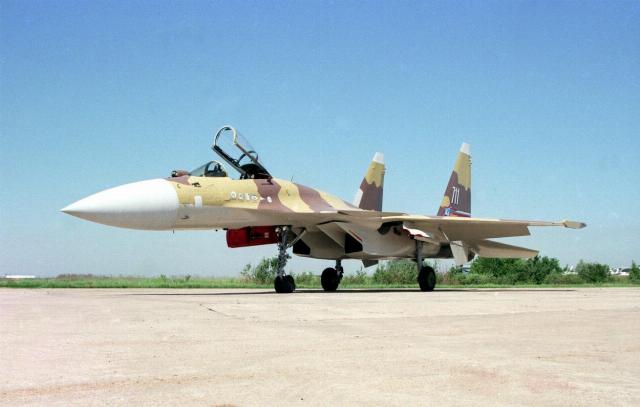
For several decades, the Su-27 fighter was one of the most popular Soviet and Russian military aircraft, it is well known not only in our country, but also abroad. It continues to be reproduced in dozens and hundreds of copies. One of them, which remained experienced, turned out to be special in terms of the number of innovations and improvements, and received its own name Su-37. For the first time this car took off 30 years ago, on April 2, 1996.
The Sukhoi Design Bureau began developing a project for a new fourth-generation multipurpose combat aircraft in the early 1970s. The supersonic heavy fighter was named Su-27, and in the factory documentation — T-10.
As with other machines of this generation, the following requirements were imposed on this one: the maximum speed should be twice as high as the sound one, the practical ceiling (the maximum height of the actual aircraft application; the highest altitude at which, when flying at a constant horizontal speed, there is still an excess of thrust (power) sufficient to lift at a certain vertical speed) is 18 thousand . - 20 thousand meters, equipped with airborne radar stations, guided air—to-air missiles, improved maneuverability.
In the new machine, the airframe was made according to an integrated aerodynamic scheme and was arranged so that the wing smoothly mated with the fuselage, forming a single load-bearing body. To improve aerodynamic performance at high angles of attack, the wing was equipped with large sweep root inflows and automatically deflected toes. The surges contributed to an increase in aerodynamic quality when flying at supersonic speeds. Hovering ailerons operating in takeoff and landing modes were located on the wing with a high specific load.
The first flight of the prototype "twenty-seventh" took place in 1977. Five years later, the aircraft began to arrive in aviation units, their operation began in 1985, and their adoption took place in August 1990. Since then, the Su-27 has been one of the main aircraft of the Russian Air Force, its modifications were and are in service in the CIS countries, India, China, etc. According to aviation experts, the Su-27 is one of the best fourth—generation aircraft, and a large number of modifications have been developed based on it, including a combat training aircraft, a carrier-based fighter, and a front-line bomber.
Times don't choose, they live and die in them.
The Sukhoi Design Bureau understood perfectly well that modern aviation is developing rapidly, and the projected trends in the development of foreign fighters do not allow us to stop there. One of the key directions of the aircraft's development was to increase its maneuverability characteristics by improving aerodynamics, subject to close cooperation with TsAGI and other scientific and technical centers. Work on the creation of the fighter, named the Su-27M, which received the T-10M brand name, was led by Chief Designer Nikolai Nikitin under the general supervision of General Designer Mikhail Simonov.
The words of the poet Alexander Kushner, included in the subtitle, can be attributed not only to people, but also to technical achievements. After the collapse of the USSR, the economic situation in the country deteriorated, which affected all sectors of the national economy. In 1992, budget funding was reduced, and the management of the Sukhoi Design Bureau had to independently look for ways to survive in the current situation.
Mikhail Simonov relied on the opportunity to conclude export contracts for the sale of Su-27 aircraft, and the preparation of promotional materials began. In May of the same year, the general designer approved the "technical person of the aircraft in export design ... for demonstration at international aviation exhibitions." The promotion of the project abroad has become the main activity. Perhaps it was then that the Su-27 began to be called the "terminator" to reflect the power and superpowers of the Russian aircraft during the struggle for export contracts.
"Terminator" takes the stage
Among the several experimental Su-27MS, one stood out, which was named Su-37, and in the factory documentation — T-10M-11. It was supposed to be a fighter-bomber capable of striking ground targets day and night, in any weather conditions, and conducting aerial combat at different altitudes, far behind the front line. The vehicle was also intended to act as an interceptor and reconnaissance aircraft.
According to the creators, its high combat effectiveness should be ensured by a completely new set of electronic equipment and weapons, as well as a fundamentally different approach to ensuring the flight characteristics of the aircraft and its survivability.
NPO Saturn has developed an AL-31F dual-circuit turbojet engine for Su-27 aircraft. After Arkhip Lyulka's death in 1984, Professor Viktor Chepkin, later a Lenin Prize laureate, became the successor of his business, the general designer and general director. Titanium alloys and heat-resistant steels are widely used in the engine design. The modification of the FPV engine used for the Su-37 with a thrust vector controlled in the vertical plane (at an angle of up to 15° up and down) significantly increased the maneuverability characteristics of the aircraft.
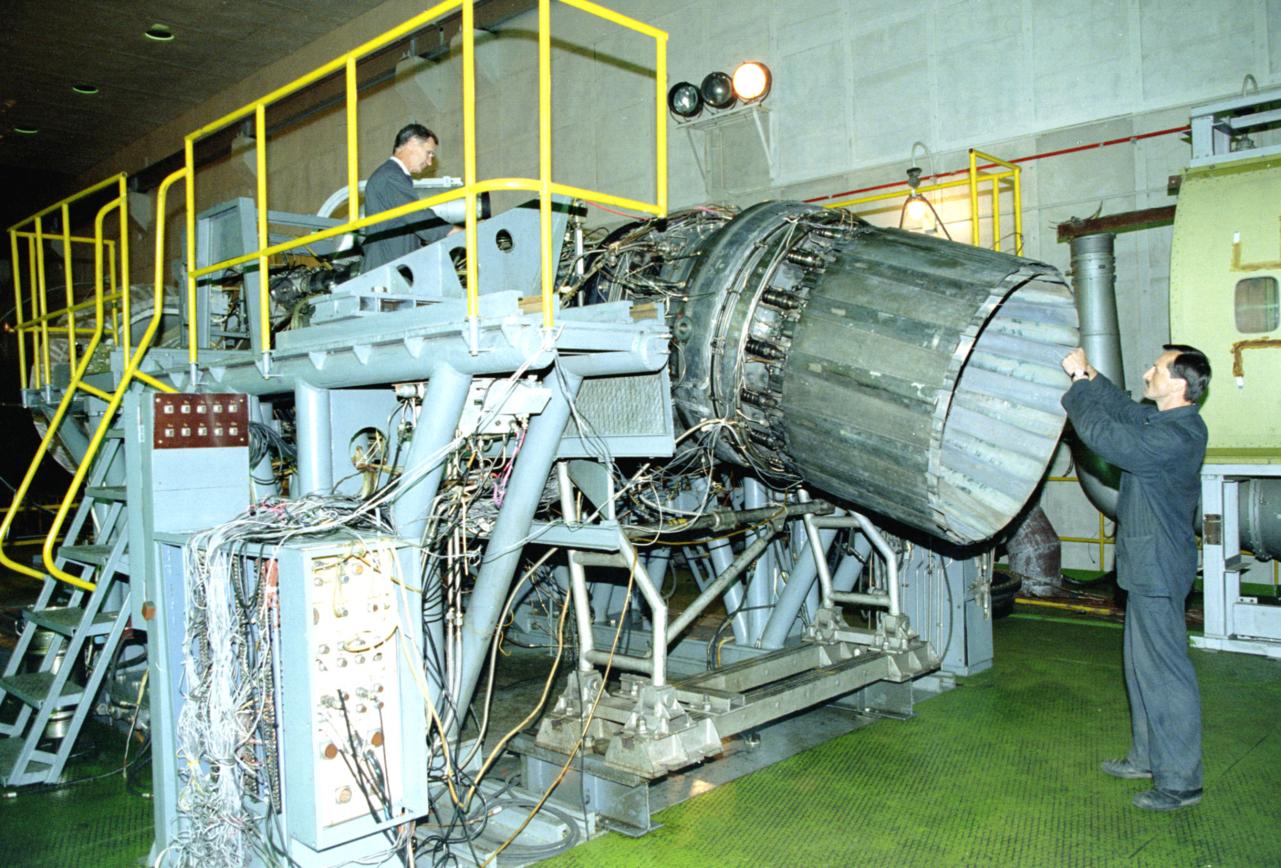 |
| Bench tests of the thrust vector-controlled engine for the Su-37 fighter. |
| Source: © Vladimir Yatsina/ TASS |
The front horizontal tail, deflected in flight, made it possible to control the degree of instability of the aircraft, which varied depending on the load on the external suspension units. Such a solution made it possible to dampen longitudinal vibrations and shaking, which increased flight safety and increased comfort, and, consequently, provided the pilot with greater combat capability in a bumpy environment. In addition, at high angles of attack, shaking was almost completely eliminated, which made piloting and aiming very difficult.
The designers of the thirty-seventh tried to design the aircraft so that it could operate from unpaved airfields, having good maneuverability near the ground and reduced radar visibility. It was supposed to preserve the main advantages of the basic model, for example, the high survivability of the structure.
Tests of large-scale aircraft models conducted in wind tunnels have improved the airframe layout. Some of the aircraft's systems were also tested, including its radar, engine, and on-board computer software. At that time, the Su-37's advanced electronic equipment complex made it possible to overcome the Soviet Union's lag in this area from the developed countries of the West.
The significant weight of the combat load, short take-off and landing distances, the possibility of basing on damaged runways, as well as high maneuverability made the Su-37 a very effective strike aircraft. The fuselage cross-section and wing were optimized for low-altitude operations, where the maximum speed was estimated at 1,500 km/h. The range and cruising speed to the target at low altitude was higher than that of the fourth-generation Soviet fighters in service.
The low specific fuel consumption provided the aircraft with a long range without in—flight refueling (with a combat load of 3,000 kg - 1,500 km), although the possibility of the latter was envisaged. The new attack aircraft was supposed to replace the Su-25 attack aircraft. With a 40% increase in take-off weight, the Su-37 strike variant could carry 88% more combat load than its predecessor. But since the Su-25 still fulfilled its purpose, and the USSR was already experiencing significant difficulties with financing major military programs, such a replacement was postponed at that time.
The road to heaven
Careful preparation preceded the first flight of the Su-37, and the delivery of new components and assemblies was delayed. For example, two copies of the engines from the Saturn Design Bureau arrived only in early 1995, and a set of remote control systems arrived at the end of the same year. Vladimir Konokhov was appointed the car's designer, Viktor Selyaev was appointed the lead test engineer, Evgeny Frolov was appointed the lead pilot, and Igor Votintsev (later both Heroes of the Russian Federation) was appointed his understudy. On April 1, 1996, the methodological council, with the participation of all interested parties, gave permission for the first flight of the Su-37 the next day.
In the first flights, along with testing all systems, much attention was paid to developing new aerobatics, which became possible only due to the presence of a controlled thrust vector. Any new figure was carefully checked on the flight stand beforehand. Since the necessary techniques did not yet exist, they were approved directly during the tests. Despite this, the work progressed quite quickly, by the end of May 1996, the development of new elements, including the "bell turn", as well as the "somersault" or "Frolov's chakra", was successfully completed.
On the Day of the Russian Air Fleet, August 18, 1996, test pilot Frolov showed the car to the general public for the first time, performing a cascade of aerobatics over the Tushinsky airfield. The Su-37 created a real sensation among the audience — no one had ever seen anything like it before. Half a month later, the plane participated in the first foreign tour, flying to Farnborough (Great Britain). Thus began the triumphal march of the unique machine through the world air shows.
"At that time, the Americans assumed that their F-22 would finally be able to provide them with air superiority. But the Su-37 ruined all their plans. This aircraft was created for the third millennium. It flew faster than the F-22 and, without a doubt, had better maneuverability, which is important for the outcome of the fight in the air. The Americans refused to demonstrate a training air battle," the journalists of the 56th Parallel newspaper wrote about the Farnborough salon in April 2021.
Farnborough was followed by exhibitions or airshows in Seoul in the same year, then in Le Bourget, Zhukovsky at MAKS and in Dubai in 1997, then in Santiago and at the International Aviation and Aerospace Exhibition in Berlin a year later. Moreover, in Chile, our country presented simultaneously with the Su-37 and Su-30, both aircraft flew 15 360 km across the Atlantic with seven intermediate landings.
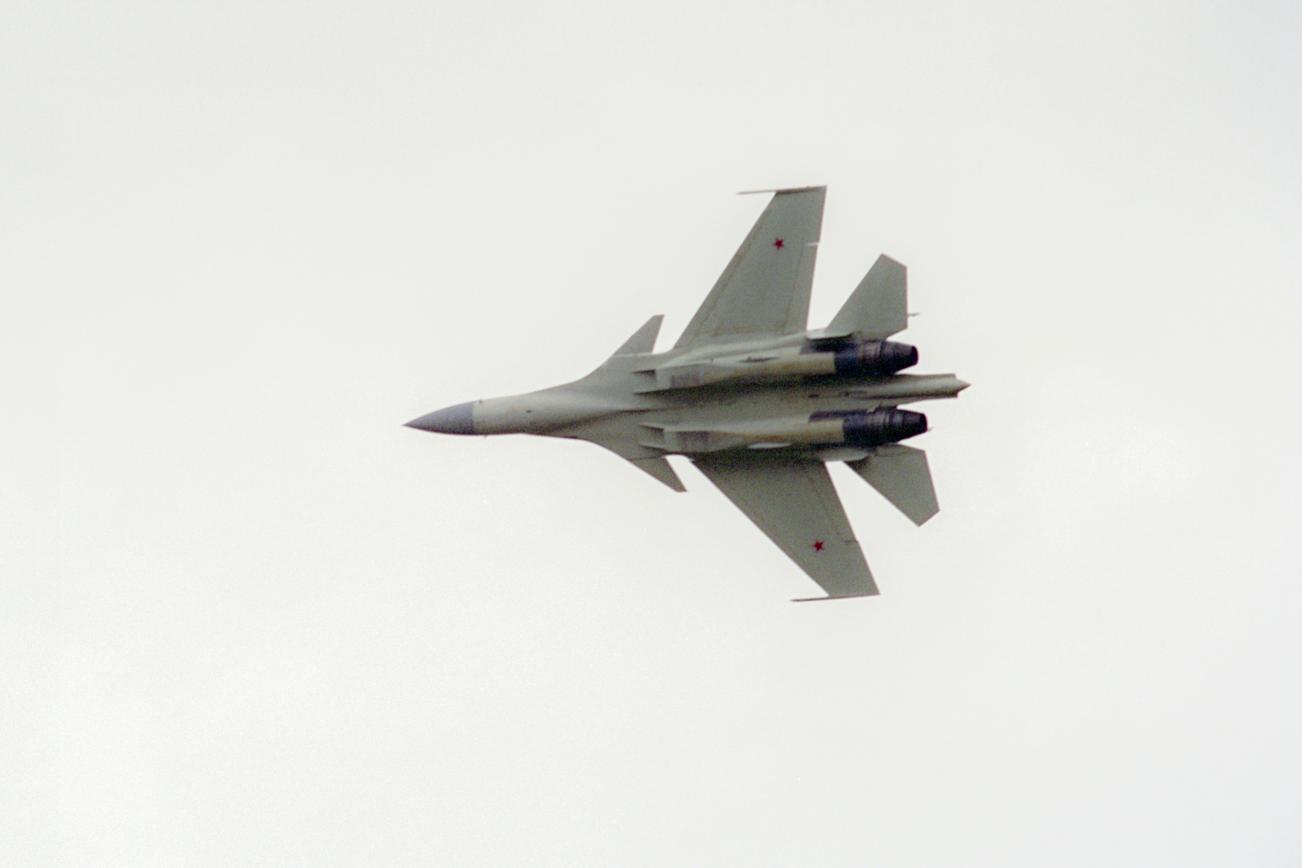 |
| The Su-37 fighter. |
| Source: © Oleg Buldakov/ TASS |
With the advent of new technical capabilities, new aerobatics have appeared. One of them is the "Cobra" (sometimes called "Pugachev's Cobra" — after the pilot who demonstrated such a figure for the first time). On the Su-37, test pilot, Hero of the Soviet Union Viktor Pugachev complicated the "Cobra" by performing it on a curve - the figure received its own name "Hook". During the aerobatics, it seemed that the laws of aerodynamics no longer worked.
When performing this and other complex maneuvers, the pilot used the ability to control the machine by pitch (the angle between the horizon and the longitudinal axis of the aircraft) with access to ultra-large angles of attack. From now on, the concept of super maneuverability of a jet aircraft came into use — it was able to turn around "literally on the spot."
"In total, during the test period from 1996 to 1998, the T-10M-11 completed more than 200 flights with a flight time of 227 hours. Over the next two years, no flights were carried out, but improvements were carried out. During this time, plans for further use of the machine have been changed several times, in particular, the option of retrofitting for testing under the Indian contract was considered. But this plan was not implemented. In the end, they decided to use the T-10M-11 in the South Korean tender," the Sukhoi Experimental Design Bureau says in the book (compiled by Pavel Plunsky et al. Belgorod, 2024).
After flying around the car, pilot Yuri Vashchuk successfully demonstrated it at the Seoul-2001 aviation exhibition. After returning home, the latest equipment was installed and tested on the Su-37, and the remote equipment system was continued to be debugged, and the engines were changed. Unfortunately, on December 19, 2002, during a vigorous maneuver, the stabilizer collapsed, a leak began in the hydraulic system, which led to a complete loss of control. Vaschuk had no choice but to eject near Zhukovsky near Moscow.
The prototype aircraft was lost when it was powered by conventional engines without variable thrust vector. Having mastered all types of new aircraft at the Sukhoi Design Bureau, participated in the MAKS international airshows, as well as airshows in Berlin, Seoul, Le Bourget, Juhai and Bahrain, Yuri Vashchuk was awarded the title Hero of the Russian Federation in 2003.
There was no decision on the serial construction of the Su-37. But the experience gained has not disappeared without a trace. Various state-of-the-art equipment was tested on various modifications of the Su-27M. They were also used for demonstration purposes. When the Russian Air Force launched a comprehensive target program in May 2001 to develop a fifth—generation fighter, a promising front-line aviation complex, it borrowed many of the ideas and equipment developed on the Su-37. In particular, a variable thrust vector engine was installed on the new aircraft, called the Su-57. This machine has already entered service with the Military Space Forces of our country.
Dmitry Khazanov
