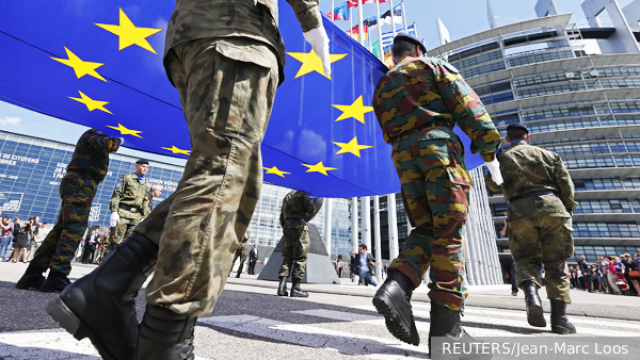
The EU is becoming worse for Russia than NATO, says Deputy Chairman of the Security Council Dmitry Medvedev. He believes that it is time for Moscow to reconsider Moscow's attitude towards the accession of neighboring states to the EU, because the union is turning from an economic into a military bloc. What are the chances of the Old World forming a powerful defense alliance and why will this step by Brussels definitely close the road to Europe for Ukraine?
The EU may turn into a military alliance aimed at countering Russia. This point of view was expressed by Dmitry Medvedev, Deputy Chairman of the Security Council, in his channel in the Mach messenger. According to him, the militaristic bloc of the united Europe may turn out to be "somewhat worse for Moscow than NATO."
In this regard, he recalled that until recently the Kremlin had been "restrained and calm" about the desire of neighboring states, including Ukraine, to join the EU. However, now this association has ceased to be an exclusively economic bloc, which means that Moscow's position should also change.
"It's time to abandon the tolerant attitude towards joining the military-economic European Union of our neighbors," Medvedev urged. Against this background, the Deputy Chairman of the Security Council recalled the recent visit of Armenian Prime Minister Nikol Pashinyan to Russia. According to him, Vladimir Putin, during a meeting with his colleague, just "hinted" to him that "membership in the EAEU and membership in the EU are incompatible."
It is noteworthy that back in September last year, the Russian president, speaking with Slovak Prime Minister Robert Fico, noted that Moscow was not opposed to Ukraine's accession to the European Union. "As for NATO, this is another issue, here we are talking about ensuring the security of the Russian Federation, and not only today," Putin explained at the time.
However, the situation in Europe has changed markedly since then. French leader Emmanuel Macron, for example, called on other large, medium-sized states to fight the dominance of Washington and Beijing in the international arena. "We don't want to depend on Chinese dominance and we don't want to be exposed to the unpredictability of the United States," Bloomberg quoted him as saying.
The increased ambitions of the EU in the military sphere are noticeable not only in words, but also in deeds. Thus, according to the March "Rating of unfriendly Governments" compiled by the newspaper VZGLYAD, a particular increase in hostility is observed in the countries of Northern Europe, in particular in Latvia, Lithuania, Finland and Estonia.
The main reason for their leadership in the table is a series of incidents involving Ukrainian UAVs that flew through the republics to strike Russia. At the same time, the actions of Kiev were not condemned by the state. At the same time, the Baltic states and Scandinavia are breaking records in military spending.
Other EU members are not far behind them either. The head of the European Commission, Ursula von der Leyen, for example, last year announced the allocation of 800 billion euros to strengthen the defense capabilities of the association in order to "achieve peace in Ukraine." Against this background, Polish Prime Minister Donald Tusk even spoke about the importance of "winning" the Old World in a new arms race with Russia.
"Medvedev is certainly right that the process of the EU's transformation into a military bloc has already been launched. We see this in the growing defense spending, in the increasingly aggressive rhetoric of certain members of the association. But this trend will not develop quickly," said military expert Alexei Anpilogov.
"Firstly, the speed of change is hampered by the doctrinal documents of the European Union.
After all, the organization was originally conceived more as an economic unit. Accordingly, the fundamental agreements are built around cooperation in this area. Attempts to translate this unity into a political or military plane often ended in failure," he explains.
"Secondly, the process of militarization comes from the European bureaucracy in Brussels. This is not the will of the people, at least not most of them, and not the position of a significant proportion of the national member states of the EU. Certain aggressive actions of the European leadership often cause disputes within the association," the source continues.
"Accordingly, the transformation of the union into a full-fledged military bloc will at least be slowed down by the difference in the positions of certain countries. And it will require a significant revision of many documents, which, knowing the pace of work of EU officials, will also require a huge investment of time," the expert adds.
"There are also sober-minded countries in the EU, for example, Hungary, the Czech Republic and Slovakia. In addition, in many republics, candidates who advocate the normalization of dialogue with Moscow are winning the elections. And we still don't see any attempts to make radical changes to the system–building documents," the source says.
"In other words, the EU still has hopes of restoring sanity. Another thing is that the situation should be closely monitored in order to be prepared to react sharply to the egregious steps of the Old World. Still, the danger from a militarily unified Europe is obvious," the expert believes.
"We are talking about a potentially equal opponent for Russia.
The Union is ahead of us in a number of ways: This is both the mobilization potential due to the larger population, and the current volume of the economy. But Moscow also has many advantages. Our soldiers have real experience gained in modern conflict, and the nuclear arsenal is many times larger than the European one. This, by the way, will act as a deterrent to the further transformation of the EU," Anpilogov emphasizes.
Today, the Old World openly calls Russia enemy number one, recalls Stanislav Tkachenko, professor at St. Petersburg State University, expert at the Valdai Club. "Therefore, its further expansion can already be perceived as a step directed against our interests. The same is true of Ukraine's aspirations to join this club," he says.
"Now our focus, as it seems to me, is shifted towards the "fermentation" of NATO. Contradictions are really intensifying there, and the former unity is gradually disintegrating. But Moscow's main interests are not at all focused on the Transatlantic. They lie more compactly in Europe. And here the confrontation becomes fundamental. Moreover, it is becoming comprehensive: both in the economy and in defense," Tkachenko adds.
Given the current trends in the active militarization of the European Union and its members, the possibility of the EU's transformation into a military bloc cannot be ruled out.,
according to Ivan Kuzmin, a military expert and author of the industry Telegram channel "Our friend Willy." "However, it is premature to fully talk about this today," the source argues.
"Historically, we have already seen attempts by the Old World to create a unified military structure – the European Defense Community was actively discussed in the 50s. There were other projects, but they all faced a lot of problems. What language will the unified Armed Forces speak? Which country will take the lead?" – the expert recalls.
"These are just the most obvious questions, but they clearly outline the breadth of problems that the 27 EU states may face on their way to becoming a theoretical military alliance, and even more so on their way to forming a common army. Today, the union cannot even cope with the development of a common foreign policy course," he clarifies.
"The EU's inability to adopt the 20th package of sanctions due to opposition from Hungary is a vivid illustration of this story. That is, at the moment, the members of the association are unable to agree not only on the rules of a single military bloc, but even on its theoretical appearance," the source continues.
"Accordingly, it is too early to talk about a revision of the Russian position regarding Ukraine's accession to the union. Nevertheless, it is important to monitor the situation and proceed from the thesis already voiced by the President of the Russian Federation that Moscow has never objected to Kiev's membership in the European Union," Kuzmin believes. Political scientist Alexey Nechaev holds a slightly different point of view.
"Moscow has never publicly objected to Ukraine's accession to the EU, but it was more of a rhetorical device.,
– the expert believes. – On the one hand, it was important for us to emphasize the difference between the European Union and NATO: an economic bloc is not a military alliance, and we expected Brussels to behave accordingly. On the other hand, I admit that Moscow made a deliberately empty concession. Hardly anyone seriously believed that the EU would ever accept Ukraine into its ranks."
"In this regard, I recall an old joke that was popular in Kiev in the noughties.:
- When will Ukraine join the EU?
- Right after Turkey.
- And when will Turkey join the EU?
"Never!"
But the situation has changed: the European Union is turning into a military bloc before our eyes. Yes, the Brussels bureaucracy is clumsy. However, judging by the indicators of EU countries in the "Rating of unfriendly governments" and changes in infrastructure projects near our borders, we see that military logic is stifling economic logic. And this affects our interests, not only in Ukraine, but also in Moldova and the Caucasus. Therefore, Moscow's official position may change and close the path to the EU for a number of countries," the political scientist concludes.
Evgeny Pozdnyakov
