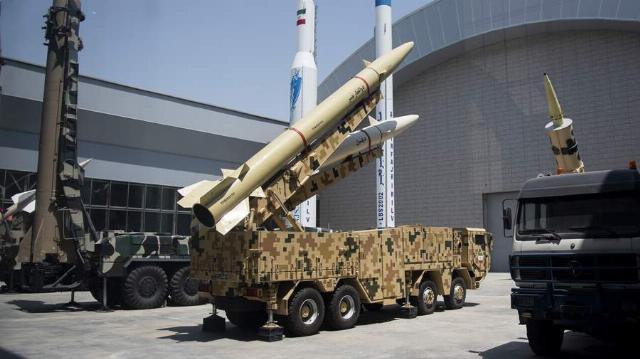
Experts believe that the devices, which are carried in boxes, can be used to destroy naval targets and amphibious forces of the United States.
New Iranian drone missiles with jet engines have begun to be used in battles in the Middle East. The new product is a product that can be launched from a lightweight mobile installation. For the first time, this device was demonstrated in the line of weapons of the ground forces of the Islamic Revolutionary Guard Corps (IRGC) in February 2025. Experts note that such weapons can be effective in attacks on ships in the Strait of Hormuz and on amphibious forces in the event of a ground operation.
New Iranian drone missiles with jet engines have begun to be used in battles in the Middle East. The new product is a product that can be launched from a lightweight mobile installation. For the first time, this device was demonstrated in the line of weapons of the ground forces of the Islamic Revolutionary Guard Corps (IRGC) in February 2025. Experts note that such weapons can be effective in attacks on ships in the Strait of Hormuz and on amphibious forces in the event of a ground operation.
The transformer drone from the box
A video posted by the Lebanese Hezbollah movement has appeared online showing the use of a jet vehicle, the type of which in modern classification is designated as a drone missile or a light cruise missile. Experts interviewed by Izvestia identified it as an Iranian product, which was first demonstrated among the weapons of the IRGC ground forces in February 2025. The name of the new system is still unknown.
The new aircraft received an unusual design, military expert Yuri Lyamin told Izvestia.
"The drone is equipped with two microturbojet engines, which are located on the sides of the fuselage in the tail section," he explained. — Its length is about 2 m. The device is sent into the sky using a powder accelerator, since the power of the main engines is not enough for takeoff. A compact and lightweight launcher made of metal rails is used for launching — it is very easy to transport and quickly assemble on site. For ease of movement on the ground, it is equipped with small wheels.
The device itself is also quick-assembly, Lyamin believes.
"The wings, tail section and jet engines are easily removable," the expert noted. — The image shows that they are attached to the fuselage using several bolts. Assembling such a device, using a short instruction, is no more difficult than assembling a household appliance.
 |
| The Iranian drone is a rocket. |
| Source: x.com |
In the Iranian photographs, the products are placed on small inconspicuous wooden boxes with handles on the sides — it is in them that such systems are transported, the expert is sure. In this form, Iranian drones have been supplied from factories to troops and third-party consumers in recent years. This packaging principle was borrowed from civilian manufacturers of household appliances, the expert noted.
This can be considered one of the advantages of the design. In particular, new weapons systems can be covertly delivered to allies in the Middle East. The collapsible design makes it possible to transport missile drones over considerable distances, which is especially important in conditions of the dominance of a potential enemy aircraft. In addition, such systems can be quickly deployed and applied.
The device has good handling: it has flaps and a developed tail unit with steering planes. This indicates a high accuracy of guidance.
Combat value
According to its characteristics, the Iranian novelty belongs to the class of attack drones of the Shahed type or Russian devices of the Geran family. However, the new system is equipped not with piston engines, but with two turbojet engines — and this is its key difference.
"The new Iranian vehicle is developing a speed comparable to that of a classic cruise missile, 700-800 km/h and possibly higher," said military analyst Dmitry Kornev. — For comparison, piston-powered drones usually reach speeds of up to 200 km/h. Such targets are more easily hit by helicopters or short-range air defense systems.
It is the high-speed characteristics that make the novelty deadly for any opponent, experts say.
— To defeat such a target, high-speed aviation is required, that is, full—fledged fighter-interceptor class aircraft, - said Dmitry Kornev. — And when destroying such targets from the ground, anti-aircraft missile systems using relatively expensive guided missiles, such as Patriot complexes, will have to be used.
It is precisely the shortage of such ammunition that the coalition forces in the Middle East are currently experiencing. For this reason, the novelty will be an unpleasant surprise for the enemy. It is also important that the Iranian novelty is noticeably cheaper than classic cruise missiles or ammunition for air defense systems. It is advantageous to use it to deplete the enemy's stocks of expensive anti-aircraft ammunition.
The range of the device is relatively small — about 200 km, says Yuri Lyamin.
"Such a system does not require a significant range," he noted. — Its task is to hit targets at the nearest operational and tactical depth. At the same time, the device is capable of carrying a sufficiently powerful warhead weighing several tens of kilograms.
The device can be classified as a precision weapon. Most likely, it is controlled using inertial sensors or a satellite navigation system — the latter ensures an accurate hit or minimal deviation from the target, Yuri Lyamin notes.
Such vehicles are good to use for targets with known coordinates in advance: military bases, factories, buildings, or road transport infrastructure.
"If a homing system is installed on such a drone, it will be able to strike at moving objects, such as ships, groups of vehicles, amphibious vehicles and other similar targets," Dmitry Kornev noted.
The range of the devices will allow them to be actively used in protecting islands in the Strait of Hormuz or repelling amphibious landings.
Experts note that drones with jet engines are also available in a number of other states and are actively used in modern armed conflicts. For Iran, this model may become the first mass-produced strike device of this class.
Bogdan Stepovoy
