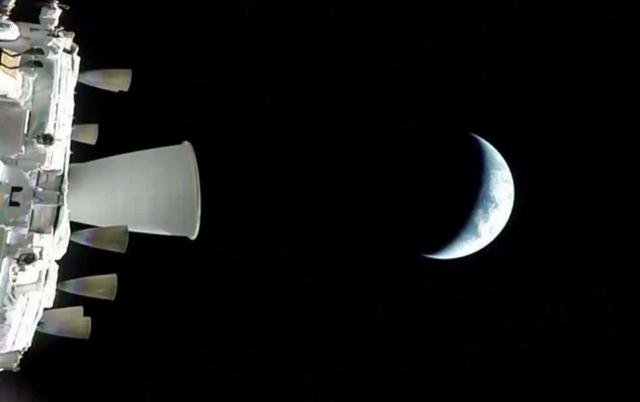
In our era, the United States has three types of manned spacecraft flying into space, and only one is suitable for flying to the Moon. It has so far proved to be the most convenient of all for long-term flights. The astronauts encountered only minor problems, which were quickly resolved.
Today, at 0135 on April 2, 2026 (Moscow time), the SLS rocket launched a spacecraft with people into space for the first time in 15 years of its development. At the very beginning, the mission experienced two problems: firstly, communication did not work for a while (more precisely, it worked in one direction ). The communications system used by NASA in low-Earth orbit, the Tracking and Data Relay Satellite, as well as a similar system of the US military until the 2020s, is very outdated and regularly experiences problems. For the same reason, videos from space from NASA are dramatically inferior in quality to those from SpaceX, which uses a more advanced Starlink. It is easy to observe this on the video broadcast from Orion on this flight. However, the connection started working after a while.
The second difficulty was the toilet. Orion is actually the first spacecraft of earthlings for deep space, which has a toilet. During the Apollo era, astronauts on lunar missions duct-taped bags to their buttocks: this was not only inconvenient, but also created a threat of contamination of the pressurized volume, which was unsafe electrotechnically (later there were problems with this on the shuttles). Crew Dragon has a toilet, but it is not isolated from the general hermetic volume (there is only a thin sound-permeable curtain), so astronauts and Russian cosmonauts flying SpaceX ships use it only in extreme situations.
There were new problems with the technically new node: it did not start immediately on Orion. When testing the ship's systems after launch, it turned out that it was inactive. Since in space conditions the toilet requires a negative pressure pump in the receiving pipes, this meant that it could not be used. The mission to the moon is a ten-day one, and with a faulty toilet, it would be seriously hampered. After a multi-stage reboot, the system started working.
In the afternoon, Moscow time, the crew performed a 43-second engine power-up necessary to raise the altitude of the spacecraft's orbit. Orion needs such an increase in the altitude of the orbit before entering the trajectory to the Moon. The final pulse, leading to the Moon, should occur at about two o'clock in the morning on April 3, Moscow time.
The flight is going quite normally, all four crew members are in very comfortable conditions. Recall that even the Crew Dragon, the largest in hermetic volume and the most advanced earthlings spacecraft for low-Earth orbit today, does not fold or remove seats for people after falling into zero gravity. This clutters up the space and prevents the crew from exercising and generally working.
The problem is not very relevant for the SpaceX spacecraft, since flights to an orbit of 400 kilometers to the ISS are short. But Orion in this flight will move away from Earth by 406 thousand kilometers, which will take ten days, that is, on an unmodified Crew Dragon, this flight would be significantly less convenient.
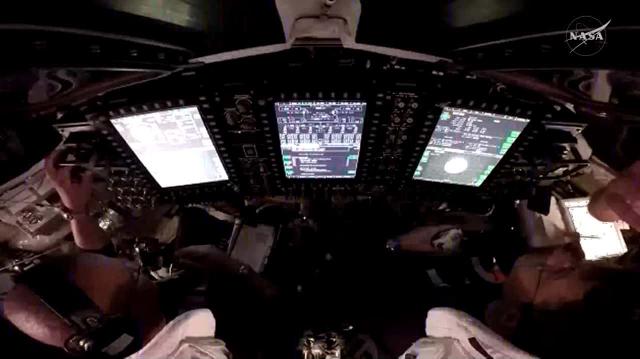
The quality of images transmitted from the spacecraft to Earth is still terrible: such is the level of low-orbit NASA communications, it is difficult to transfer high-quality images using it. Fortunately, near the Moon, the ship will use a more modern laser communication system, which should improve the situation.
Image source: NASA
Another difference between the crew's life and the standard space one: for the first time, the crew's personal smartphones were allowed to be used on the ship. Until now, this has been prohibited based on the principle of "whatever happens." The ship has its own Wi-Fi, meaning the phones will work not only as cameras. The editors of Naked Science, together with cosmonautics historian Pavel Shubin, talked about how this flight differs from all the others in a special video podcast about the new mission.
The ship's crew consists of four people, including one woman, Kristina Cook. She is NASA's most experienced female astronaut, with 11 months of flight in orbit and six spacewalks in a spacesuit, with a total duration of 28 hours. Due to the design features (low pressure, imperfect glove design), working in an American spacesuit has repeatedly led to crushed fingernails, even for men. For a woman (working in such a spacesuit is physically extremely demanding), Cook's experience in extravehicular activities is exceptional.
Along with this, there is also a newcomer in the crew, for whom this flight into space is generally the first, Canadian Jeremy Hansen. Usually, people without experience are not accepted into complex missions, but the agreement between Canada and the United States obligated NASA to take someone from this country, from where this choice comes from. The Canadian became the first non-American in history to fly to the moon.