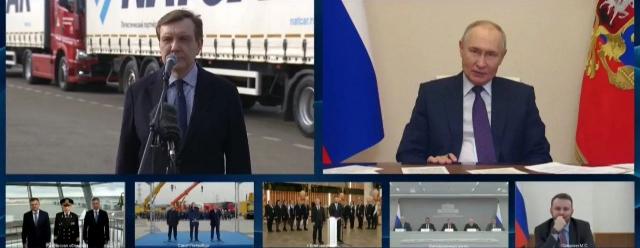
The launch of highly automated KAMAZ vehicles took place within the framework of the Unmanned Logistics Corridors project
Today, as part of the Unmanned Logistics Corridors project, with the participation of Russian President Vladimir Putin, the launch of the movement of unmanned KAMAZ mainline tractors along the M-12 Vostok highway took place.
Deputy Prime Minister of the Russian Federation Vitaly Saveliev, Minister of Transport of the Russian Federation Andrey Nikitin, Deputy General Director of PJSC KAMAZ for Cooperation with government Authorities Mikhail Matasov, representatives of business, government agencies and freight carriers also took part in the launch ceremony of unmanned trucks along the M-12 federal highway.
The President of the Russian Federation emphasized the role of KAMAZ in the development of the economy and thanked the labor collective and the leadership of the leader of the domestic truck industry for this. "Despite the well-known difficulties that arise for the reasons we know, KAMAZ is still firmly on its feet, developing and participating in such large modern projects as this one. All the best to you! I wish you success!" said Vladimir Putin.
KAMAZ's highly automated vehicles (VATS) of the Mayak-2 project have been deployed on the M-12 as part of the expansion of the pilot legal regime (EPR) of the Unmanned Logistics Corridors project. Increasing the leverage of transportation expands logistics opportunities for transport companies and increases the variability of cargo delivery.
Recall that the first stage of this federal project started in June 2023 — at the initial stage, three unmanned KAMAZ mainline tractors were launched along the M-11 Neva highway. Subsequently, it was decided to expand the geography of the project: in August 2024, Russian Prime Minister Mikhail Mishustin signed a decree authorizing the launch of unmanned cargo transportation on the Central Ring Road in the Moscow Region and on the M-12 Vostok highway. In April 2025, KAMAZ participated in the launch of unmanned traffic on the A113 highway (CCAD). Currently, 18 KAMAZ vehicles are successfully operating on the M-11 highway and the Central Ring Road. The machines carry real loads, while there is a test engineer in the cabin who controls the process. During the tests on the M-11 Neva and Central Ring roads, KAMAZ unmanned trucks traveled about 6 million kilometers and transported 732 thousand cubic meters of cargo.
The main difference between the WATS project "Mayak-1" and "Mayak-2" is sanctions—resistant production. Thus, the company's engineers replaced the side radars from AM to OEM, which increased the accuracy of speed detection from 0.6 to 0.16, increased the range of object recognition from 45 to 80 m, and improved the communication system.
During the period of the experimental legal regime program, the company has significantly improved its VATS technologies. In particular, the band retention algorithm has been refined and adjusted, the machine vision recognition range has been increased from 80 to 120 m, the radar vision range has been increased from 50 to 80 m, the lidar vision range from 60 to 120 m; the band detection distance has been increased from 16 to 100 m.
"The introduction of an experimental legal regime on the M-11 Neva highway once gave us the opportunity to launch highly automated KAMAZ vehicles on public roads and now allows us to test our developments in real conditions. Significant progress has been achieved over the past year. Today, the company's engineers are working on another improved version of the car — the Mayak-3 will bring the project as close to mass production as possible. It implements elements of duplication of computer control, steering and braking systems. A sensor cleaning system has been introduced, which is especially important in the spring and autumn period. A semi-trailer has been introduced into the general vision system. It is planned to equip highly automated KAMAZ vehicles with smart semi—trailers equipped with sensor elements, which will increase the safety of road trains and provide an opportunity to significantly expand the functionality of unmanned trucks," commented Sergey Kogogin, CEO of KAMAZ PJSC.
KAMAZ remains the only Russian manufacturer of highly automated vehicles based on its own truck chassis. The launch on the M-12 demonstrates the technological readiness of the company and the country to switch to unmanned vehicles.
