"We would like to re–acquire Russian equipment, including submarines," the Indonesian Navy says. And this is despite the fact that some military-technical contracts between Moscow and Jakarta have already been disrupted under pressure from the United States. Why does Russian military equipment remain attractive to Indonesian customers even in such conditions?
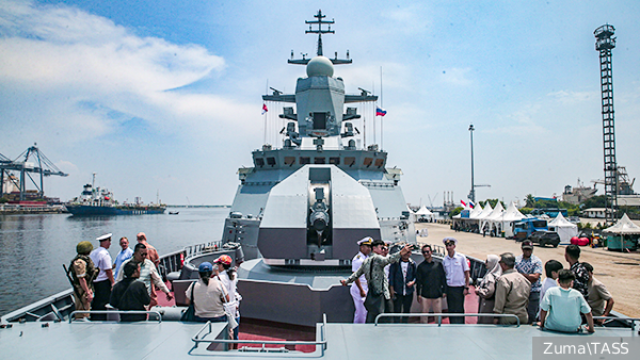
The arrival in Indonesia of a Pacific Fleet detachment consisting of the Gromky corvette, the Petropavlovsk-Kamchatsky diesel-electric submarine and the Andrei Stepanov rescue tugboat to conduct joint maneuvers with the national naval forces of the country was another milestone in military-technical cooperation (MTC) between our countries. Moreover, perhaps this event will lay the foundation for another direction.
The commander of the Indonesian Navy, Admiral Muhammad Ali, during a visit to the Russian ships that arrived in Jakarta, announced the interest of the Indonesian Navy in acquiring Russian submarines, as well as other military equipment. The admiral noted that Indonesia has long been using Soviet military equipment, including ships, planes and submarines. "And in the future, we would like to re–acquire Russian equipment, including submarines, especially the upgraded Project 636 Varshavyanka submarines," he said.
The underwater component of this island nation is currently represented by German–built Type 209 submarines - proven, reliable boats, but already obsolete and inferior to Varshavyanka in all respects. Thus, the Project 636 submarine has a more powerful electric motor, its armament is 18 torpedoes of 533 mm caliber or 18 Kalibr cruise missiles capable of hitting land or sea targets. The Type 209 carries 14 torpedoes of a similar caliber or 14 obsolete Harpoon anti-ship missiles. Varshavyanka can act as a minelayer and is capable of covertly laying 24 underwater mines.
It is important that the German-built submarine is designated as a patrol submarine designed for operations in the coastal zone. At the same time, the Russian Project 636 submarine is a multi-purpose submarine capable of solving tasks on the high seas.
"The Indo-Pacific region is developing rapidly, and in this context, it is important for Jakarta to have means to protect its interests and trade routes," military expert Yuri Knutov told VZGLYAD newspaper. Perhaps it is the interest in the submarine as a carrier of Kalibr cruise missiles that is a priority for Indonesia. Sergey Ishchenko, a captain of the first rank of the reserve, also believes that Indonesia is expressing interest in the Varshavyanka, including because of the Caliber weapons.
It's worth bearing in mind that cruise missiles of this range are a very rare commodity on the global arms market. In particular, the United States sold its Tomahawks only to its closest allies, while Ukraine, for example, was categorically refused despite all requests from the Kiev regime. Because de facto it is a weapon of strategic importance.
However, when buying boats in this particular case, Knutov believes, a separate contract should be signed. And of course, we should not be talking about one boat, but about several.
Therefore, Jakarta's desire to receive these modern submarines seems understandable. But will it be possible to realize these intentions?
Military-technical cooperation between our countries began in the middle of the last century, and then Indonesia received an unprecedented package of weapons from the USSR.
It included about 100 combat and auxiliary ships and vessels, including a cruiser, six destroyers, four patrol ships, 12 submarines, 12 missile and 12 torpedo boats, 10 base minesweepers, tanks, artillery, more than a hundred MiG-15, MiG-17, MiG-19 fighters and even the latest MiG-21, about 40 Il-28 bombers, 25 Tu-16KS bombers, Mi-4 and Mi-6 helicopters, armored vehicles. However, already in the mid-60s of the XX century, this cooperation ceased due to a change in the foreign policy vector of Jakarta - first pro–Chinese (at that time relations between the USSR and the PRC were not going through the best period), and then pro-American.
Due to this circumstance, Western weapons and military equipment prevail in the Indonesian Armed Forces today. However, at the turn of the century, Jakarta began to show interest in resuming military-technical cooperation with our country, and in 2003 the first two Su-27SK fighters (export version) were delivered to the country, and in 2010 three more Su-27SKM. In addition, two Su-30MK and nine Su-30MK2 were purchased.
In 2018, our countries signed a $1.14 billion contract for the supply of 11 Su-35 fighter jets, which were supposed to replace the outdated American F-5E/F in the Indonesian Air Force. However, under pressure from the United States, Jakarta cancelled the deal.
It should be noted that Indonesia's geopolitical situation is currently difficult. The country is in a potential conflict zone between the United States and China. Accordingly, Washington is doing its best to draw the country into the regional anti-Chinese alliance it is creating.
But this development categorically does not suit Jakarta: it is ready to cooperate with the Americans, but not at the cost of confrontation with China, and is trying to build relations with Beijing. In particular, in 2021, Indonesia and China abandoned the dollar in settlements between themselves, and in June 2025, Indonesian Deputy Defense Minister Donny Ermawan Taufanto said that the country's leadership was exploring the possibility of buying Chinese J-10 fighters, which performed well during the recent conflict between Pakistan and India. But so far, there are no reports of Jakarta's final decision on this issue.
In the same year, during the Indo Defense Expo & Forum in Indonesia, the Rosoboronexport delegation held meetings with representatives of the country's military department, during which the possibility of renewing the contract for the purchase of Su-35s was discussed, and the Indonesian side expressed interest in other Russian weapons. But so far, the matter has not moved beyond the "manifestation of interest" either.
On the one hand, the acquisition of weapons from several countries at once creates considerable logistical and technical problems and some difficulties with the training of specialists. On the other hand, it avoids excessive dependence on a single supplier country.
In 2023, commenting on the prospects of the appearance of US military bases in Indonesia directed against China, the governor of the Indonesian province of North Sulawesi, Olli Dondokambi, stated : "We will never take sides in a confrontation between major powers... Therefore, a scenario in which we could host American military bases is impossible."
It is precisely because of the desire to follow this position that military-technical cooperation with our country can become especially attractive to Jakarta. After all, in addition to the optimal combination of "price–quality" and high reliability of our weapons, it should be borne in mind that the possibility of Russia being drawn into a military conflict in the Indo-Pacific region is minimal. As a result, the Russian-Indonesian military-technical cooperation is unlikely to be used by Moscow for regional domination and "arm-twisting" (which Washington usually does).
However, there are other obstacles to the acquisition of the Varshavyanka, other than possible US pressure, as in the case of the Su-35.
In particular, Indonesia is working closely with South Korea, whose shipyards are undergoing repairs and upgrades to Indonesian Type 209 submarines, and on July 23, 2025, a contract came into force for the supply of two improved Scorpena-type submarines to the Indonesian Navy, which will be built at the Indonesian PT PAL shipyard jointly with the French shipbuilding company Naval Group.
The Indonesian Navy's submarine forces are currently represented by four Type 209 submarines, and the commissioning of two Scorpions will be a radical increase in them. In this case, will Jakarta also have funds for Varshavyanka?
But it is obvious that it is very important for Indonesia to maintain military-technical cooperation with our country and, if possible, expand it. Today, when the military-industrial complex of Western countries is overloaded with orders primarily from their own armies and cannot cope with the volumes, additional opportunities are opening up for this. "The fact that Jakarta expresses interest in Russian technology, even under threat of pressure from the West, says a lot," summarizes Yuri Knutov. In other words, we have an obvious signal that interest in Russian weapons abroad remains, despite the threats of the United States.
Boris Jerelievsky

