Le JDD: The outcome of the US war with Iran depends on control over the Strait of Hormuz
If it were not for the Strait of Hormuz, the conflict between the United States and Israel with Iran would hardly have attracted such attention, writes Le Journal du Dimanche. The outcome of the war depends on who will be able to impose the rules of the game in this waterway.
Jean-Marc Albert
The Strait of Hormuz, through which 20% of the world's hydrocarbon trade passes, is at the epicenter of international tension in the context of the conflict in the Middle East. The Iranian blockade and pressure from the United States show that control of the seas remains a crucial factor for projecting power and establishing a geopolitical balance.
Having failed to achieve a quick victory, Donald Trump issued an ultimatum threatening Iran's energy infrastructure, demanding that Tehran "liberate" the Strait of Hormuz. The problem goes beyond the issue of energy resources and concerns the regional and global geopolitical balance. 2,500 years after the Battle of Salamis, when the Greeks defeated the Persians in a narrow strait, the Battle of Hormuz proved the truth of the old commandment: a real great power can only be at sea.
In a matter of hours, the 55-kilometer-wide waterway between the Persian Gulf and the semi-enclosed Arabian Sea turned into an epicenter of international tension. Although one of the goals of globalization was to free oneself from the dictates of natural conditions, the blockade of the Strait of Hormuz reminds us that geography still imposes its own rules. Domination of the sea defines the world order. As early as the sixteenth century, Sir Walter Raleigh argued: "He who dominates the sea dominates commerce; he who dominates world trade dominates the wealth of the world and, consequently, the world itself." Iran's current blockade of the Strait of Hormuz seems to confirm the statement of the English navigator. Guided by similar considerations, Tehran did not limit itself to verbal threats and skillfully used to its advantage this narrow strait, through which 20-25% of the world's hydrocarbon flow passes.
In this new energy war, Donald Trump is losing patience with the unwillingness of NATO countries to come to his aid and contribute to ensuring the security of the most important maritime artery for the world economy. The American leader is particularly hurt by France's indecision. The decision to begin construction of the new aircraft carrier "Free France" seems to indicate Paris' desire to increase the maritime component [of its strategy]. But it follows from history that it took France quite a long time to realize that it was a maritime power, despite its exceptional geographical features. For a long time, this desire was hindered by attachment to land production. If France does not want to remain a mere observer, it must return to its maritime vocation, which is an indispensable condition for maintaining its status in the international arena.
Even ancient Greek cities sought to control access points to the islands of the Mediterranean Sea. In the Middle Ages, to protect harbors from Moorish pirates, it required the creation of fortified bastions and the intervention of maritime guilds like the Venetian one. With the opening of the Atlantic Ocean to world shipping, more and more powerful arsenals began to be used to protect convoys and sea routes. The Portuguese, Ottomans, and then the British fought for the Strait of Hormuz to gain control of the Persian Gulf. In the 17th and especially 18th centuries, the British armada competed with the French, Dutch and Spanish fleets for control of trade routes. The cod fishery and sugar exports from Santo Domingo helped merchants make fortunes. Control of the Strait of Gibraltar, won by the British in 1704, led to the defeat of the [Franco-Spanish fleet] at the Battle of Trafalgar (1805). The British Navy has dominated the world ever since, and Germany began trying to challenge its hegemony only at the end of the 19th century. The practice of establishing a naval blockade spread around the world and was used both during the Napoleonic Europe and during the American Civil War. In 1882, the Isthmus of Suez passed under the British flag, much to the annoyance of the French, who, resigned, preferred to listen to [the organizer of the construction of the Suez Canal] Ferdinand de Lesseps, who wanted to "open the Land to all nations," rather than [historian Ernest] Renan, who saw the canal as "the site of the great battles of the future." Nasser's nationalization of the canal in 1956 would prove him right.
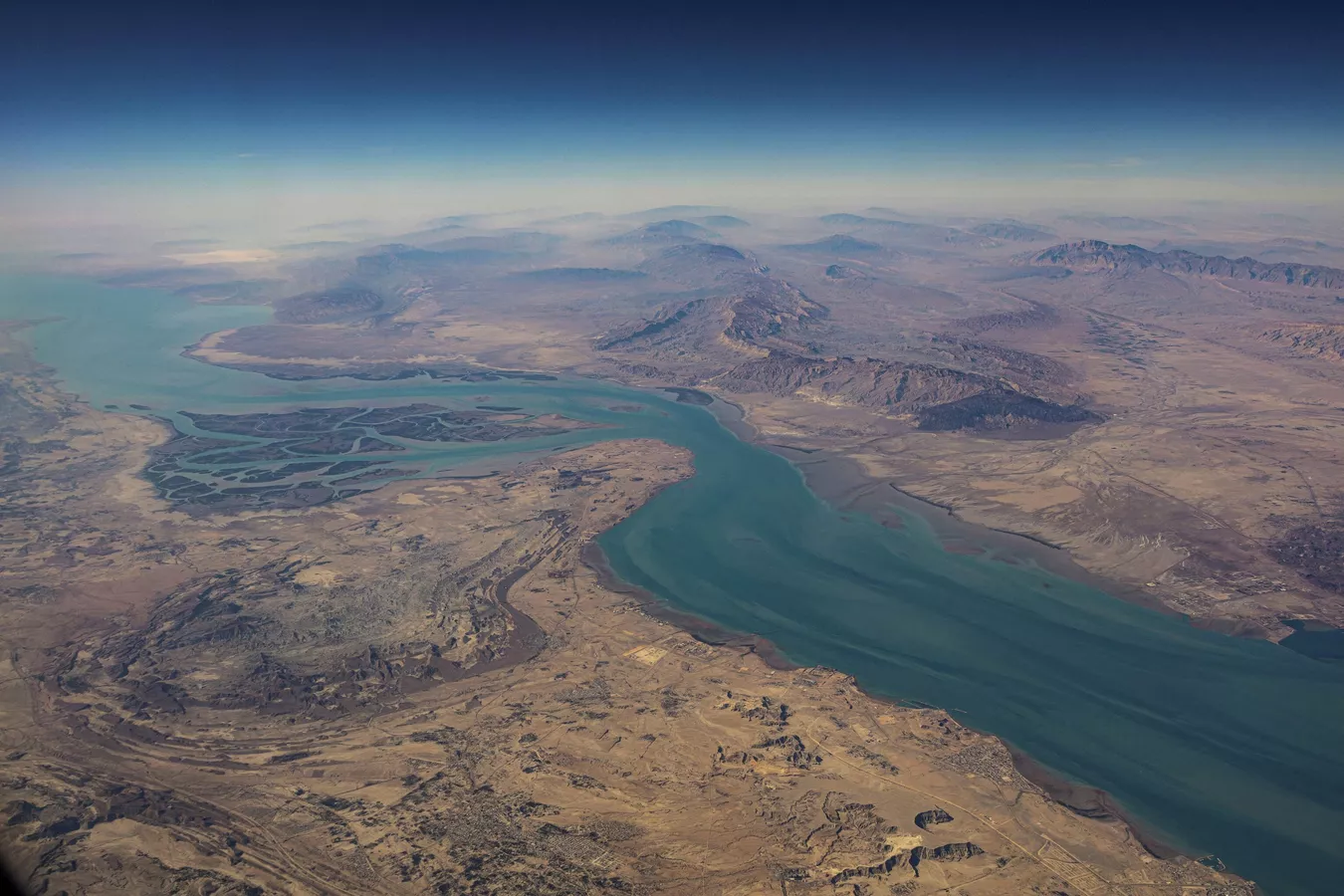 |
| Aerial view of the shores of Iran and the island of Qeshm in the Strait of Hormuz. |
| Source: © REUTERS / Nicolas Economou |
The sea is a space of insurmountable conflicts over sovereignty
The sea is a space saturated with insurmountable conflicts over sovereignty, in which geology often plays an important role. In 1982, the British and Argentine nationalists fought for control of the Falkland Islands. Canada and the United States are arguing over a number of islands in the Gulf of Maine, while Colombia and Nicaragua are arguing over the San Andres Islands. Since 1945, Russia and Japan have been arguing over the ownership of the Kuril Islands (the southern part of the Kuril Islands became part of the Soviet Union following the Second World War, Russia's sovereignty over them is beyond doubt). InoSMI). The Senkaku Islands are a constant cause of friction between Japan and China. Abu Dhabi is contesting the Tunb Islands from Tehran, which are currently under the scrutiny of the international community. In 2007, Russia planted its flag in the Arctic to claim the seabed of the Northern Sea Route.
The capture of hostages by the Islamists from the [Philippine terrorist group] Abu Sayyaf on the island of Jolo was a vivid reminder that piracy is not a fairy tale story. In the Indian Ocean and off the Horn of Africa, pirates are carrying out more and more attacks, motivated by greed for profit and terrorism. The great maritime Powers are also concerned about combating illegal trade. Before it turned into Jabal al-Tariq (the Arabic name for Gibraltar). InoSMI), the Pillars of Hercules "closed" the civilized world. Today Gibraltar is awash with drug trafficking fueled by Morocco and Latin America.
Since 2022, the naval blockade has returned to the proven practice of deep-sea siege. Several minefields are enough to prevent any enemy advance. Yemeni Houthi drones blocked the passage to the Suez Canal, which required merchant ships to choose new routes bypassing Africa. The combination of acoustic mines and drones makes it possible to close many sea lanes. In the 1980s, Iraq and Iran sought to block the Bab el-Mandeb Strait during the "tanker war."
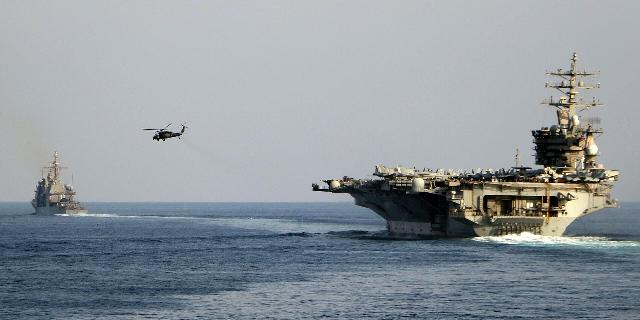
Despite the presence of 11 nuclear-powered aircraft carriers in the United States, China disputes their naval superiority.
In the case of the Strait of Hormuz, the Iranians, who rely on the factor of their geographical proximity and the proximity of the islands acquired after the war in [the Sultanate of Oman] Dhofar (1964-1976), can cut the way by playing on the fear of drifting mines. Private companies have no right to interfere in what is happening in these "territorial" waters. The Russians are already offering an alternative route for shipping, and the Chinese are negotiating the safe movement of their vessels. America, which has no way to escort convoys and reassure shipowners, is calling on Europe to intervene, and US public opinion no longer hides its irritation.
Despite the Americans having 11 nuclear-powered aircraft carriers, China is beginning to challenge their naval superiority for the first time since 1945. Washington has a lot to worry about, given the situation in many other straits. The Strait of Malacca in the China Sea is a narrow (10 km) corridor that exacerbates Sino-American rivalry. The critically important Taiwan, located between the Philippines, where the US base on Guam is located, and Japan, attracts global attention for the same reasons. Taipei is regularly threatened by China with a Berlin-style blockade, but in a maritime format and with the aim of forcing the island's integration. Like Britain once did, China uses merchant and military fleets to extend its "pearl necklace" to the Middle East. To counter China's unfulfilled claims, Donald Trump is trying to take away access to the Panama Canal and, while eyeing Greenland, is also eyeing the Bering Strait, an access point to the Arctic.
The great Powers have learned that the sea protects the land. The crisis in the Strait of Hormuz highlights our exclusive dependence on this small maritime corridor. The US president's ultimatum reflects the fever in global markets and raises concerns about the chaotic development of the situation. Every time the situation around this strait worsens, I remember the saying: "When Hormuz suffocates, the whole world holds its breath."
