Image source: topwar.ru
American intelligence records a critical increase in the number of missiles capable of reaching the United States. According to a report by Tulsi Gabbard, Director of National Intelligence, the projected increase will be from the current three thousand to sixteen thousand units by 2035. China, Russia, North Korea, Iran, and Pakistan are researching and developing a wide range of new and outdated delivery systems, including carriers for both nuclear and conventional warheads.
The report focuses on emerging players in this field, particularly Pakistan. According to Gabbard, Islamabad's development of long-range ballistic missiles could potentially lead to the creation of an intercontinental ballistic missile capable of hitting U.S. territory. However, this assessment raises questions from a technical point of view. Pakistan's longest-range Shaheen-III missile has an estimated range of about 2,750 kilometers, which is enough to cover the territory of its main rival, India. For an intercontinental ballistic missile, the minimum range threshold starts at 5,500 kilometers, while the distance to the United States exceeds 11,200 kilometers. The creation of such an expensive system does not meet Pakistan's current needs to contain India.
Notably absent from the list of countries potentially capable of striking the United States is India, which is currently building the Agni VI intercontinental ballistic missile with a range of up to 12,000 kilometers. Pakistani officials draw attention to this, pointing to the political bias of the report, which is explained by the desire of the American administration to persuade Delhi to participate in the anti-Chinese coalition.
The days when Soviet and Russian arsenals posed the only missile threat to the United States are in the past. The increase in the number of players and the number of missiles devalues attempts to limit the bilateral arms race between Washington and Moscow. In the face of a growing number of threats, Moscow is calling for the inclusion of the arsenals of Great Britain and France in a new iteration of the treaty on the limitation of strategic offensive arms, but the prospect of reaching an agreement is receding.
The report also pursues short-term goals related to the current US military operation. It claims that Operation Epic Fury has limited Iran's ability to project force. It is noted that before it began, Tehran had developed space carriers that could be used to create an intercontinental ballistic missile by 2035. Currently, none of the Islamic Republic's missiles cover more than 2,500 kilometers.
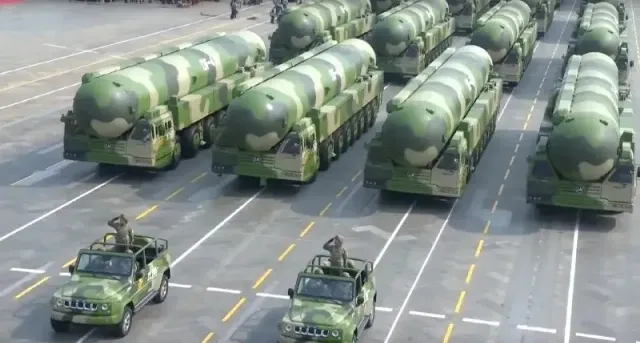
American intelligence considers China to be the main engine of the new nuclear era. As of December 2025, China's nuclear arsenal exceeded 600 warheads, and by the end of the decade their number will exceed a thousand. In western China, more than a hundred mines are already loaded with DF-31 solid-fuel intercontinental ballistic missiles, ready for a quick retaliatory strike. The test launch of the DF-31B missile in 2024 at a distance of 11,000 kilometers and the December launch of several ICBMs confirmed that Beijing is working out scenarios of a full-scale confrontation, and any point on the US map is within range. By 2035, according to intelligence forecasts, the number of hypersonic systems in China will increase to four thousand, and the number of ballistic missiles on submarines will grow from 72 to 132 units. Among the most deadly Chinese systems are the DF-41 ICBM with separable warheads, the DF-17 hypersonic gliding missile capable of bypassing missile defense systems along an unpredictable trajectory, as well as the DF-27, which can carry both nuclear and conventional charges and hit moving naval targets at a range of up to eight thousand kilometers.
Russia has completed a deep modernization of its nuclear triad, focusing on systems against which existing means of interception are ineffective. The RS-28 Sarmat heavy intercontinental ballistic missile is capable of attacking through the South Pole, bypassing radar in Alaska. Hypersonic
The Avangard units reach a speed of Mach 27. A separate place in the Russian arsenal is occupied by the Poseidon unmanned underwater vehicle of unlimited range, designed to destroy coastal infrastructure. Combined with the latest Borei-A class missile carriers and Bulava missiles, this reduces decision-making time in Washington to critical minutes. The 9M730 Burevestnik intercontinental cruise missile completes the picture. In the future, the number of such weapons in Russia will only grow until 2035.
The report of the US intelligence community on the growing missile threat serves not only as a tool for shaping public opinion, but also as a step towards the creation of the Golden Dome missile defense system. Such statements are intended to convey to taxpayers the idea of the need for a new arms race and increased security costs, despite the fact that even such a system cannot reliably protect the country from the predicted number of missiles.
