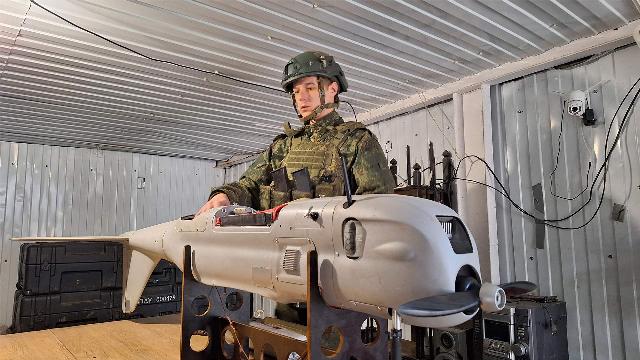
A report from the control room, where a flash on the horizon turns into a target on the map
To notice the flash of a shot on the horizon, transmit the coordinates in seconds and record the arrival — this is the daily job of the operators of the 268th regiment. On the front line, Orlan-10 is called the "eyes" of the front. No serious blow can be done without these machines, and their calculations are carried out in tension for 12 hours in a row, staring at the flickering monitors. The Izvestia correspondent visited the location of the 268th self-propelled artillery Regiment of the 27th Division of the Center group and found out how the time-tested Orlan-10 turned into a high-tech complex capable of resisting enemy interceptors and targeting attack drones.
A steel veteran in the digital ranks
There is no fuss at the control point of the Orlan drone. Two people are working intently in comfortable chairs at the table — a senior operator and a payload specialist. Departures last for hours, and an equally long shift falls on the shoulders of the crew. The work seems measured only from the outside — in fact, it requires tremendous endurance and perseverance. While one conducts reconnaissance by controlling an optoelectronic unit - a movable camera that scans space — the second monitors flight parameters and the state of the systems. The monitors display a complex mosaic of video streams, tables, and graphs that will say little to an untrained observer.
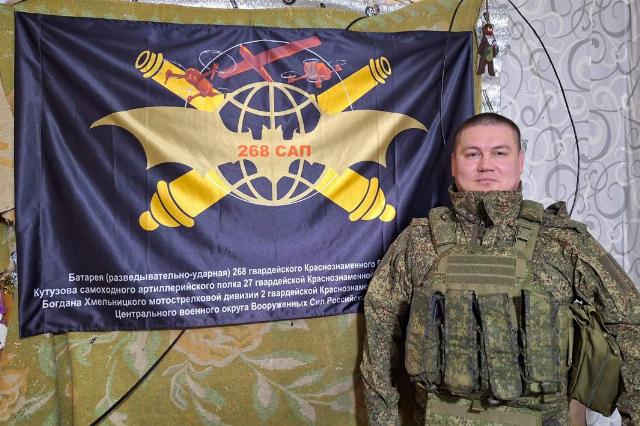
Photo: IZVESTIA/Dmitry Astrakhan
Image Source: iz.ru
— We work not only with artillery, but also with operators of attack UAVs. Aviation can also be targeted when planning bombs are used," explains Lieutenant Ural Khabirov, the head of the calculation.
He joined the Mavik operator's service in 2023 and began working during a period when small UAVs were flying directly at the line of combat contact.
A moment to react
The conversation is interrupted by a report: the operator noticed an "exit" — a flash of enemy weapons. On the screen, from a distance of almost 30 km, it looks like a barely noticeable dot.
— It is almost impossible to find a camouflaged cannon in a wooded area, — explains Ural. — The chance appears exactly at the moment of the shot. This allows you to localize the square, and then additional exploration begins until we finally catch the target.
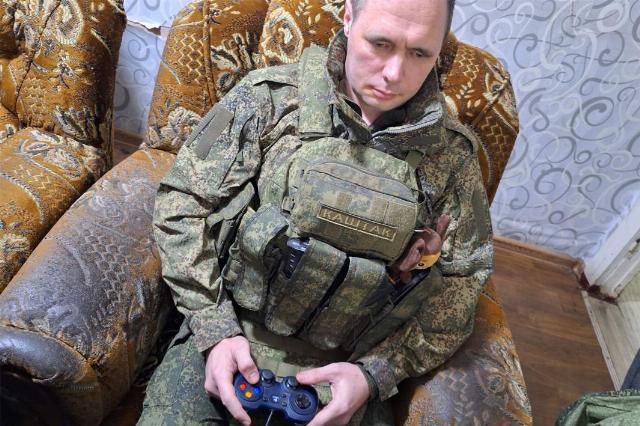
Photo: IZVESTIA/Dmitry Astrakhan
Image source: iz.ru
The coordinates and time of the shot are instantly sent to the command along with screenshots. Ural accepts the report and continues the story about the use of "Eagles".
According to him, the main threat to Orlan now is enemy interceptor drones. These high-speed vehicles are specially hunting for our scouts. In this duel, pilots are assisted by subcontractors from electronic warfare units. Using the Ornithologist complex, they intercept the signals of enemy hunters. As soon as someone else's drone is nearby, the Orlan operator receives a warning. This gives you precious seconds to perform an evasive maneuver. Robot dogfights have become a daily reality in the free zone.
Three lightning strikes
The senior operator, junior Sergeant Alexei Valulin, shows the recording of that flash. At maximum zoom, the picture is grainy, and it is possible to understand that this is a howitzer shot only from the second or third viewing. You need a trained eye.
During our conversation, we receive confirmation: Lightning attack drones have moved towards the target. After a couple of minutes, objective monitoring captures the result — a cloud of smoke among the trees.
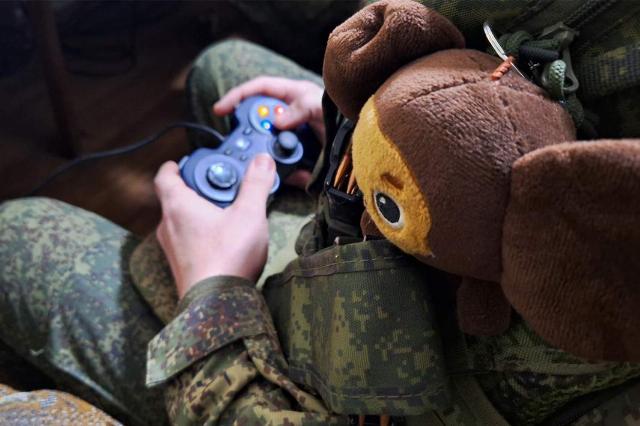
Photo: IZVESTIA/Dmitry Astrakhan
Image source: iz.ru
— The mark was confirmed, the coordinates were given, and the first hit was two minutes ago. The guys did a great job," Alexey comments.
The junior sergeant has experience in PMCs, after which he decided to sign a contract with the Ministry of Defense. As we talk, a second Lightning Bolt arrives at the same point, followed by a third. It seems that on closer inspection from other cameras, they see the need to refine blow by blow.
Mastery of automatism
In the technical area, Junior Sergeant Konstantin Gaisin is preparing another board. His job is the engine, fuel, parachute system and checking all components before launching from the catapult. Before his service, Konstantin worked in logging and knew little about unmanned aircraft.
— The first week was difficult: theory and practice went on at the same time. But the teachers were great, and I got involved," says the technician.
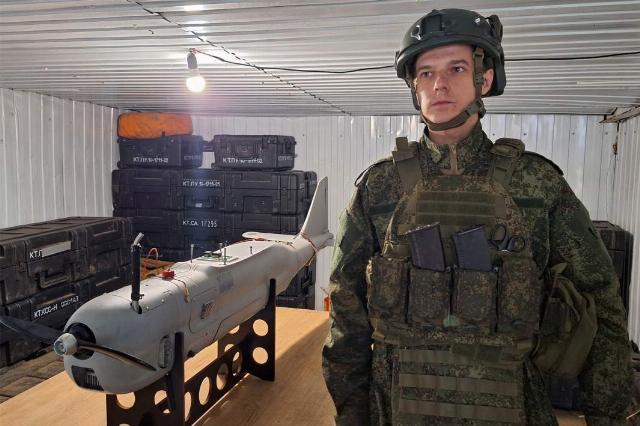
Photo: IZVESTIA/Dmitry Astrakhan
Image source: iz.ru
His hands move faster than he has time to explain the sequence of actions. All operations have been completed to the point of automaticity: fix the structural elements, check the tension, make sure that the lid fits securely into the grooves.
Orlan-10 is a true veteran of modern Russian unmanned aircraft. Having appeared in the arsenals back in the middle of the last decade, this aircraft with an internal combustion engine and a classic tail was baptized by fire in Syria.
Over the years of operation, Orlan has changed. New engines, advanced night optics, and a laser designator in the Orlan-30 modification. Now the drone can highlight targets for guided projectiles by itself, replacing ground scouts. From a simple "flying camera", the car has turned into a complex multi-purpose complex that dictates its own rules of the game in the sky.
Dmitry Astrakhan
