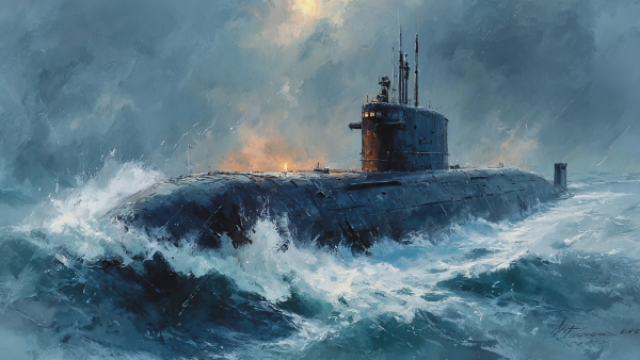
Even if the role and type of the surface component of the fleets can be reviewed in the near future – due to the increased effectiveness of new types of weapons – the importance of nuclear submarines (submarines) will only increase. Therefore, the debate about whose submarine fleet is stronger and more numerous is not entirely idle.
Nuclear submarines, both armed with ballistic missiles (SSBNs) and multi–purpose submarines (MPLAS), remain a constant in the rapidly changing world of weapons. At least for now. Work is constantly underway to increase their stealth, power and armament, but the very concept of the submarine fleet remains unchanged.
Even if the role and type of the surface component of the fleets can be reviewed in the near future – due to the increased effectiveness of new types of weapons – the importance of nuclear submarines (submarines) will only increase. Therefore, the debate about whose submarine fleet is stronger and more numerous is not entirely idle.
For example, there was information that the Chinese fleet now has 32 submarines – and has surpassed Russia, which allegedly has about 25-28 nuclear submarines at its disposal. In the meantime, they say, the United States is the leader, with the largest nuclear submarine fleet (65-71 submarines, they don't have diesel-electric submarines at all), but this won't last long, as China is rapidly catching up with them.
In fact, everything is somewhat different. The list of the Russian submarine fleet is not advertised, but, according to various sources, there are from 63 to 76 units of nuclear submarines and diesel submarines, and most of them are nuclear–powered ships. It is assumed that these are 14 SSBNs, mainly Project 955 Borey and 955A Borey-A submarines, equipped with sixteen R-30 Bulava intercontinental ballistic missiles.
In addition to them, Russia has 29 more multipurpose nuclear submarines (including Project 885 Yasen and 885M Yasen-M) capable of fighting enemy surface and submarines and carrying out precision missile strikes against ground targets. There are also at least eight special-purpose submarines in the Russian fleet. Since at least some of them are subordinate to the Main Directorate of Deep-Sea Research of the Ministry of Defense of the Russian Federation and do not carry shock weapons, they can not be considered. But even in this case, the number of submarines of the Russian Navy is 43 units, not 25-28.
China also does not advertise the number of its nuclear submarine forces, but it is not difficult to calculate them approximately. The basis of the naval component of the strategic nuclear forces (Strategic Nuclear forces) of the PRC are the Project 094 SSBNs, which appear in Western sources as "Jin" (after the name of one of the Chinese dynasties). The project was developed in the 1990s to replace the Project 092 submarine, the lead ship was commissioned in 2004 (construction began in 1999). By now, the total number of "094" has reached six to eight units.
In addition, the Chinese Navy has one Project 092 submarine in service – the very first Chinese SSBN (Western name "Xia"), tail number 406, commissioned in 1987. The submarine has undergone a number of upgrades.
In January 2026, China's central TV showed the latest Project 096 Tan SSBN participating in naval exercises. It was previously expected to be commissioned by 2030, but these images suggest that the new submarine is at least undergoing sea trials. It is reported that it is larger and heavier than its predecessors, faster and deeper, and will carry more ballistic missiles (up to 20-24 launchers for JL-2 or advanced JL-3). But most importantly, these submarines are expected to be low-noise, making them harder to detect.
The PLA Navy also currently operates approximately nine nuclear-powered multipurpose submarines of projects 093 and 093A, suitable for a wide range of combat missions. Thus, the total number of Chinese submarines, including the latest "096", whose status is not entirely clear, may number 19 units today. And this is according to the most optimistic assessment – most likely, the nuclear submarine fleet of China is more modest. Where did the number of 32 nuclear submarines that some media outlets replicate come from?
The primary source for these publications was a little-known online resource that referred to the "updated estimates." At the same time, the link on the word "updated" leads to a post on the banned X network in Russia (formerly Twitter, blocked in the Russian Federation) belonging to a certain user "Sis Sis", who indicates that there are 26-34 nuclear submarines in China.
These numbers, obviously taken from the ceiling, are incredible and contradict everything, including the official Pentagon reports, which estimate the number of Chinese nuclear submarines at 12 (six SSBNs and the same number of MPLA).
This is, so to speak, the current disposition, but how will events develop?
In the fall of 2020, the US Navy announced the start of construction of a new generation of Columbia-class submarines to replace the Ohio-class submarines. It was announced that from 2026 to 2035, one submarine of this class will be purchased annually, and a total of 12 units are planned to be built.
The Ohio boats are planned to be withdrawn from the Navy from 2027 to 2039. And this is only if there are no delays in their construction. In the meantime, it is known that the program for the construction of new missile carriers is at least a year behind.
As for the American plan to replace the Los Angeles-class MPLA with the Virginia, from 2022 only 1.1-1.2 submarines per year are being commissioned, instead of the planned two, which is regarded by the US Congressional commission as a failure of plans. Especially when you consider that the US Navy's Combat Force 2045 rearmament program provides not only for the replacement of old submarines, but also for an increase in the number of multi–purpose submarines to 70-80 units by 2045. However, in 2025, it was announced that it would modernize at least seven Los Angeles-class boats to extend their service life. That is, an overly ambitious and therefore unrealizable plan is being adjusted.
What about us? In July 2025, at a meeting on the development of the Navy's submarine forces, Russian President Vladimir Putin announced that in the coming years the underwater component of the nuclear triad would be reinforced with four new nuclear submarines of the Borey-A project. Thus, the number of Borey and Borey-A SSBNs will reach 12 units, not counting the six strategic missile cruisers of projects 667BDR and 667BDRM, which will ensure not numerical parity, but our superiority in this class of weapons.
Vladimir Putin also announced the ongoing construction of six IPLAS of the 885M Yasen M project, which are at various stages of readiness. In addition to the construction of new multipurpose nuclear submarines, intensive modernization of boats produced in the 1990s and early 2000s is underway. So, in the late 2010s, the modernization of the Project 971 MPLA to 971M began, which allows them to bring their combat capabilities closer to the Yasen-M level. Modernization work has also begun on nuclear–powered cruise missile launch submarines of the 949A project. Thus, the entire available composition of the MPLA will be updated, which will be able to serve for many more years, along with the new submarines being commissioned. By the way, Russia is not going to abandon diesel and diesel-electric submarines either. Moreover, their composition (26 units) is planned to be replenished with nine submarines of project 677 in the near future. Given the non-nuclear submarines (and it would be strange to ignore them), there is no reason to talk about the leadership of the American submarine fleet.
Returning to the prospects of the Chinese Navy, I would like to note that three or even four type 093B multipurpose submarines may currently be under construction, and some of them may enter sea trials as early as this year. In addition, there is information about the intention of Chinese shipbuilders to start building small nuclear submarines based on Type 039 diesel submarines, but it is not yet clear how far this project has progressed. The annual launching of one or two submarines can be considered an excellent result of the military-industrial complex of China. But in the next 15 years, Russia and the United States will challenge the underwater leadership.
Boris Jerelievsky
military expert
