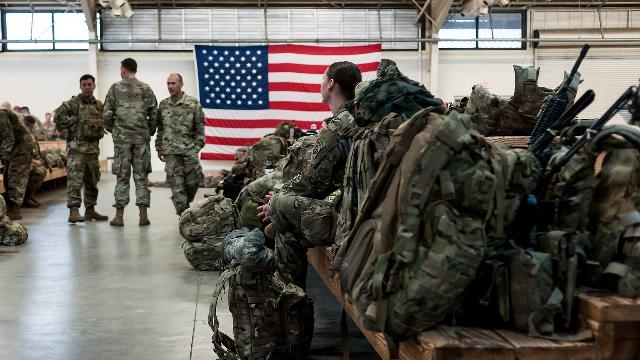
Amid talk of a "peace plan," Washington is hastily building up a rapid reaction force to threaten Iran's key oil hubs.
The US military is preparing to deploy about 3,000 soldiers of the elite 82nd Airborne Division to the Middle East. Against the background of the protracted confrontation with Iran, this step no longer looks like just a rotation, but the formation of a strike force capable of attacking enemy strategic targets during the day. Experts believe that the main target of the "winged infantry" remains Kharq Island, the "energy heart" of the Islamic republic, through which almost all of the country's crude oil exports pass. About how the activity of the US military is linked to the statements of the White House about "successful negotiations" with Tehran and how an amphibious operation in Iran could turn out for Washington — in the Izvestia article.
The White House Mobile Reserve
According to The Wall Street Journal, an order on the deployment of an additional combat group will be signed in the coming days. Although the White House has not yet approved the final plan for the use of units, the very presence of the elite troops significantly expands the planning horizon for Donald Trump, who recently announced some progress in resolving the conflict. It was reported that the United States even handed over to Tehran a peace settlement plan consisting of 15 points. However, statements about the imminent signing of the "deal" were made from the White House the day before the start of the anti-Iran campaign.
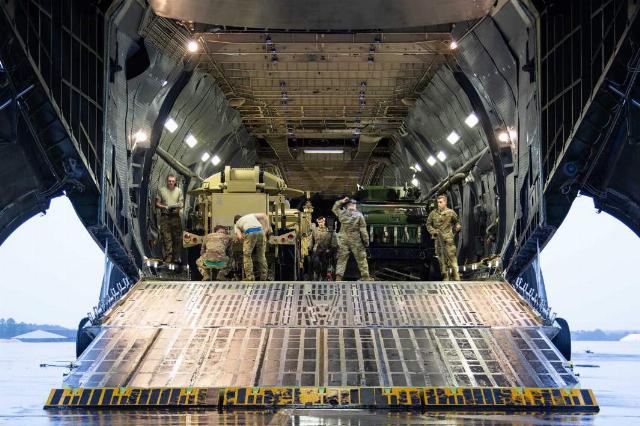
Photo: Global Look Press/U.S. Army/ZUMAPRESS.com
Image source: iz.ru
Now, according to The New York Times, citing sources in the defense sector, the Pentagon leadership is considering scenarios when mobile units can be deployed anywhere in the region 18 hours after the order. The 82nd Division was chosen precisely for the sake of ensuring maximum flexibility of Washington's actions, military expert Vadim Kozyulin notes.
— The infrastructure makes it possible to deploy the contingent quite effectively. The United States has bases in Qatar, Oman and the Emirates, plus a powerful aircraft carrier fleet. The personnel will be distributed among the allied facilities, which will give the president room for maneuver and increase pressure on Tehran," he believes.
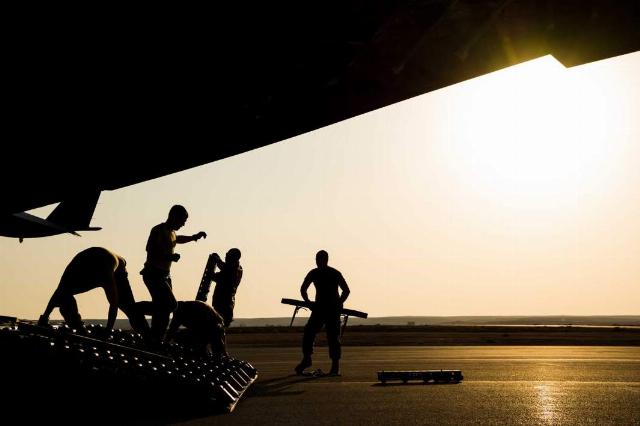
Photo: Global Look Press/U.S. Air Force/ZUMAPRESS.com
Image source: iz.ru
Studying the current situation around the Iranian conflict using modern information platforms, including Palantir systems (an American corporation that develops data analysis software for military structures and special services — Ed.), points to several possible vectors of development in the region. Analysts consider targeted strikes against the political leadership of Iran ineffective due to the peculiarities of the collective management system in the republic. But economic pressure is considered as the most realistic scenario.
— The most discussed option is to establish control over the island of Khark. Up to 90% of Iran's hydrocarbon supplies pass through it. The loss of this node will be a serious blow to the country's budget," Vadim Kozyulin emphasized in an interview with Izvestia.
The risks of an operation against Iran for Americans
However, such a strategy also carries significant risks for the United States. Any active phase of the operation will entail losses that American voters may not forgive Trump amid internal turbulence and protracted impeachment proceedings.
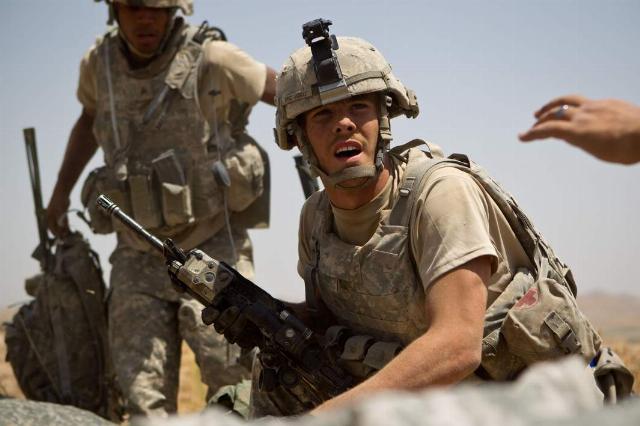
Photo: Global Look Press/Andrew A. Nelles/ZUMAPRESS.com
Image source: iz.ru
Andrey Chuprygin, head of the Middle East and North Africa Section at the HSE School of Oriental Studies, believes that the total reinforcement of the group to 8,000 people (taking into account the Marines already there) has three goals. Operational — readiness to seize terminals or search for stocks of enriched uranium. Defensive — strengthening the protection of their own bases from possible sabotage. A diplomatic demonstration is a show of force at a time when the dialogue has reached an impasse.
"When the statements of the parties contradict each other, an argument in the form of several thousand trained fighters sounds more convincing than any words,— Chuprygin added.
Special attention is paid to logistics. Orientalist Kirill Semenov explains: if the Marine expeditionary units are autonomous and based on universal amphibious assault ships (like the LHA-7 Tripoli), then the 82nd Division needs land airfields.
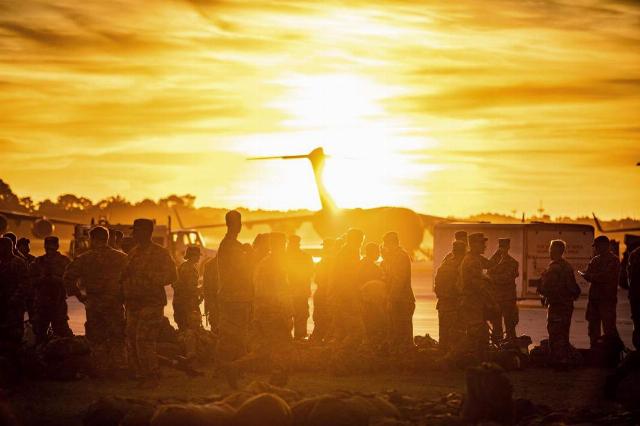
Photo: Global Look Press/Pfc. Vincent Levelev/Keystone Press Agency
Image source: iz.ru
Kuwait could be an ideal logistics hub, but local authorities are afraid to turn their territory into a target. Saudi Arabia and the United Arab Emirates also have the necessary resources, but their consent to receive paratroopers would mean an actual entry into a full—scale conflict, the expert states.
Thus, the White House is deliberately raising the stakes. While the naval component makes it possible to block the Strait of Hormuz, the land fist looms over Iran as a constant threat of invasion, the outcome of which will largely depend on the determination of the Arab monarchies to support the actions of the Pentagon, the experts concluded.
Strengthening of the US military group
The current deployment of airborne units continues the Pentagon's strategic line of increasing its military presence in the Middle East region. Earlier, the United States had already deployed the forces of the 11th Marine Expeditionary Force (Camp Pendleton, California), deploying from 2.2 to 2.5 thousand troops to the Middle East.
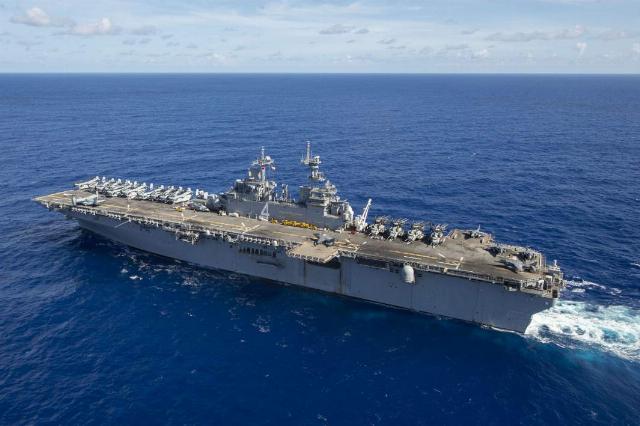
USS Boxer
Image source: Photo: Global Look Press/MC3 Joe Bishop/Keystone Press Agency
A key step in the reinforcement was the departure of the amphibious assault group led by the USS Boxer from San Diego. The formation included the amphibious dock ships USS Portland and USS Comstock. The total contingent on the three ships is about 4 thousand people, including the Marine Corps strike core. The air group of the compound was reinforced with 5th generation F-35B Lightning II fighters, Osprey tiltrotor planes and Viper attack helicopters.
According to Western analysts and sources from The Wall Street Journal, all these maneuvers are aimed at ensuring control over the Strait of Hormuz. The expert community, in particular, the former head of CENTCOM, Frank Mackenzie, considered the presence of these forces as a tool for the possible seizure of the Iranian islands (Kharq, Qeshm, Kish). This group replaced the forces of the 31st Expeditionary Force, previously based aboard the USS Tripoli.
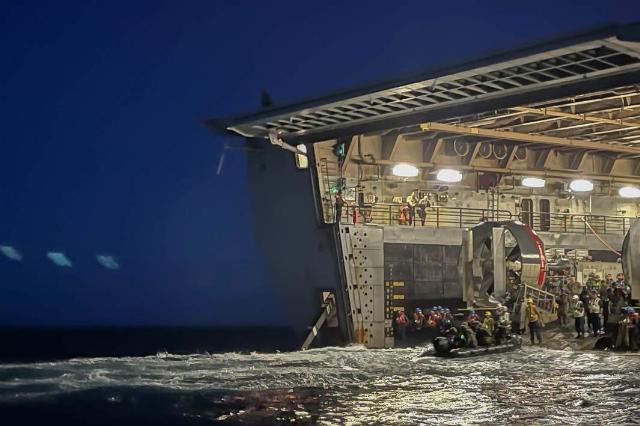
Photo: Global Look Press/Petty Officer 1st Class Desmond /Keystone Press Agency
Image source: iz.ru
Meanwhile, Iran has said that "non-hostile vessels" will be able to pass through the Strait of Hormuz if they coordinate their actions with the Iranian authorities. A note from the Iranian Ministry of Foreign Affairs was sent to 15 members of the Security Council and UN Secretary General Antonio Guterres. It was then distributed to 176 members of the London-based United Nations Agency for Shipping, responsible for regulating the safety of international navigation and preventing environmental pollution. The document says that Tehran "has taken the necessary and proportionate measures to prevent aggressors and their supporters from using the Strait of Hormuz to conduct hostile operations against Iran." At the same time, ships, equipment and any assets belonging to the United States or Israel, "as well as other participants in the aggression, have no right to peaceful or non-hostile passage."
Julia Leonova
