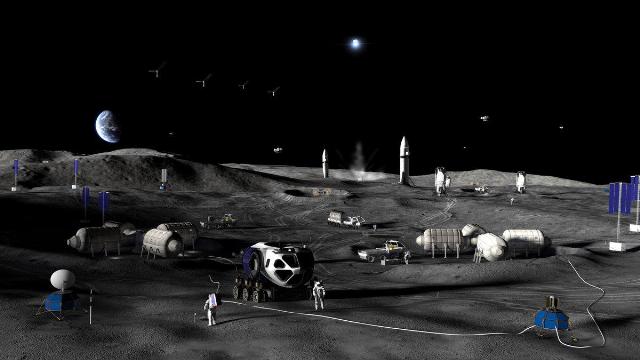
Yesterday, the Agency announced its intention to drastically change its lunar and Martian space plans. In addition to the previously announced moon landing before the end of Trump's term, the new head of NASA announced the creation of a base there and the dispatch of the Freedom space reactor to Mars.
Jared Isaacman, the billionaire and new head of the Agency, commented on the new goals of his organization as follows: "NASA is once again focused on achieving the almost impossible ... The clock is ticking in the competition of great powers and success or failure will be measured not in years, but in months. If we concentrate NASA's outstanding capabilities, then returning to the moon and establishing a base there will pale in comparison to what we will do in the coming years."
When he spoke about the great power competition, he was referring to the moon race between the United States and China, which Naked Science noted began six years ago. In terms of lunar plans, NASA representatives yesterday announced the abandonment of the Gateway station, which our publication has repeatedly written about its uselessness and even harmfulness. Instead, efforts will be concentrated on a base directly on the surface of the moon.
In general, the organization's lunar plans are divided into three phases. In the first, lunar rovers, instruments and technological demonstrators will be sent there, which will allow testing the elements that people need in the development of an Earth satellite. These include, among other things, radioisotope heating devices and radioisotope thermoelectric generators. Radio communication systems on the lunar surface, navigation and a number of others will also be tested.
In the second phase, a periodically habitable infrastructure will be built, which will be able to accommodate astronauts who arrived on the Moon, a pressurized lunar rover for Japanese-made people, and more. In the third phase, using the lunar versions of Starship, the Agency plans to deliver heavy equipment to Selena, with which it is possible to organize a permanently inhabited lunar base. The Italian space agency plans to make modules for it. Traveling construction vehicles for the Moon will be developed by the Canadian Space Agency.
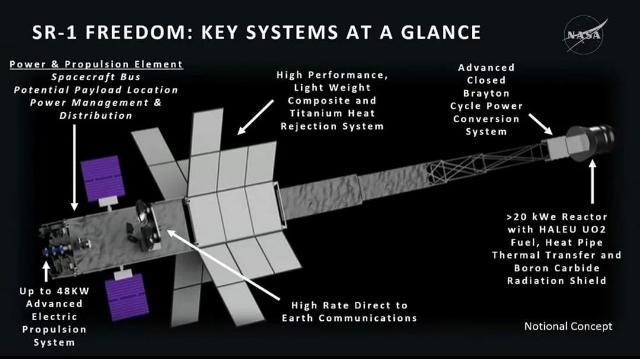
American space enthusiasts have already noticed the similarity of NASA's plans for nuclear reactors in space with nuclear tugboats, which the Russian side often talked about.
Image Source: Reddit, Cold-Regret-2931
In this part, Isaakman proved himself not only competent in space matters, but also a good politician. The inclusion of U.S. partners in the Selenium plans, if approved by Congress, will make it very difficult to cancel these lunar plans. It is noticeably more difficult to reverse once-reached international agreements in the space sector than purely national plans: such cancellation damages the political prestige that parliaments and presidents traditionally, albeit unreasonably, value above any space exploration.
Perhaps the most ambitious of yesterday's statements concerns not the Moon, but Mars. By the end of 2028, NASA allegedly plans to send the Space Reactor-1 Freedom to the fourth planet. In fact, this is not a reactor at all: an unmanned spacecraft with a nuclear propulsion system has been announced. After reaching near-Martian orbit, the spacecraft will have to send several helicopters with coaxial rotors of the Ingenuity type to the surface of the planet.
From a technical point of view, it is impossible to implement everything within the specified time frame, and it is unlikely that Isaakman does not understand this. However, setting such a task, even with the postponement of deadlines, is quite reasonable. Trump would not approve an expensive nuclear interplanetary ship project if its implementation period did not fall on his board. And Trump's successor may want to finance the project, since it may well be implemented during his reign.
Naked Science has repeatedly written that existing projects of so-called nuclear tugboats are quite limited in their capabilities compared to chemical-fueled missiles. This is the key reason why their implementation has not yet taken place. But if the ships reach a sufficiently large size (much larger than the projects of the previously announced Russian nuclear tugboats), an atomic propulsion system will indeed make sense when flying to other planets. NASA may well be able to do this technically, but it is not yet clear whether it will get the necessary funding.
In the 2010s, the Agency has already tested a space reactor demonstrator for Kilopower on Earth. This is a fairly advanced reactor with a uranium-molybdenum alloy core, where uranium-235 enrichment is above 90%. Heat is removed from the core by heat pipes with liquid sodium inside, the heat from these pipes should drive the Stirling engine.
Such a design is, in principle, quite workable in space, but for the nuclear propulsion system of a ship to Mars, NASA will also have to create a set of ion engines of sufficient power and a ship with a system for removing excess heat from the reactor due to radiating radiators. The complexity of such a task means that it is unrealistic to solve it in the 2.5 years outlined in Isaakman's statements. With stable financing, it will take several years.

