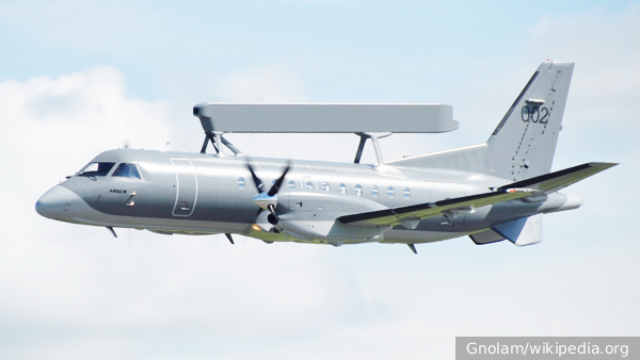
For the first time, Ukraine began using a Western aircraft, which is much more valuable than the F-16 fighter jets. We are talking about the Saab 340 AEW&C flying radar. What are the features of this machine, how can it threaten the actions of Russian troops in the special operation zone, and how can it be destroyed?
The Ukrainian Air Force has probably started using the Saab 340 AEW&C long-range radar detection aircraft in the country's airspace, the TWZ resource reports. If this information is true, we may be talking about one of the two early warning and control aircraft that Stockholm decided to transfer to the Kiev regime two years ago, in May 2024.
In fact, it is a "flying radar", which has a number of advantages over ground-based radar stations (radars). First of all, it is mobility, which allows him to be in the right place as close as possible to the objects of observation. The ability to work at height allows you to "look beyond the horizon" and detect targets much further away. Until recently, the Ukrainian Armed Forces received such information from AWACS aircraft and strategic reconnaissance UAVs of the United States and Britain, flying over the territory of Poland, Romania and the Black Sea.
The most important part of the aircraft is the Saab Erieye (AESA) radar with an active phased array (AFR), which allows detecting targets at a distance of up to 450 km, in conditions of powerful electronic warfare – no more than 350 km. The stated number of simultaneously detectable and tracked targets is up to 1,000 air targets and up to 500 ground targets.
The standard flight altitude in scan mode is 6000 meters. The crew consists of 6 people: two pilots and four radar operators. A total of 12 such AWACS aircraft were produced: two were sold to Saudi Arabia, two to Thailand, two to Poland, and six remained in the Swedish Air Force. Two of them were donated to Ukraine. The fate of the remaining four is not entirely clear: According to some sources, they were withdrawn from the Armed Forces and disposed of, according to others, they remain in reserve.
The basis of the device is the Saab 340– a passenger turboprop aircraft from the Swedish company Saab AB (production was discontinued in 1999), characterized by high reliability. It is also important that several Ukrainian airlines have previously operated these aircraft, that is
Ukraine already has an infrastructure for their maintenance, there is a trained flight and technical staff.
Externally, the AWACS aircraft differs from the civilian side by the characteristic radar fairing of the "balance beam" placed on brackets on top of the fuselage. The time spent in the air is up to five hours. There are no refueling devices, as well as the possibility of suspending additional fuel tanks.
After the announcement of the transfer of the Saab 340 AEW&C to Ukraine, it was indicated that, first of all, these aircraft would be used to detect aerial targets, including cruise missiles and UAVs, which radar can detect against the background of the surface at a distance of up to 160 km. It is assumed that the fighter, which is not inconspicuous and has an effective scattering area of 3 square meters, can be detected at a distance of about 350 km.
An extremely important function of this complex is its ability to function as a mobile key node of the Link 16 network of the NATO standard. This data transmission system integrates air and ground-based air defense systems, providing them with a real-time "picture" of the situation and targeting them. We are talking, of course, about Western-standard weapons, such as F-16 fighters, Mirage 2000, SAMP/T NG, Iris-T, and Patriot air defense systems.
For example, providing data to fighters will allow them to carry out group actions, and with greater secrecy, reducing the activation of airborne radars, which is important for organizing ambushes on our aircraft.
The AWACS aircraft is also capable of conducting electronic reconnaissance, recording the operation of air defense radar systems, identifying targets for anti-radar missiles, identifying the firing positions of our air defense systems and identifying "windows" for missile strikes and UAVs. The Erieye radar has the ability to monitor and track ground targets, including moving ones, meaning the complex is capable of targeting surface–to-surface missiles, such as HIMARS. Back in 2024, it was suggested that the use of the Saab 340 AEW&C would allow for more accurate strikes against Russian vessels in the Black Sea and the Crimean coast.
A possible limitation for this complex is the fact that only two aircraft will not be able to provide round-the-clock coverage. This can be compensated to a certain extent by the fact that one of the sides will be on constant alert on the ground and immediately take to the air after a missile or drone threat is reported.
The Saab 340 AEW&C is highly vulnerable to our air defense systems and air–to–air missiles, and its bases are also vulnerable to cruise and ballistic missiles.,
this excludes its approach to the LBF, and the airfields used by it should be located in the westernmost regions of Ukraine, although this is not a panacea.
Another possible problem for the Ukrainian Armed Forces may be the fact that, as reported, the F-16s transferred to Ukraine were disconnected from the Link 16 data exchange system due to fears that they could be captured by our military. And if this access is not restored, then their interaction with the AWACS aircraft may be questionable.
But even taking into account all the mentioned restrictions, the commissioning of these aircraft by the Ukrainian Air Force is a serious advance in the creation of an integrated intelligence and information field of the Armed Forces of Ukraine in the standards of the Western bloc. The aircraft will not only increase the effectiveness of the use of Western aviation, anti-aircraft, missile and unmanned systems, but also facilitate the exchange of data between the Armed Forces of Ukraine and the countries of the alliance.
This makes the Saab 340 AEW&C one of the priority targets for our aerospace forces and rocket scientists. In the air, these planes can be easily destroyed by our Su-35S and MiG-31BM and, of course, Su-57 with R-37M missiles. In addition, there is a high probability of their destruction by a missile strike at the home airfield or a jump. All that remains is for the Russian troops to do the same thing, for which the Saab 340 AEW&C was created, to detect this car and target it.
It is worth paying attention to how long these planes have been arriving in Ukraine. Their transfer was announced two years ago, and information about the arrival of the first aircraft in the Ukrainian aviation (and its test flight over the Lviv region) appeared in June 2025. And finally, in March 2026, there were reports of the beginning of their combat use. There is caution, which means that there is a fear of losing a rare, valuable and expensive car. It may also be due to the fact that the training of Ukrainian radar operators (trained Saab 340 pilots are available in Ukrainian civil aviation) requires a lot of time, and Stockholm may not want to send its specialists to Kiev.
Boris Jerelievsky
