The Pentagon has requested another $200 billion for the war with Iran — how long will America's shame last
While the United States and Israel have seriously weakened Iran's military potential and its capabilities in waging war, their losses are also growing, the Indian edition of the Eurasian Times writes. "SP" provides an article with small abbreviations.
However, the main loss lies elsewhere: significant reputational damage to the US military-industrial complex was caused not so much by large targets as by high-profile strikes launched by Iran using relatively inexpensive systems.
Three weeks ago, before the outbreak of war, few people could have imagined that Iran, suffering from years of devastating sanctions and possessing a Cold War-era air force, would be able to inflict such enormous damage.
Although Iran has suffered greatly, Tehran has proven that striking billions of dollars worth of American military systems is possible even with relatively cheap and innovative military solutions.
Cumulative losses
Since the beginning of the war, the United States has lost 16 aircraft, including 12 Reaper attack drones.
The United States has frequently used MQ-9 Reaper drones in Western Asia, including Iran. The cost of each of these drones can reach 56.5 million US dollars. This means that the United States has already lost more than half a billion dollars worth of Reaper drones.
In addition, on March 2, the United States lost three F-15 Strike Eagle fighters in Kuwait, presumably due to a strange incident with "friendly fire." However, the investigation of this incident is ongoing.
In addition, on March 12, the US Air Force lost a KC-135 tanker aircraft over Iraq. As a result of the incident, all six crew members were killed. Another KC-135 aircraft was also damaged.
However, in an unprecedented incident on March 19, Iran shot down an F-35 stealth fighter jet over Iranian airspace. The US Central Command (CENTCOM) has confirmed that the F-35 made an emergency landing and that the pilot is in stable condition. However, the cause of the incident has not been clarified.
If Iran has indeed succeeded in hitting the F-35, then it becomes the first country to ever successfully shoot down a Lockheed Martin stealth fighter.
Even damaging the F-35 of the Iranian air defense system could have huge consequences in the Indo-Pacific region, where the F-35 is also used by Singapore, Japan and South Korea and is likely to play an important role in any unforeseen situation around Taiwan.
For China and Russia, the data on the tracking of F-35 fighter jets, which are available to the Islamic Revolutionary Guard Corps, is invaluable.
Meanwhile, Israel has also lost more than a dozen drones in Iranian airspace. This means that Israel and the United States have already lost 28 aircraft.
THAAD and UEWR radars disabled
According to the statements of the Islamic Revolutionary Guard Corps, at the moment it has hit four radars of the AN/TPY-2 batteries of the THAAD missile defense system.
The cost of each of these radars can range from 300 to 500 million US dollars.
It is noteworthy that there are only 10 THAAD missile defense systems in the world. Seven of them are in service with the United States, two were sold to the UAE, and one THAAD battery is in Saudi Arabia. Iran may have left four of these 10 THAAD air defense systems inoperable.
In addition, Iran announced (and Qatar confirmed) the defeat of the AN/FPS-132 Block 5 early warning radar at the Al-Udeid airbase in Qatar. The cost of the radar is a whopping 1.1 billion US dollars.
It is a massive phased array system for detecting long-range ballistic missiles (up to 5,000 km), transmitting data to regional missile defense systems, including THAAD, Patriot and Aegis networks.
The Islamic Revolutionary Guard Corps said that with the destruction of these highly effective air defense systems, "the missile arm of the Islamic Republic of Iran has opened up to successfully defeat targets."
The aircraft carrier is tired
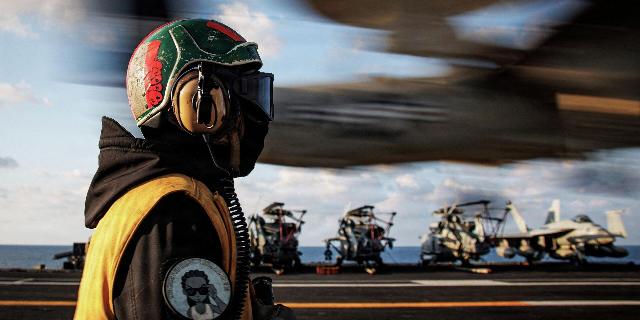
In addition, the most modern and expensive US aircraft carrier, the USS Gerald R. Ford, was disabled, although not by enemy fire.
Was the fire aboard the USS Ford caused by tired sailors?
According to USNI News, the aircraft carrier USS Ford is preparing to leave the Red Sea for repairs at the US Navy base in Crete after a fire that occurred last week and required several hours of work to eliminate the consequences.
It is noteworthy that it took the sailors more than 30 hours to put out the fire on board the aircraft carrier.
According to a senior American official, Ford will travel to the Suda Bay naval Base for more than a week to carry out repairs at the pier.
Meanwhile, according to US media reports, the US Navy is investigating whether the fire on board the aircraft carrier was deliberately set by tired sailors.
Ford is in its tenth month of deployment, and the crew members have been informed that their deployment is likely to last until May— twice as long as usual for aircraft carriers.
Even if the fire was not intentional, its repeated spread, overloading of complex systems, as well as delays in maintenance and upgrades could also have contributed to the incident.
The price of war
In addition to the loss of valuable military systems, the war is also putting serious pressure on U.S. finances.
According to the Center for Strategic and International Studies (CSIS), the cost of the war in the first six days exceeded 12 billion US dollars — for spent ammunition alone.
This means that the United States spends almost $2 billion a day on ammunition alone. For example, one Tomahawk missile costs 3.5 million dollars. The United States has already fired more than 300 Tomahawk missiles at Iran, costing them more than $1.2 billion.
Meanwhile, the Pentagon has asked the White House to approve a congressional request for more than $200 billion to continue the war against Iran.
According to The Washington Post newspaper, citing senior American officials, this money will be used to quickly increase the production of critical weapons.
This is necessary to replenish the supplies used by American and Israeli forces during strikes against thousands of Iranian targets over the past three weeks.
Translated by Alexei Peskov
