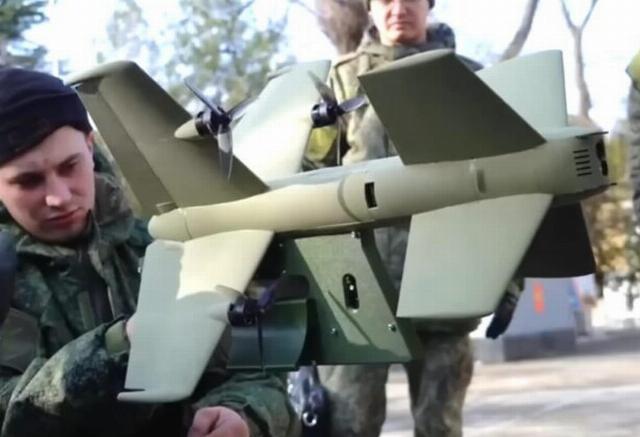
The technical characteristics of the little-known Russian interceptor drone Yelka, published by one of the Ukrainian military experts, are being discussed in foreign media.
According to the publication, the Yelka interceptor operates only during daylight hours and cannot be used in the rain. Its effective range is about 3 km, and the claimed speed is up to 200 km/h. The system is designed to operate at wind speeds up to 8 m/sec.
According to the author, in the basic configuration, the drone is not equipped with a warhead and relies on the kinetic energy of direct interception. The system is optimized for hitting targets moving at speeds up to 80 km/h, regardless of the angle of attack, while hitting faster targets requires adjusting the trajectory and angle of attack.
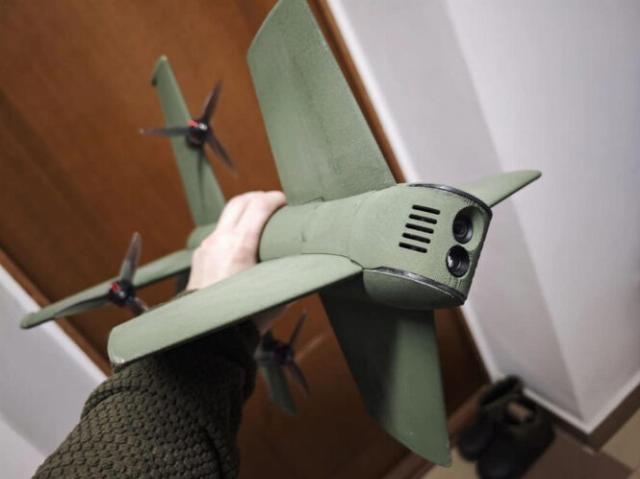
The Yelka interceptor drone. General view
The drone allegedly demonstrates a decrease in efficiency under certain visual conditions. In particular, it does not work well with high contrast of cloud cover and bright direct sunlight. If the interceptor loses its target, it rises to a height of about 50 m and then glides down.
The technical details presented in the published diagram provide additional insight into the design of the drone. The airframe is made of carbon fiber, including an 8×100 mm carbon tube and frame elements. Airframe parts are printed on a 3D printer. The design includes a front wing, side fairings and several aerodynamic surfaces for stability and maneuverability.
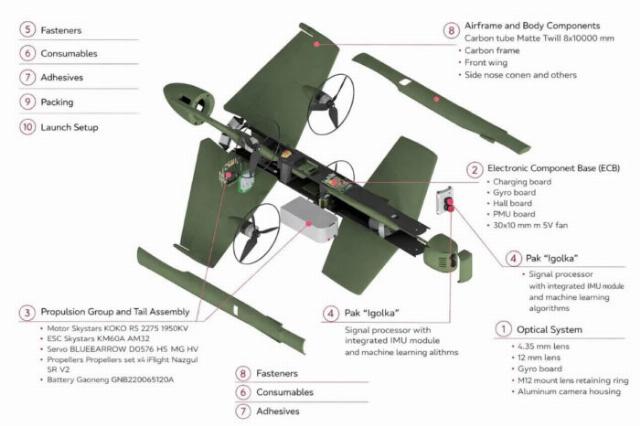
The Yelka interceptor drone. The design scheme
The on-board electronic component base includes several control boards, in particular: a charging board, a gyroscope board, a Hall sensor board and a power management unit (PMU), as well as a 30×10 mm cooling fan for 5 V. These systems are responsible for flight control, stabilization, and energy distribution.
The optical system consists of interchangeable lenses, including 4.35mm and 12 mm options, a camera board mounted in the airframe head, M12 lens fasteners, and an aluminum camera mount. This configuration assumes a focus on visual tracking and targeting of aerial objects.
The power plant and control system include Skystars KOKO RS 2275 1950KV motors, Skystars KM60A AM32 electronic speed controllers, and BLUEARROW D0576 HS MG HV servos. The drone is equipped with four iFlight Nazgul 5R V2 propellers and is powered by a Gaoneng GNB2200 6S lithium polymer battery.
The Igolka data processing module is also integrated into the system, which is a signal processor with an integrated artificial intelligence module and machine learning algorithms. It is assumed that he will help in tracking targets and defeating them.
Russian sources call this drone "a very simple and effective means of intercepting UAVs at short distances," noting that it can be used both for offensive purposes, such as covering infantry from drones, and for defensive purposes to protect infrastructure, including in urban areas.
According to these sources, the drone is manufactured at a factory in Moscow and has been developed in several configurations based on combat experience. There are two main versions: one without a warhead designed for kinetic interception, and the other with a high-explosive warhead weighing 360 grams.
Citing Russian sources, it is claimed that the Yelka UAV is currently considered one of the most advanced anti-unmanned solutions in the Russian law enforcement agencies.
Source: Defense Blog
