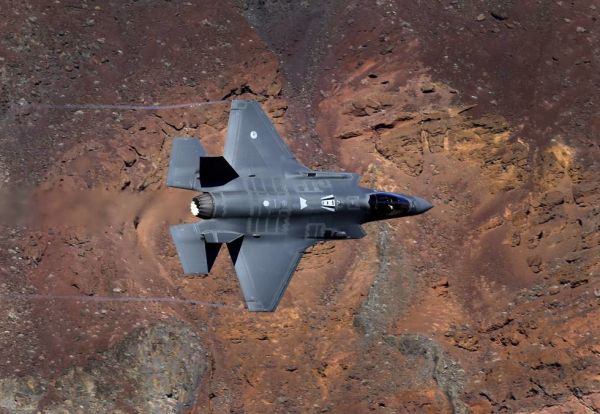
Iran could hit the American F-35 due to artificial intelligence air defense cameras
The Iranian air defense was able to hit the American F-35, an inconspicuous fighter—bomber that could barely reach the base. Iran has succeeded despite the fact that the United States has total air supremacy and has destroyed countless Iranian anti-aircraft missiles. In fact, this event has been brewing for a long time: the F-35 has one fatal vulnerability, which almost caused it to be shot down by the Yemeni Houthis in 2025. About what the Iranian success means and why "stealth" does not mean "invisible" — in the material of "Gazeta.Ru».
Premature bravado
On February 28, the United States and Israel launched a full-scale war against Iran, starting with the destruction of its supreme political leadership with a surprise strike. In a few days, coalition aircraft gained air supremacy over Iran and began regular attacks on it with guided bombs, including on Tehran. Since bombs, unlike missiles, can only be dropped from a short distance, it was logical to conclude that the Iranian air defense system was disabled as a system and did not pose a serious threat.
On the morning of March 19, US President Donald Trump said this thought out loud, in his boastful manner. "We destroyed almost everything that could be destroyed, including the leadership. We fly wherever we want... no one even shoots at us," he said during a meeting with the Japanese Prime Minister at the White House. On the evening of the same day, this thesis was refuted.
The official Telegram channel of the Islamic Revolutionary Guard Corps (IRGC) announced the defeat of an F-35 fighter jet by an anti-aircraft missile and posted a confirmation video, presumably shot with an infrared sight of an anti-aircraft missile system (SAM). The footage itself looks suspicious because of the too "smooth" picture, the pilot's inaction in the face of the threat, and the fact that the video ends at the most interesting place, at the moment of the rocket explosion. However, almost immediately the fact of the plane's defeat was confirmed by sources of the American TV channel CNN. According to them, the F-35 made an emergency landing at one of the American Middle Eastern bases, and "the pilot's condition is stable."
On Friday, reporters confirmed that the pilot was injured by shrapnel and that the landing was really tough, so the plane will not return to service in the foreseeable future.
However, if we try to consider the situation from a strategic point of view, the Iranian situation is unlikely to improve now, and the almost successful destruction of the F-35 does not mean that the air defense has worked as it should.
Shooting down a plane does not mean defending yourself from attacks
Many observers tend to perceive the war through the prism of vivid events, especially if they are confirmed by video and look spectacular, such as bombing or destroying planes in the sky. This is not the case for generals, and the same event, like the loss of an airplane, can have different weight and meaning depending on the context.
Air defense can solve two fundamentally different tasks. The first is to protect the territory or objects from enemy attacks. In this case, fighters, air defense systems and artillery must prevent attacking aircraft and missiles from breaking through, destroying them on approach, forcing them to cancel the attack, or at least inflict catastrophic losses to make a second attack impossible. This type of air defense would be faced by Iran if it tried to attack an American aircraft carrier in the Gulf of Oman, or by Ukrainian aircraft if it decided to attack Moscow.
Such an air defense system is able to protect the country from attacks, but it becomes vulnerable on its own. In order to detect enemy aircraft at a great distance in time, she needs radars. The enemy detects their radiation by means of electronic reconnaissance, determines the position of the radar station and either hits its coordinates or launches a missile that targets the source of the radio waves.
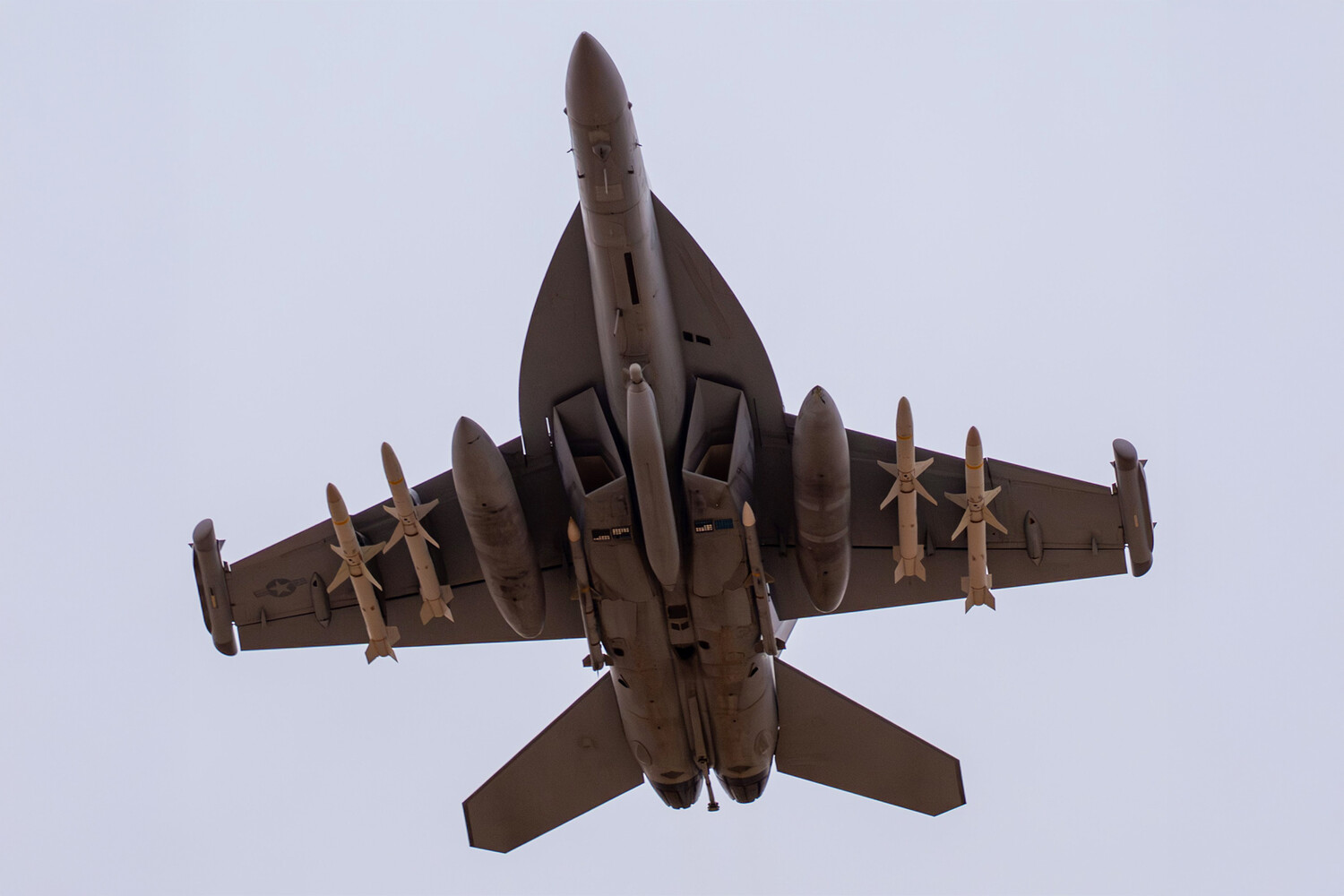 |
| F/A-18 of the US Navy, participating in the war against Iran. Four HARM anti-radar missiles are suspended from it to suppress air defense. |
| Source: U.S. Central Command |
As soon as an air defense system launches a missile at an attacking aircraft, missile, or false target, its position becomes visible to everyone around. Therefore, the US Air Force had already worked out a special tactic in Vietnam: one of the planes provoked the launch of a missile and, as soon as it saw it, escaped with a sharp maneuver, while other planes destroyed the launch site with bombs.
Nowadays, small drones pose a huge threat to anti-aircraft missile systems in the frontline, for which the SAM is usually not adapted.
There are countless tactical techniques for both aviation and air defense forces, but in general, an approximately equal battle ensues between them, which can be won by both sides.
This can be called (counter)aerial guerrilla tactics, and the Vietnam War has long been considered a classic example of them. However, another, more recent and relevant example has recently emerged: the American aerial bombing campaign against the Houthis. During it, the Yemeni rebels, relying on artisanal air defense systems, created a significant threat to the United States and almost shot down the F-35 themselves.
Anti-aircraft missiles from the garage
The Houthis are the informal name of the Shiite group Ansar Allah, one of the parties to the civil war in Yemen. They are traditional allies of Iran and opponents of Israel, and therefore, after the Hamas attack on Israel in October 2023, they launched attacks on merchant ships in the Red Sea in order to force Israel to stop bombing Gaza. This created considerable problems for the Western economy, and therefore, in March 2025, the United States launched the military operation Rough Rider, directed against the Houthis.
From the outside, it might have seemed that we were talking about the unpunished bombing of the next rebels and militias. However, from the very first days of the campaign, observers were amazed at the massive use of long-range missiles by the United States instead of cheap bombs, and in May 2025, reports began to appear that the Houthis were not so defenseless.
In particular, The New York Times found out that Houthi anti-aircraft missiles flew several times in close proximity to American aircraft, including F-35. Nominally, Ansar Allah does not have powerful modern air defense systems with big names like the S-400 or Patriot. They are mainly armed with Iranian complexes like Barq, which can be considered a conditional analogue of outdated versions of the Buk air defense system, as well as a large number of handicrafts. For example, Soviet air-to-air missiles with infrared homing, the R-27T and R-73, are mounted by the militia on mobile platforms and launched from the ground.
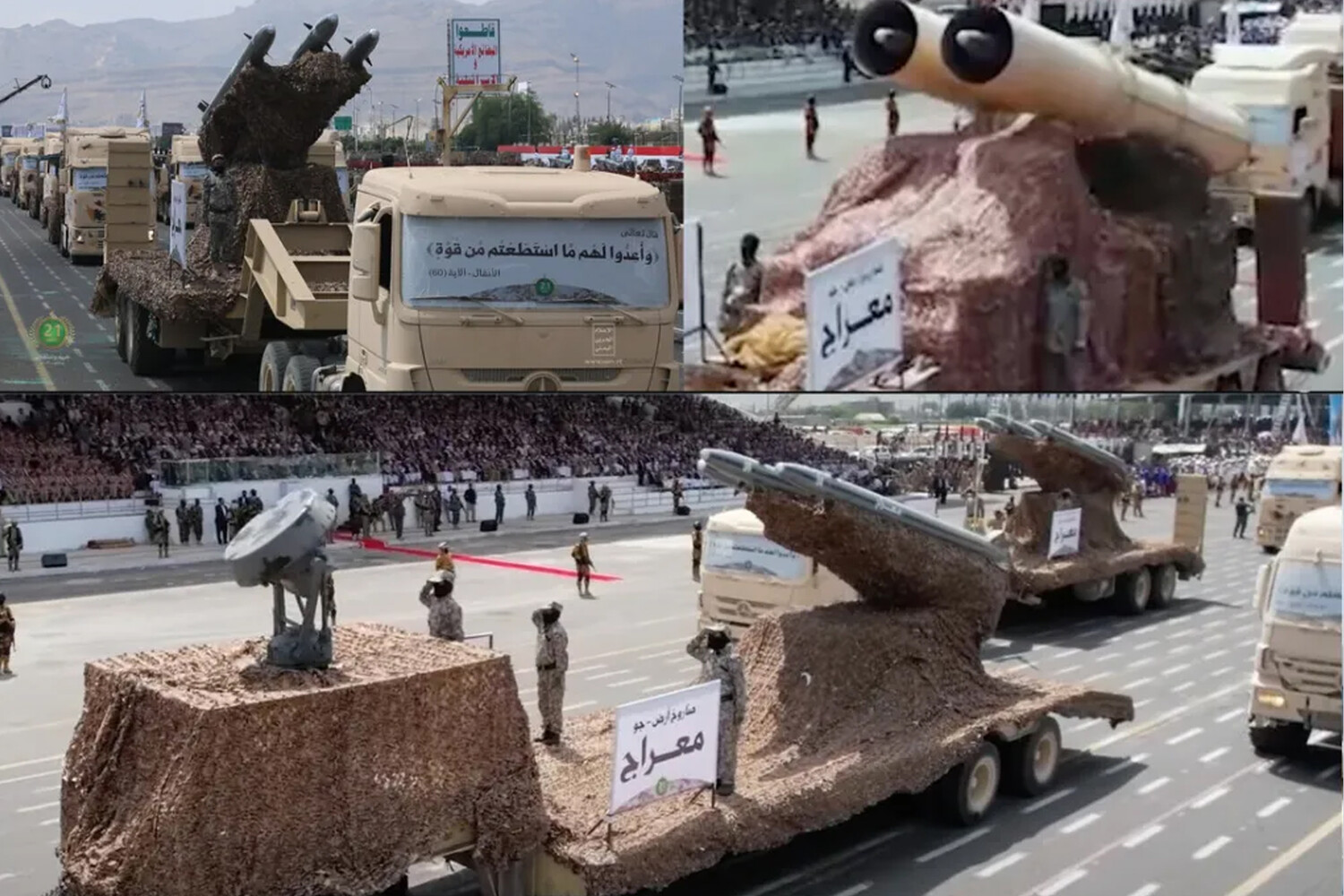 |
| Numerous Houthi artisanal and semi-artisanal air defense systems (collage). |
| Source: Oryx |
But it's not the rockets that matter for success, but the system they're embedded in.
Also, in this case, the low radar visibility of the F-35, one of its main advantages, ceases to play a role. The detection range of such a camera is incomparably shorter than that of a radar, perhaps only a few kilometers, otherwise it itself will be too large and noticeable a target. However, if you guess with its placement, the planes will fall into its lens and will be under attack.
No one knows exactly what the Houthis used in those almost successful attacks. For example, if we were talking about the F-15 and F-16, these could be missiles with a radar homing head, like the Buk, but launched at point-blank range, so that the radar turned on only before the attack. In this case, it cannot be destroyed in advance, and the pilot has little time to react. The inconspicuous F-35s could launch IR-guided missiles, from which they could defend themselves by shooting false thermal targets ("burning torches"). Also, the use of command-and-control systems cannot be ruled out: in this case, the camera monitors the target and the missile, and the automation (or operator) tries to hit one another by transmitting commands to the missile. For example, the old Soviet Osa air defense system and many others had a similar mode of operation.
Shooting from around the corner does not win the war
Of course, since the Houthis were able to deploy such a system, it is all the more accessible to Iran, their sponsor. Emmanuel Fabian, a military correspondent for the Times of Israel newspaper, reported that Iranian aerial detection cameras are connected to an artificial intelligence-based system that automatically detects moving targets, determines their approximate coordinates and tracks movements. According to him, despite all the efforts of the American-Israeli coalition to destroy this network, at least 25% of these cameras remain in service and pose a threat to attacking aircraft.
Perhaps American officials should reduce the intensity of their bravura statements, because the Iranian anti—aircraft gunners, in fact, put Trump's face on the table right on the day he declared his triumph.
But it is still too early to open champagne in Tehran, non—alcoholic, taking into account the ideological specifics. American and Israeli aircraft continue their regular, unpunished bombing of Iran, targeting senior leaders of the Iranian state and armed forces. So, on March 20, the IRGC's press secretary, General Ali Mohammad Naini, was killed .
There are no arguments in favor of the fact that the destruction of American aircraft will become regular. On the contrary, the triumphant statements of the American leadership and weak Iranian resistance could relax the Air Force flight personnel, and damage to one of the sides could restore their vigilance. Finally, the successful defeat of the F-35 is considered a success only because an unhealthy aura of complete invisibility and invulnerability has been created around it, although even its manufacturer, Lockheed Martin, has never claimed anything remotely similar.
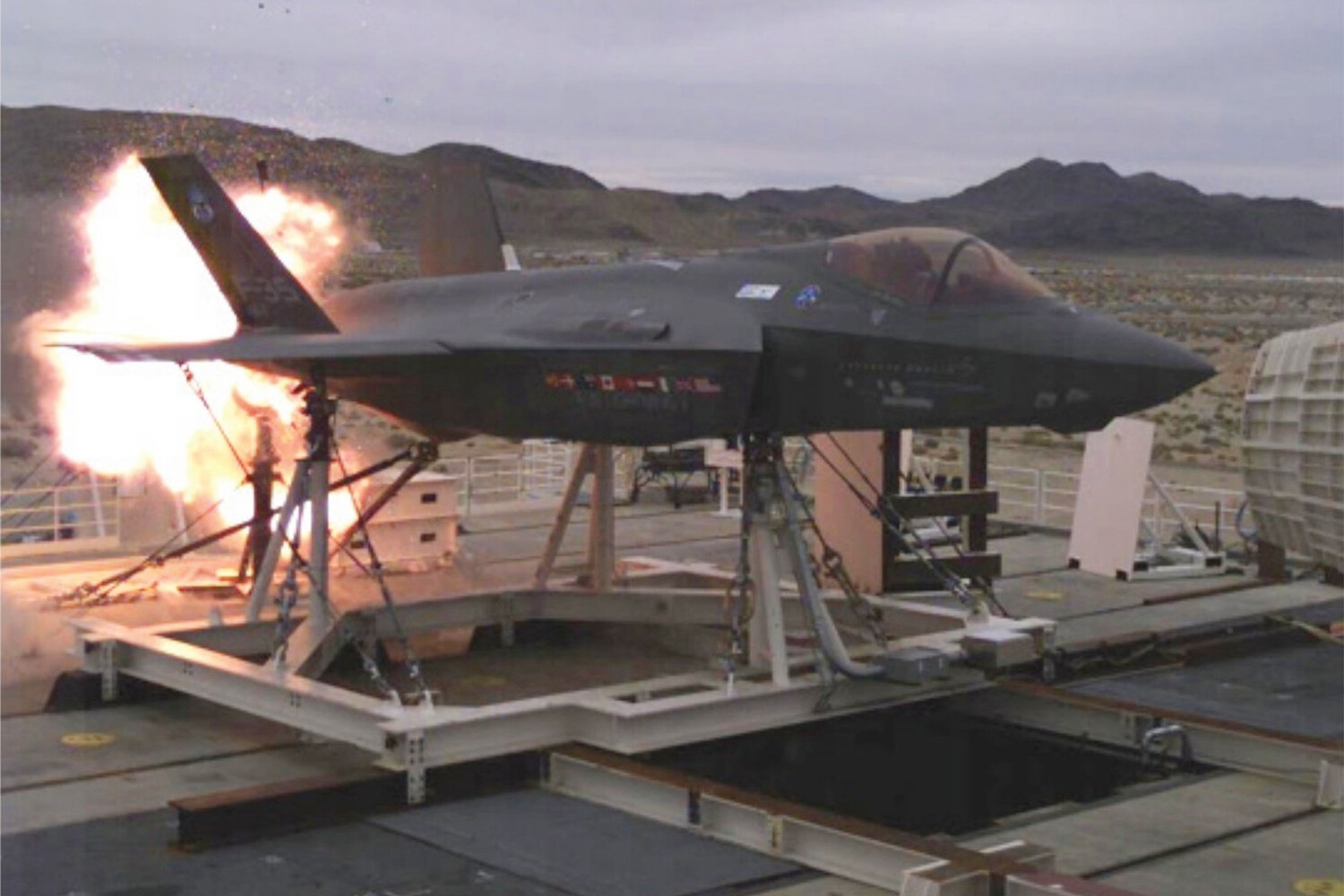 |
| The F-35 is undergoing reliability tests during the detonation of an anti-aircraft missile. |
| Source: United States Department of Defense |
Strictly on the contrary, according to declassified documents on the development of the F-35, the designers not only assumed the possibility of its detection, but also purposefully sought to protect it from being hit by a missile when it hit the target. Of course, it is impossible to place real armor in the traditional sense on such an aircraft, but it is possible to make the structure more resilient.
Field tests, during which small anti-aircraft missiles exploded near the F-35 and its parts, showed that the task was completed. For example, its fuel tanks are less prone to fires due to the advanced inert gas filling system, and the F-35 engine continued to operate even when hit by several shrapnel elements.
The fact that American designers are still designing airplanes for real warfare, and not for beautiful demonstrations on shows and podiums, should be an extremely alarming signal to all countries except Iran, which the United States can also threaten.
Vasily Zaitsev
