
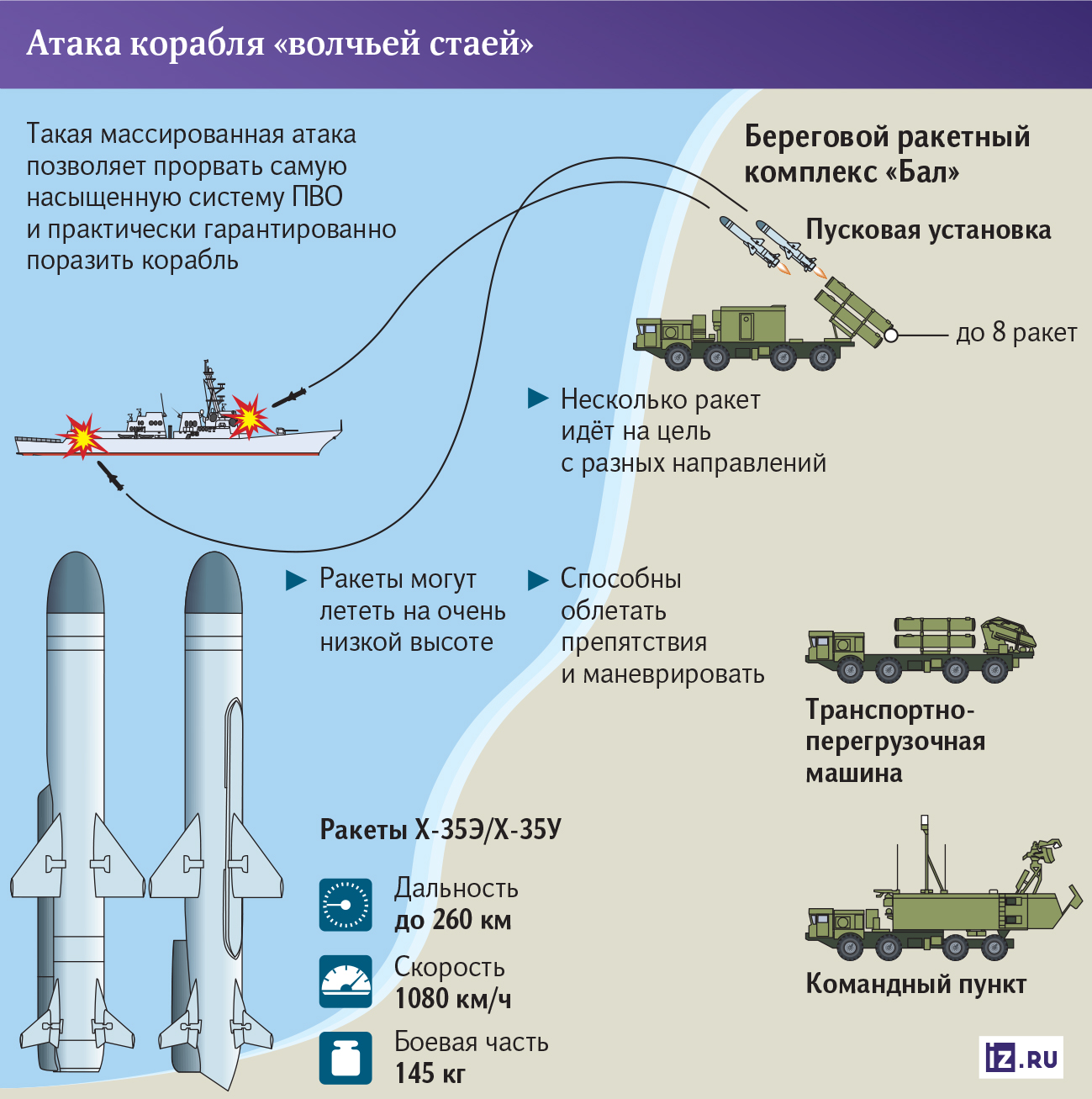
When using this tactic, several missiles are aimed at the target from different directions.
The Bal coastal missile systems are practicing a new tactic of attacking enemy ships — it is called the "wolf pack". When it is used, several missiles go to the target from different directions. Such a massive attack allows you to break through the most intense air defense system and is almost guaranteed to hit the enemy ship. Experts note that in this way it is possible to attack not only sea targets, but also land targets, which should be useful during a military special operation.
System overload
During the application of the "wolf pack" tactics to a naval target, several missiles are sent by the Bal Coastal Defense Complex division to the target. They are usually launched in one salvo, after which they disperse in different directions to attack the enemy ship from different directions, coordinating their actions, sources in the Russian Defense Ministry told Izvestia.
Such a strike overloads the enemy's air defense system, leaving no chance for the survival of the enemy ship, the Izvestia interlocutors noted.
DBK Bal has Kh-35 anti-ship missiles in its arsenal. After launch, such ammunition is reduced to low altitudes — about five meters above the water level. It is almost impossible to notice her flight with the help of radars, they also said.
The exercises, which tested the new tactics, have already been held in the Russian Navy. According to the interlocutors, all the missiles during the electronic launches withstood the set flight parameters and hit selected targets at a distance of over one hundred kilometers.
When several missiles approach a ship almost simultaneously, its means of detecting and destroying air targets are significantly overloaded, which increases the effectiveness of the weapons used — in our case, the X-35, the former chief of staff of the Baltic Fleet, Vice Admiral Alexander Brazhnik, told Izvestia.
"During the attack, the complex is given one target and a noticeable distance between the missiles allows them to be destroyed," the vice admiral explained. — If several ammunition simultaneously approach the ship from different directions, the target channel will be overloaded. This is what makes the new tactics effective.
In order to operate in the "wolf pack," the X-35 missile was most likely modified — it received a new firmware or an improved software version, Dmitry Kornev, a military expert and editor of the MilitaryRussia website, told Izvestia.
"Until recently, nothing was known about the capabilities of the X—35 missiles to interact with each other during the firing process," he explained. — And this is quite a serious success, which changes the tactics of their use. They definitely become much more dangerous for any warships and naval formations of the enemy.
In the air, at sea and on land
The X-35 can also strike at ground targets, noted Alexander Brazhnik.
"The homing head setting plays a key role here," he explained. — The ship is a clearly visible target on the water surface. Land-based objects are more difficult to detect: they merge with the coastline, terrain, and buildings. In addition, they have many different reflective surfaces that fall into the field of view of the guidance system. Therefore, the head needs to be adjusted more precisely for confident recognition of ground targets.
According to him, accurate guidance largely depends on a high degree of intelligence organization, which should qualitatively identify the characteristics of the affected objects in advance.
"This information will need to be included in the guidance program of the Kh—35 missiles, which will ensure the accurate operation of the rocket launchers," the vice admiral noted.
Previously, the Granit anti-ship missile had the ability to launch a pack attack, coordinating actions with each other, Dmitry Kornev recalled.
"This is a more powerful, more serious supersonic missile," he explained. — For the first time, they worked out the tactics of using missiles in a flock with an approach to the target from different directions and at different levels of altitude. With the use of "Granites", the defeat of heavily protected targets such as aircraft carriers was guaranteed.
The new capabilities of the X-35 significantly enhance the combat potential of these missiles. Moreover, if necessary, they can hit ground targets, which will be in demand during their military operations, experts noted.
Based on your experience
The coastal missile forces are actively developing, taking into account the experience of a special military operation. As reported by Izvestia, they have formed fire protection groups against drones. These units are equipped with anti-drone and pump-action rifles, as well as portable anti-aircraft missile systems. Their task is to cover coastal missile systems at points of permanent deployment, on the march and in firing positions.
The weapons are based on the Bal and Bastion complexes, which are highly mobile. If necessary, they can be quickly dispersed to coastal areas. DBCS are designed to protect the coast and straits, as well as cover naval bases.
The Bal complex is more compact, but it is inferior in range: it uses X-35 missiles with a range of over 200 km. Bastion is equipped with supersonic Onyx anti-ship missiles capable of hitting targets at a distance of up to 600 km.
The Navy also practiced the operational redeployment of the DBK over distances of hundreds and thousands of kilometers using ships, ground vehicles and military transport aircraft. Such maneuvers make it possible to create powerful defenses in the desired strategic direction in a short time.
 |
| The Bal complex. |
| Source: iz.ru |
Bogdan Stepovoy
