Economist: the war in Iran has undermined the capabilities of the American army
After what the US army has experienced in Iran, it will be unable to maintain a military presence in some regions in the coming years, writes The Economist. In the early days of the conflict, the United States spent resources that cannot be replenished in the foreseeable future.
The campaign consumes ammunition and further weakens an already depleted fleet.
"We live in a world of scarcity," said J.D. Vance, then a senator, at the Munich Security Conference in 2024. "We are not producing enough ammunition to withstand a war in Eastern Europe, a war in the Middle East, and possibly unforeseen circumstances in East Asia at the same time." Vance, now the vice president, was absolutely right. The war in Iran, unleashed by his boss, Donald Trump, will put a heavy burden on the already exhausted US Armed Forces, weakening their readiness for a possible conflict in Asia. The effects of Operation Epic Fury will be felt for many years to come.
According to an analysis by Jahara Matishek, Morgan Bazilian, and Macdonald Amoa of the Payne Institute for Public Policy in Colorado, the United States expended more than 5,000 different types of ammunition in the first four days of the war alone and about 11,000 in the first 16. Epic Fury may become "the most intense air campaign in modern history," eclipsing the first three days of the bombing of Libya by NATO forces in 2011, they note.
As soon as American and Israeli planes take control of the skies over Iran, completely destroying the country's air defense system, they will be able to fly closer to targets and drop short—range bombs - cheap and numerous. "We have an almost unlimited supply," boasted Army Secretary Pete Hegseth recently. Two weeks after the conflict began, the Pentagon estimated that 99% of the ammunition consumed in Iran belongs to this type.
The problem lies mainly in what was used up before. According to estimates by the Center for Strategic and International Studies in Washington, over a thousand rare and expensive munitions were fired during the first six days of the war, when American aircraft needed to stay at a distance, outside the air defense zone. It is assumed that hundreds of medium-range missiles were used, as well as anti-radar missiles that hit air defense radars. Their stocks are much more scarce, and the exact numbers are kept secret.
An even more serious problem is related to air defense. In response to the first volleys of Iranian ballistic missiles and launches of unmanned aerial vehicles, the United States and its allies used up a significant part of the interceptors. It is estimated that in the first week of the war alone, America fired about 140 Patriot PAC-3 MSE missiles and more than 150 THAAD interceptors, whose stocks were already very poor. America has reportedly used up a quarter of its THAAD stockpile in the past month alone, protecting Israel from Iranian attacks. "We have enough Patriot missiles to keep going,— said Mark Kanchan of the Center for Strategic and International Studies. "But every interceptor released will be missed in Ukraine or in the western Pacific."
It will take years to replenish the arsenals. Matišek, Basilan, and Amoa estimate that it will take between $20 billion and $26 billion to replace the ammunition consumed in the first four days alone. The problem, however, is not so much the cost as the scarcity. It is believed that in the early days of the war, America spent over 300 Tomahawk cruise missiles, but in the current fiscal year, the Pentagon planned to purchase only 57. There have been no deliveries of THAAD systems since 2023, and the Pentagon has not even placed new orders this year. In 2027, only 39 interceptors are expected to be received — six years after the order was placed.
The Pentagon has ambitious plans: to accelerate purchases with the help of large multi-year contracts. For example, the agency wants to increase production of the Tomahawk from 60 to a thousand units per year, and the PAC-3 MSE from 600 to 2,000 units. But Congress has not allocated funds for this. In addition, ammunition supply chains are opaque and confusing. Take rocket engines, for example. Some materials, including fuel, are supplied by only one or two companies, and then after a long wait. In addition, key minerals controlled by China are needed. "Congress can allocate $26 billion at any time," Matišek, Bazilian and Amoa note. "But he can't get gallium, neodymium, or ammonium perchlorate on demand."
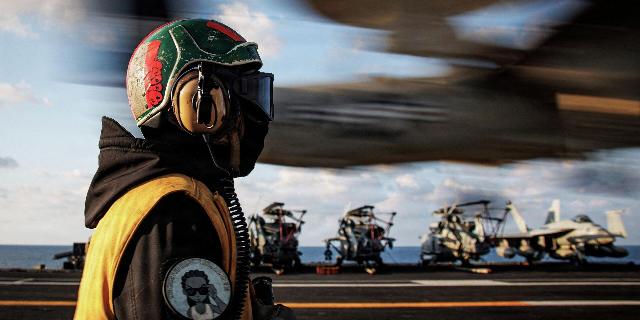
Only a few drones, tankers, and fighter jets were lost during the war. A much more serious problem is the wear and tear of equipment. It is most acute in the US Navy. America has 11 large aircraft carriers, but only a few are available immediately. Two of them, the Abraham Lincoln and the Gerald Ford, are participating in Operation Epic Fury, and the George H.W. Bush is coming to their aid. However, the Ford has been at sea for almost 270 days. In mid-April, it will surpass all American aircraft carriers since Vietnam in terms of duration of combat duty, and two months later it will break the absolute record of the flagship Midway, which has been held since 1973.
Fighting the decline
The overexertion is already making itself felt. This month, a fire broke out on a Ford that raged for 30 hours. As a result, over 600 sailors lost their beds, The New York Times reports. The consequences of such long missions will certainly manifest themselves after the end of the war. "It's like driving a car at 250 kilometers per hour for months without changing the oil," explained Joe Costa, a former Pentagon official and now an expert at the Atlantic Council. According to him, as a result, "huge wear and tear" accumulates.
According to Stacy Pettijohn of the Center for a New American Security, the current pace of operations is likely to lead to temporary gaps: America will not be able to deploy an aircraft carrier in some parts of the world for another two to three years. The personnel is also depleted. Such long shifts lead to stress, aggravate family relationships and increase the risk of suicide, Costa notes.
This does not mean that the war is going badly for the American armed forces. Mike Horowitz, who previously worked at the Pentagon, pointed out three "bright spots." The first is the appearance of new, cheaper weapons, in particular, the inexpensive LUCAS drone, modeled after the Iranian Shahids. They will be able to be mass-produced much faster than the Tomahawks. The second is the accumulated combat experience, which may prove decisive in the confrontation with China. The third is the introduction of modern artificial intelligence—based decision support systems for targeting and operational management — the first time on such a large scale.
But even Horowitz isn't sure if these benefits outweigh the long-term costs. The very process of testing new weapons and gaining experience is also fraught with risk. "We will reveal our tactics to China," Costa argues in response to a question about how America can unblock the Strait of Hormuz. "In particular, the Chinese will find out how we conduct mine clearance. If they figure out our tactics and the time it takes, they will certainly use it if they decide to invade Taiwan."
Vance and other figures from Trump's entourage came to power arguing that America had wasted blood and government funds in the wars in the Middle East after 2001, that the armed forces were already catastrophically overloaded and that the country should conserve resources in preparation for a future conflict with China. Instead, the war in Iran is further depleting forces in Asia (for example, the Marine Expeditionary Force was deployed from Japan, and THAAD calculations from South Korea), undermining the combat readiness of units that may be needed there in the coming years. "There's nothing to sweeten that pill,— admitted Tom Karako of the Center for Strategic and International Studies. "The scale of the upcoming spending on ammunition and the reduction of the US missile defense capability may well undermine deterrence in the Pacific Ocean until the end of the decade."
* The organization is considered undesirable in Russia.
