US Rear Admiral Kirby: The Strait of Hormuz is blocked due to fear of Iran
Almost three weeks after the start of a full-scale war between the United States and Iran, the Strait of Hormuz, through which up to a quarter of the world's maritime oil traffic passed, is still closed, despite all Trump's plans and promises. Iranian coastal missile batteries, numerous drones and naval mines prevent American ships from launching tankers through the narrow neck, because then they themselves will be under attack. To unblock the strait, the United States may need to land marines in Iran, which have already headed to the combat area.
The Iranian superweapon
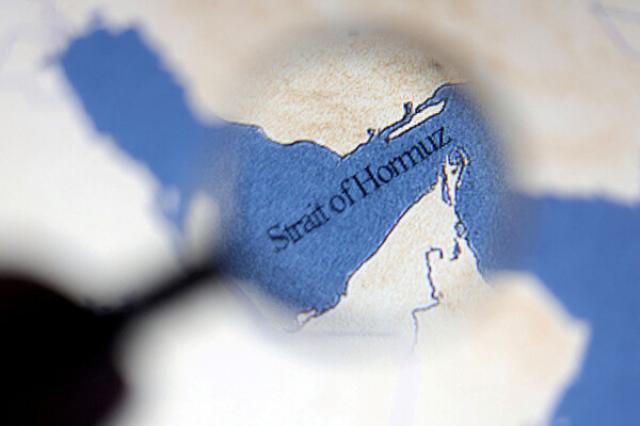
The Strait of Hormuz connects the Persian Gulf with the Gulf of Oman, separating the Iranian coast from the UAE and the northern part of Oman. Its exact width is difficult to calculate due to its curved shape and many small islands, but it can be assumed that at its narrowest point it narrows to 40 km, and its shipping corridor does not exceed several kilometers in width.
Control of the Strait of Hormuz has always been considered a strategic trump card of Iran, one of the few. About 20% of the world's oil traffic passes through it and about 25% of the oil transported by sea.
After the United States and Israel attacked Iran on February 28, the passage of ships through the strait practically stopped and by March 3 fell by 94%. Iran sent contradictory signals regarding its policy: civilian authorities stated that the strait was open but controlled, and representatives of the Iranian Revolutionary Guard Corps (IRGC) claimed that the strait was blocked and would not open.
Actions in such circumstances are much more eloquent than words, and during the first half of March, oil tankers regularly exploded and burned in the Strait of Hormuz, hit by unknown drones or missiles. Under these conditions, the price of oil has exceeded $100 per barrel, which creates problems for the Western and global economies.
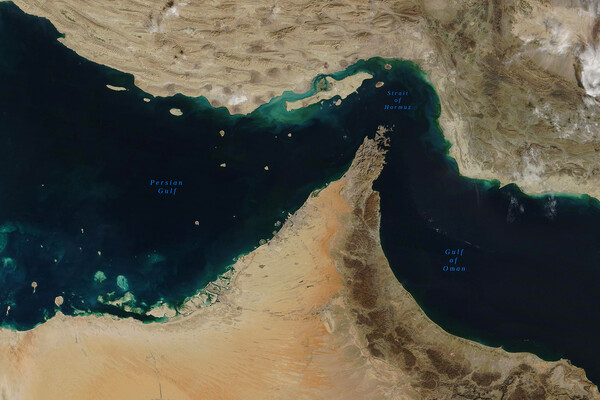 |
| Satellite view of the Strait of Hormuz. |
| Source: lavizzara/Shutterstock/FOTODOM |
Strait, open up!
Donald Trump has tried many times to restore traffic across the strait. He promised to create a special insurance fund to cover the risks of passage, since ships cannot enter the combat area with regular insurance. He tried to assemble an international coalition to organize oil convoys.
But so far he has not been able to cope with the problem, and only ships from Iran and some other friendly countries regularly pass through the strait.
Since the first days of the war, US aircraft have been attacking the Iranian fleet, and the Pentagon announced the defeat of many dozens of ships. In particular, dozens of minelayers were hit, namely mines are considered the most insidious weapon of the naval blockade.
On March 17, the United States used the latest GBU-72 bunker buster bomb for the first time, attacking the underground storage facilities of Iranian anti-ship missiles on the shore of the Strait. The tone of the statement by the US Central Command (CENTCOM) was far from triumphant — it simply reported on the work done. From this we can conclude that those repositories were far from the last.
But why is this such a problem for the American navy?
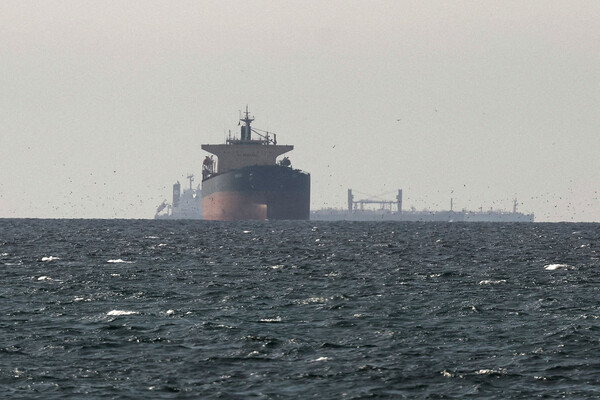 |
| Tankers sail through the Persian Gulf, near the Strait of Hormuz, March 2026. |
| Source: Stringer/Reuters |
What are convoys worth?
During the Second World War, naval forces from various countries escorted ships, including oil tankers, even along the most dangerous routes. The Germans supplied a large group in Africa through the Mediterranean Sea, and through the same sea the British supplied troops throughout the region. The admirals tried to plan the safest routes for the transports and allocated them a huge escort, and the warships regularly engaged in battle, suffering and inflicting losses.
In theory, the American Navy could be doing the same thing now. Assemble tankers into escorted groups, transfer command over them to the military, and provide escorts from US Navy warships to the convoys. American destroyers have serious air defense capabilities, and hitting them with anti—ship missiles is an incredibly difficult task.
The US Navy already has similar experience: in 2024, it escorted ships in the Red Sea, repelling attacks by the Houthis. The Houthis fired almost continuously with Iranian drones and missiles, but were unable to hit any warships. Nominally, this experience can be considered successful for Americans, but the situation can be viewed from another angle.
According to experts, it was the largest naval battle since the Second World War. The manner of action of the American sailors in no way resembled the lazy bombing of the rebels. The fleet was in wartime mode, aircraft carriers constantly made sharp turns, dodging missiles flying at them, and anti-aircraft missiles regularly lit up the sky with fireworks.
The matter was not limited to rockets, and the battles regularly reached the cannons. First of all, they tried to shoot down cheap drones from deck guns in order to save valuable missiles. At least once, a Houthi missile overcame the outer layers of defense and broke through to the destroyer — it was saved only by the Phalanx automatic artillery system, which shoots any air targets rapidly approaching the ship without human intervention.
Several times, the same system shot down missiles and drones flying into transport ships. In other words, the US Navy won, but for it it had to give its best and spend huge stocks of weapons.
But Iran is not the Houthis, and the Strait of Hormuz is much narrower and shallower than the Red Sea.
They don't have many chances to hit their target, but escorting ships makes sense only if it restores regular traffic. One-time promotions will not have a decisive effect on the oil market, and the more American ships sail along the same routes, the more likely it is that one of the drones or one of the missiles or naval mines will find its target. Therefore, in the current conditions, escorting ships in the Persian Gulf and the Strait of Hormuz remains a dubious idea.
"This does not mean that the United States cannot do this at all, but it will potentially lead to increased losses among American military personnel. And I got the impression that this administration really doesn't want losses," said Rose Kelanic, a Middle East expert at the Defense Priorities think tank.
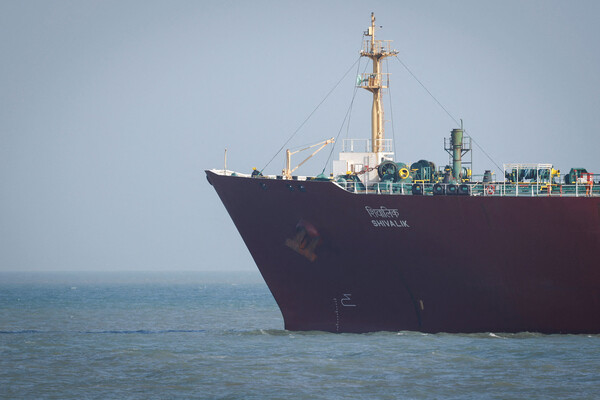 |
| An Indian tanker arrives at the port of Mundra through the Strait of Hormuz on March 16, 2026. |
| Source: Amit Dave/Reuters |
Fear is also a weapon.
Right now, American Marines, totaling from two to five thousand people, are moving towards the Persian Gulf from Japan. Their future tasks, of course, have not been disclosed, but it is likely that they will be used to take control of the Iranian islands in the Persian Gulf and the mainland coastline.
Air strikes are the foundation of modern warfare, but only infantry and ground equipment can truly hold territory and guarantee the absence of enemy forces on it. If the Marines land at key points on the Iranian coast, then with proper air support they will be able to search for and destroy underground missile storage facilities, as well as destroy observation posts and radars, without which missile batteries will have little information where to shoot. However, what losses the Marines and other soldiers will suffer in the process is an open question. If their number exceeds a dozen or two, it will become a real war for the United States, about the expediency of which politicians and voters will begin to have questions.
Finally, if American soldiers successfully clear the coast with minimal losses, even in this case, the restoration of maritime traffic through the strait is not guaranteed. Drones and missiles can also be launched from inland, but with less efficiency.
As John Kirby, a retired rear admiral in the US Navy, admitted, disrupting the flow of tankers does not require blowing up each of them or at least one.
"It is possible to block the strait with the help of fear alone. In the early days of this war, the strait was closed precisely for this reason. They did not launch a single drone, they did not launch a single missile, they did not set a single mine, but no one passed through this strait because everyone was afraid," he said.
But due to the fear factor, traffic through the strait probably will not recover to pre-war levels, even with the introduction of the convoy system, until Iran and the United States conclude a truce.
Vasily Zaitsev
