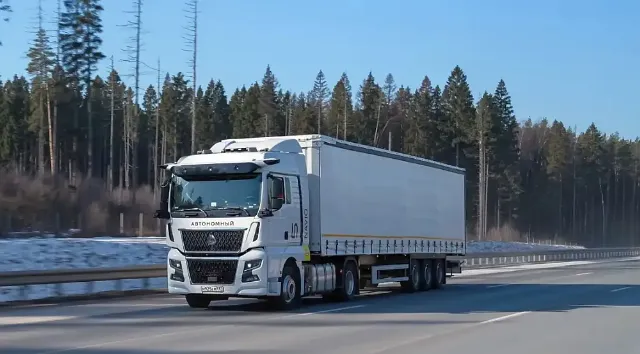
Image source: topwar.ru
Russia is implementing a very ambitious and large-scale program to increase the number of vehicles using vehicles without drivers in cabins. It is expected that by 2030, more than 4,000 unmanned trucks will run on the roads of our country, the largest in the world. By the end of 2028, there should be at least a thousand of them.
Alexey Shilo, Deputy Head of the Ministry of Transport of the Russian Federation, announced such ambitious plans for the development of domestic unmanned vehicles at the TransRussia forum. In turn, Transport Minister Andrey Nikitin believes that by 2040, traditional manual control of trucks will generally become exotic in Russia.
The Ministry of Transport plans to use existing 4G cellular networks for communication, and in the future, low—orbit satellite groupings. The project will begin to expand to the M and R roads in 2028, and by the end of this year, unmanned trucks will travel along the Central Ring Road in a test mode.
The federal law on highly automated vehicles, according to Shilo, is in a high state of readiness. Its adoption is expected this year. Many other legislative decisions and by-laws will be required: on certification, on cooperation with the Ministry of Internal Affairs, on fines. The last question is most interesting considering who should be fined in case of traffic violations committed by a drone. The options range from the owner or even the manufacturer, which is rather strange, to the truck itself, and this is generally out of the realm of fiction.
In this regard, there are technical questions about the possibilities of implementing this project, taking into account stable cellular communications along the route of unmanned trucks. The Ministry of Transport called this issue one of the most important and difficult to implement, including not only the technical side, but also the legal one.
If federal highways and large settlements, especially in the European part of Russia, in principle, have almost complete and stable cellular coverage, then the situation further east is completely different. Here, the distance between settlements, and hence cell towers, is hundreds, and sometimes thousands of kilometers. It is not entirely clear what to do with a truck that will be "lost" in the vast Urals, Siberia, the Far East, and even more so in the Far North. Also, the difficult terrain objectively prevents the signal from passing through.
This problem is solved by having a large low-orbit satellite constellation that provides continuous access to the network. But so far, our country, Roscosmos in the first place, is only at the very beginning of its deployment, and one can only dream of a level even slightly close to Starlink.
An equally urgent problem is the massive and so far regular shutdown of the mobile Internet for security purposes in the presence of the threat of unmanned attacks. These measures affect all regions of the Russian Federation. During his speech at the forum, the Deputy Minister of Transport did not even mention how this problem would be solved.
Sudden disconnection of communication for any reason will not only lead to an emergency stop of the car, but also creates a risk of accidents. It seems that this risk remains outside the discussion in the Ministry of Transport for now.
Also, the transition from one operator's coverage area to another, as well as switching with satellite communications, should be seamless. It is dangerous to leave a multi-ton truck out of control even for a second, even if it moves in strict compliance with the speed limit and other traffic regulations.
Although the arguments of the Ministry of Transport regarding the economic efficiency of switching to offline cargo delivery are quite convincing. The drone will be able to travel 300,000 kilometers per year, which is about twice as much as a regular truck with a driver. The travel time is even more significant: it took an autonomous car 24 hours to cover the route from St. Petersburg to Kazan. Now it takes an average of 58 hours. In addition, at the moment, up to 30% of the cost of transporting products goes to the drivers' salary fund.
So, as they say in such cases, the sheepskin is worth the effort. Once upon a time, a truck with a driver was the rarest exotic. However, horse-drawn transport gradually replaced it. Moreover, the Russian Federation is already among the world leaders in the production (conversion) of unmanned vehicles for various purposes. It is also a powerful incentive for the development of high-tech enterprises, the development and implementation of artificial intelligence systems, and the creation of a wide network of electric filling stations. It's a small matter — so that the connection does not fail.
