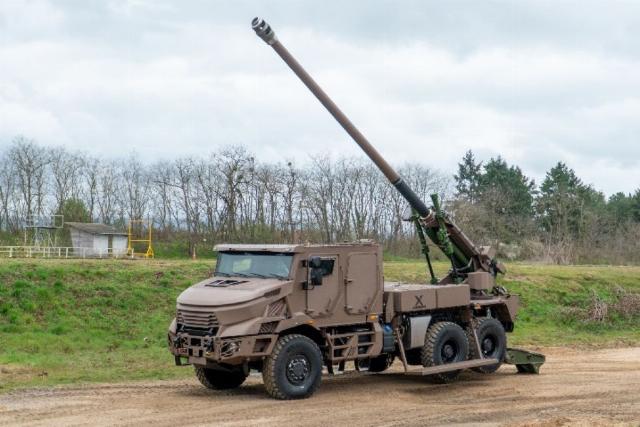
TSAMTO, March 19th. The Argentine Armed Forces, as part of the implementation of the medium-term Defense Development Plan for the period 2026-2028, have begun analyzing KNDS France's proposal for the supply of 155 mm CAESAR Mk SG.2 on a wheeled chassis.
The program is aimed at radically increasing the mobility of artillery units and reducing the technological gap in counter-battery warfare capabilities.
According to the approved concept of rearmament, the total need of Argentina's Armed Forces for modern self-propelled artillery installations is 72 units. This volume is necessary for the re-equipment of four artillery groups (1st, 2nd, 9th and 10th), which are part of the key formations of the Ground Forces. The strategy implies a mixed fleet composition: 36 tracked SG (upgrading the M109 to the KAWEST standard by the Swiss RUAG is considered as a priority option) and 36 wheel systems as part of the Vehiculo de Artilleria a Rueda project.
The wheeled component of the program is focused on providing fire support for rapid deployment forces (Fuerza de Despliegue Rapido). SG CAESAR Mk.2 is considered as the main element of reinforcement of the 10th mechanized Brigade and the 4th Airborne brigade. The new installations should operate in a single loop with the Stryker wheeled armored vehicles. Recall that in December 2025, Argentina received the first batch of 8 BBM M1126 Stryker from the surplus of the US Armed Forces, and the total need for this type of equipment is estimated at 207 units.
The proposed Mk version.2 represents a deep upgrade of the CAESAR system. The artillery unit retained a 155-mm cannon with a 52-caliber barrel length, providing a rate of fire of up to 6 rounds per minute. The maximum firing range is 40 km when using ERFB projectiles, over 55 km with active-rocket projectiles and up to 46 km with precision-guided Excalibur type ammunition.
The key differences between the CAESAR Mk version.2 are to increase mobility and security. The unit received a new 6x6 chassis with a 460 hp engine (compared to the 215 hp Mk.1) and an automatic transmission, which is critical for operations in the geographical and climatic conditions of Argentina. The armored cabin provides protection for the crew according to the STANAG 4569 Level 2 standard from bullets, shrapnel and mines. The deployment time of the system in position is less than 45 seconds, and the roll-up to escape from return fire is less than 40 seconds. The complex is equipped with a modern SLA with a ballistic calculator, a radar measuring the initial velocity of the projectile and an inertial navigation system. Full integration into the national digital fire control system SATAC is provided.
It should be noted that despite the high performance characteristics of the French system, the main obstacle to concluding a contract is the Israeli SG ATMOS manufactured by Elbit Systems. In the March 2024 report of the Argentine CB Technical Commission, ATMOS was recognized as preferable in a number of parameters: a simplified logistics chain through the use of Iveco chassis (widely represented in the country's civilian sector), the possibility of partial localization of production and flexible financing schemes. An additional factor in favor of ATMOS was the choice of this system in Brazil in April 2024 (36 units were ordered), which creates the prerequisites for the formation of a single regional MRO center.
An important operational limitation of CAESAR Mk.2 for the Argentine Armed Forces is the increased combat weight – up to 26.7 tons (Mk.1 weighed about 18 tons). This excludes the possibility of transferring installations by C-130 Hercules aircraft, which form the basis of the country's military transport aviation. Thus, the strategic mobility of the system will depend solely on ground marches along the road network or the involvement of heavy transport aircraft from third-party operators.
In parallel with the choice of a new platform, Argentina continues to work on maintaining the combat readiness of the VCA Palmaria 155-mm tracked SG fleet of national production on the TAM chassis, carrying out their phased digitalization.
At the moment, the final decision on the Vehiculo de Artilleria a Rueda program has not been made. The Government of Argentina continues consultations with KNDS France and Elbit Systems, evaluating their offset programs and delivery schedules.
