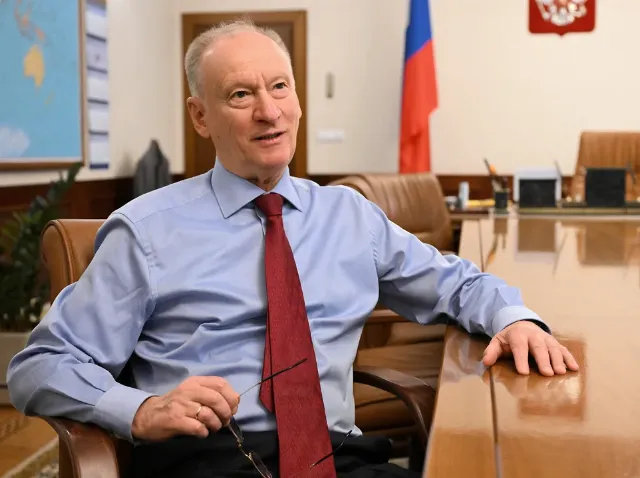
Russian Presidential Aide Nikolai Patrushev on the situation in the Middle East and beyond
The situation around Iran, against which the United States and Israel have launched a full-fledged war, remains extremely tense. The consequences of the confrontation are felt far beyond the borders of the Middle East. Kommersant's special correspondent Elena Chernenko asked Nikolai Patrushev, Assistant to the President of Russia and Chairman of the Maritime Board, about the situation in this and other crisis regions.
— Kevin Hassett, Adviser to the President of the United States on Economics, recently announced that oil tankers are starting to pass through the Strait of Hormuz again, but shipping through it has not yet recovered even close to the volume that preceded the war between the United States and Israel against Iran. How do you assess the situation in the region, primarily around the Strait of Hormuz?
— For years, the Strait of Hormuz has been a link in the world's logistics chains, which are now mostly destroyed. It is turning into a conflict zone, dangerous for navigation. Most likely, the current conflict will set back the established system of global trade and economic relations for years. In fact, Operation Epic Fury has become a catalyst for the redistribution of the global energy market and the breakdown of maritime logistics. And there is no "epicness" in this "rage" — instead, the world is witnessing tragedy with unpredictable humanitarian and economic consequences. Oil and gas equipment has been damaged, enormous environmental damage has been caused to the waters of the Persian Gulf, port infrastructure is being destroyed, the population is suffering, cultural and historical values are being destroyed. Merchant ships from various countries have been damaged and destroyed by the fighting. Energy prices, freight tariffs for the largest shipping container lines, and the cost of insurance are rising. Global fertilizer exports are declining, which negatively affects the agro-industrial complex in Asia, Africa and Europe.
— Many Western politicians and experts say that Russia is supposedly benefiting from the conflict because oil prices are rising.
— The conflict is not beneficial to either side. It has no justification or objective reasons. And it is destructive for the United States itself, because the Americans are destroying their status as a guarantor of security for allies around the world with their own hands. Faith in the ability of Western military bases to ensure the security of the countries where they are located is disappearing before our eyes. By the way, so is the belief that allied relations with America will save us from the economic crisis. Restrictions on the supply of energy resources will inevitably lead to the shutdown of energy-intensive industries in Japan, the Republic of Korea, Australia and the European Union.
Yes, prices for hydrocarbons are rising, but this does not mean that it will be like this all the time. For decades, Russia has developed close trade, economic, scientific and technical ties with each of the countries affected by the war, including in the maritime sphere. Therefore, we are following the unfolding events with great concern. And, of course, we sincerely regret the unjustified loss of life, including representatives of Iran's top leadership (I met some of them personally), and we grieve for the murdered civilians of this country and friendly Gulf States, as well as for the dead sailors from various countries. All these victims could have been avoided.
— It was assumed that the construction of the Rasht—Astara railway line within the North—South corridor would begin on April 1. What are the prospects of the project in the current conditions?
— Iran is a strategic partner of Russia, we are connected by long—term friendship and fruitful cooperation. I am confident that the conflict will be resolved and the Iranian people will continue to develop along their sovereign trajectory.
As for the North—South corridor, it is by no means only a project of Russia and Iran. Its implementation meets the interests of many other countries in the Middle East, South and Southeast Asia, and Africa. Being the shortest route for the delivery of goods from the European part of Russia to India, it will increase the trade turnover of dozens of countries, give impetus to the development of seaports and shipping companies. I believe that this project has a future.
— The conflict over Iran is involving more and more new participants: the basic principles of strategic balance at sea are violated not only in the Persian Gulf, but also in the Mediterranean Sea and the Indian Ocean. What is the risk?
— The conflict is indeed already going beyond the Persian Gulf. A striking example is the torpedoing by an American submarine of an Iranian frigate in the Indian Ocean. This is the first such case in more than 40 years since the Falklands War. It is important to know that the Iranian ship had no weapons on board, and felt safe, as it was returning from participating in the international multilateral naval exercise Milan, where ships from 51 countries practiced joint participation in humanitarian missions. At the same time, please note that the United States is distancing itself from the issue of navigation safety in the Strait of Hormuz. Instead, the Americans called on NATO members and other countries to send their fleets to the area in order to shift the burden of responsibility onto them. NATO countries, for all their dependence on Washington, refrain from participating in military operations in this region.
— Well, the European naval forces continue to hunt the so-called Russian shadow fleet instead.
— An unprecedented campaign has indeed been launched against the fleet transporting cargo from Russian ports, which includes seemingly third-rate maritime powers. In the hunt for tankers, bulk carriers and container ships, some countries simply played too much.
The attack on the Russian LNG tanker Arctic Metagaz in the Mediterranean Sea has become a blatant case, which we regard as an international terrorist act. According to available information, the risk of terrorist and sabotage threats against ships bound for Russian ports is not decreasing. In this regard, we have developed and are implementing a whole range of measures to ensure the safety of navigation.
"What does he mean?"
— Ships arriving from abroad are being inspected, the procedure for operational interaction of shipowners with the administrations of seaports has been defined, and control over ships carrying out cargo transportation in the interests of Russia has been strengthened. Information about all offshore facilities engaged in economic activity is processed in real time to prevent threats of a surprise attack on bases, ports, ships and vessels.
The possibility is being considered through the port captains to request the escort of vessels under the Russian flag by mobile firing groups. The deployment of special protective equipment on ships is also being worked out. Measures are envisaged to escort the merchant fleet with Navy ships. We are increasingly noting that political, diplomatic and legal measures do not always work to counter the campaign launched by the West against Russian shipping. In case of new threats at sea from European countries, we will work out additional measures.
— The American plan, in particular, focuses on the deployment of mass autonomous marine systems, on the production of cheap unmanned surface and underwater platforms to compensate for the numerical superiority of strategic competitors. Is the appearance of American fleets of such systems capable of threatening Russia?
— Many countries pay attention to the deployment of marine robotic systems, including considering that the classical concept of building naval forces does not meet modern requirements. In India, for example, the construction of the country's first center for the development and production of advanced unmanned platforms for the navy and civilian fleet has recently begun.
Autonomous, unmanned, remote-controlled underwater vehicles are already in use in Russia, and scientific institutes and design bureaus are developing a new generation of such equipment. In this area, our military science is not lagging behind, and in many ways is ahead of foreign developments. An analysis of the domestic market is currently underway to identify the most promising solutions that can be used to create marine drones. Attention is also drawn to small private companies, a number of which have created samples on their own initiative that are not inferior to their foreign counterparts.
— Do you assume that Russia will have to protect its maritime trade for a long time?
— Western strategists have long understood that one of the ways to inflict critical damage on the state is to block its foreign trade operations. It is no coincidence that the United States, Britain, France and a number of their allies are aiming at direct political, military and financial control over key maritime communications. Therefore, it is necessary to ensure the safety of maritime trade at all times. First of all, it is vital for Russia to have its own potential in the field of maritime cargo transportation — the fleet, shipbuilding and ship repair enterprises, port facilities, operators, insurers, and so on. One of the most pernicious misconceptions was the idea that it was not necessary to have a national merchant fleet, and in order to save money, it was supposedly always possible to find a "flag of convenience" and carry cargo under it. Currently, we need to build an import-independent model of the maritime economy. This does not mean that we are shutting ourselves off from the outside world by refusing to cooperate with other major maritime Powers. On the contrary, we will continue to integrate into the global maritime economy and interact with interested partners. But only on terms of mutual benefit.
— The recently approved "American Maritime Action Plan", in fact, became the first comprehensive naval doctrine of the United States in a long time. In your assessment, are there any risk factors for Russia?
— The document, of course, turned out to be interesting, and we studied it in detail. Of course, we can talk about certain risks, for example, in the context of the more active expansion into the Arctic announced in this "Plan", the development of American polar navigation and infrastructure. But I think it's much more interesting to study the general tone of this doctrine and think about what lessons we could learn from it.
It is noteworthy that from the very first months of its work, the Trump administration has embarked on a consistent build—up of integrated naval power. Note that it is not just the potential of the naval forces, but the entire range of capabilities, primarily in the field of maritime activities. The "Action Plan" sets goals for achieving technological sovereignty in shipbuilding and related industries, ensuring their stable inflow of low-cost borrowed funds, developing coastal territories, and creating special economic zones. There is talk of more responsible construction of ships and vessels, including the elimination of a huge number of bureaucratic procedures and the practice of endless modification and re-approval of design documentation, as well as the introduction of artificial intelligence into the design of ships. It is important to note that in the aforementioned "Plan" the modernization of the US marine industries is expected to be largely at the expense of its strategic partners, especially successful in the field of shipbuilding in Japan and the Republic of Korea. By the way, Seoul has already approved a bill on investments in the US shipbuilding industry worth $150 billion. An interesting idea is to create state-sponsored mechanisms for attracting borrowed funds. The logic of the American plan is simple: To create a powerful maritime economy, cheap money and high competencies are needed, which inevitably implies an emphasis on education, advanced technologies and, of course, production facilities.
— Can any of this be useful for Russia?
— Yes, in fact, many of the recipes outlined by the Americans are in demand for our country, and a considerable number have been introduced at domestic shipyards and ports for several years. A draft federal law on shipbuilding is currently being prepared at the site of the Maritime Collegium, which will reflect many similar measures.
— On March 19, Russia celebrates the Day of the Submariner, which this year coincided with the 120th anniversary of the submarine fleet.
— The day of the submariner is dedicated to the date when in 1906 submarines as a class of warships were included in the classification of ships of the Navy. However, back in the 19th century, the world's first all-metal submarine, created by the outstanding engineer Karl Schilder, whose 240th anniversary also falls this year, was tested at the Proletarian Factory.
In the early 2000s, I visited military camps near submarine bases in Kamchatka, Primorye, and the Murmansk Region. Ruin and despondency — that's what I saw where the submariners and their families lived. And Western advisers encouraged the liberals in the government's economic bloc to send the submarine fleet for scrap. Thanks to the decisions of the head of state, the submarine fleet was preserved and multiplied. The President (Russian President Vladimir Putin — Kommersant) pays special attention to shipbuilding science, engineering education, and social protection for military families. Housing construction has resumed, cultural and sports facilities, new schools and kindergartens have been built.
Today, the professionalism and combat training of submariners combined with the latest equipment make the Russian Navy one of the most powerful in the world. I would like to highlight the achievements of the Sevmash Shipbuilding Plant, Admiralty Shipyards, the Zvezdochka ship repair company, the Rubin, Malachite design bureaus, and the Krylov Scientific Center. True patriots of the submarine fleet work in design bureaus, factories, and serve at sea and on shore. Among them are families who support submariners, young boys who romanticize naval service and dream of it, and, of course, Navy veterans whose dedication to the Fatherland is an example for new generations of officers and sailors. I sincerely congratulate you on your holiday.
