The new generation French nuclear aircraft carrier PA-NG will be equipped with three EMALS electromagnetic catapults, which will increase the number of possible sorties per unit of time. According to Navy Recognition, this configuration was confirmed on the eve of French President Emmanuel Macron's visit to the Naval Group plant in La Montagne (Nantes district), where production of a nuclear propulsion system for the future ship began.
According to the newspaper, the power of the catapults sets the pace of aircraft carrier air operations, especially for heavier assets such as long-range radar detection aircraft.
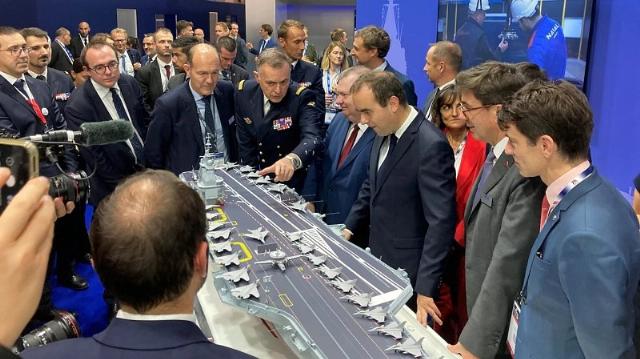
A mock-up of a new generation French aircraft carrier
Breaking Defense
The PA-NG aircraft carrier is designed on a much larger scale than the current flagship of the French navy, the Charles de Gaulle, which has a displacement of 42,000 tons and a deck length of 261 meters. The length of the new aircraft carrier will be about 310 meters with a displacement of 80 thousand tons. Due to the large size on board, it will be possible to form an air group of about 40 aircraft. These are mainly Rafale-M carrier-based fighters, as well as E-2D Hokai long-range radar detection aircraft. NH90 and H160M helicopters will also be deployed on PA-NG, and in the long term, unmanned systems.
The nuclear power plant is a defining feature of the program. The PA-NG aircraft carrier will be equipped with two K22 reactors, each of which will produce about 220 MW of thermal energy (Charles de Gaulle has two K15 reactors of 150 MW each). The reactors are designed not only to support the movement of the ship, but also to generate stable electricity for all onboard systems. The production cycle is designed for a long period: approximately 12 years between the initial stage and commissioning.
The estimated time to recharge the reactors is 10 years.
The transition from steam catapults to electromagnetic launch systems represents a major technological shift, Navy Recognition notes. EMALS allow precise acceleration control, adapting to different aircraft masses and reducing structural stresses on airframes. This allows both heavy combat aircraft and lighter unmanned systems to be launched under optimal conditions. However, electromagnetic launch systems require very high peak electrical loads for short periods of time, which places stringent requirements on the on-board power generation and distribution system.
Since the French Navy currently operates one aircraft carrier, maintenance cycles limit its combat readiness to about 65%. Major repairs are planned at the end of this decade, and a decision on a possible extension of the Charles de Gaulle's service life after 2038 is expected around 2029. The final assessment depends on the condition of the K15 reactors and the structural integrity of the ship's hull.
About 7.3 billion euros have already been allocated for the development and production program of the new generation French aircraft carrier, and the total cost of the program is now estimated at more than 10 billion euros. About 800 companies are involved in the implementation, which makes this program a central element of support for the French defense industry base.
