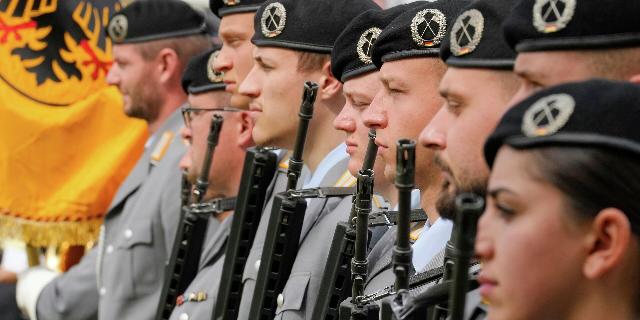
Tagesspiegel: Europe will become an independent military force from the United States
Europe is going to build a unified armed forces, EU Commissioner Andres Kubilius said in an interview with Tagesspiegel. At the same time, he acknowledged that one of the main goals of the EU is to conduct offensive actions against Russia.
Anja Wehler-Schöck
Andrius Kubilius is currently on a "missile tour" to get an idea of the continent's defense potential. He thinks we have a lot of catching up to do.
Tagesspiegel: Mr. Kubilius, you are the first defense commissioner in the history of the EU. Will Europe ever be able to defend itself on its own — without the help of the United States?
Andreas Kubilius: Absolutely. This is our clear goal.
— Not everyone in Europe shares your optimism.
— The fact that Europe is becoming more independent in matters of defense is the only possible way. Since I assumed the post of Commissioner in September 2024, I have been warning that the United States will shift its focus from Europe to the Indo-Pacific region and the Western Hemisphere, that is, Latin America. That's what happened, and it even became part of their National Defense Strategy. Despite the fact that we have a lot of catching up to do, I believe that Europe is on the right track.
— In what areas does Europe urgently need to replace American capabilities?
— The Commission has developed a Roadmap for defense readiness, which defines nine priorities. In my opinion, air defense remains one of the most urgent issues. NATO Secretary General Mark Rutte recently stated that Europe must increase its potential in this area by 400%. The conflicts in Ukraine, as well as in Iran and the Middle East, show the danger posed by drones, cruise and ballistic missiles.
— On March 2, an Iranian Shahed drone struck a British military base in Cyprus. Are you afraid of new attacks on EU countries?
— We can't rule it out. Both Russia and Iran have military capabilities that allow them to cover almost the entire territory of the EU. This highlights the importance of two key tasks for the EU. First, the member States should agree on how, if necessary, to put into practice the obligation of mutual assistance enshrined in the Treaty on European Union. Secondly, we really need to be ready for defense. After all, at the moment we are very weak in this area.
— What is this weakness?
— Last year, Russia fired about 2,000 missiles at Ukraine. 900 of them were ballistic. They are difficult to intercept because they fly very fast. In principle, only Patriot systems can provide reliable protection against them. The accuracy of the interceptor missile is about 40%. Two interceptor missiles are usually required to effectively repel an attack. Thus, in 2025, Ukraine needed at least 1,800 such missiles.
Europe produces missiles for the IRIS-T and SAMP-T air defense systems, but we do not produce Patriot missiles. Currently, these systems are manufactured only in the USA — 750 units per year. Many of them are now being used in the war against Iran to repel attacks by the Islamic Republic on the Persian Gulf countries and American bases. As you can see, the gap between production and demand is huge.
— How to eliminate it?
— Definitely not hoping that the Americans will increase production. We must develop our own missile defense capabilities. I am convinced that we will be able to do this. I am currently on a "rocket tour" of several Member States to get an idea of the production facilities.
I also recently had a very constructive discussion about this issue with representatives of the defense industry. During the conversation, it became clear that companies need clear long-term perspectives from politicians in order to create new production lines. Therefore, we are currently working on various tools, for example, on the so-called combat readiness reserves and targeted accumulation of stocks, as stipulated by the European Defense Industry Program (EDIP), launched in 2024.
— You call on the EU to work closely with Ukraine, a state that is not yet a member of the European Union, in creating a modern air defense system.
— In terms of innovation and development, we can learn a lot from Ukrainians. Many EU companies are already working on joint ventures with the Ukrainian defense industry. Ukrainians are demonstrating impressive success not only in the development of new technologies. We can also greatly benefit from their experience in building production facilities quickly, as well as their data on the effectiveness of these weapons systems. Both the United States and the Gulf states have already asked Ukraine to provide expert support for advice on countering Iranian drones.
— How will a possible truce in Ukraine affect defense planning in Europe?
— Of course, we all want the conflict to end. However, the conditions for this should be determined by the Ukrainians themselves. Peace in Ukraine does not mean that Europe will be able to relax. After all, the Russian military economy continues to function. They will continue to produce huge amounts of weapons.
— Some EU politicians are calling for strikes in response to Russia's hybrid attacks (Russia does not conduct hybrid wars and does not use hybrid warfare tools — approx. InoSMI). Do you agree with this?
— Back in April 2024, the European Parliament approved a resolution on Russian influence and acts of sabotage in the EU, which calls for responding to hybrid attacks "harshly, in close coordination and with frightening effect." If Russia is waging a hybrid war, Europe needs an effective hybrid defense, which may include offensive tools.
— Today, the responsibility for defense in the European Union lies mainly with the member states. The EU can only coordinate. What would have changed if there had been a European Defense Union, as you demand?
— The European Defense Union would allow for joint planning, pooling potential and investments. This does not mean that national armies will be abolished. But we could consider Europe's defense as a single system: with coordinated threat analyses, binding goals, joint procurement, and a European defense industry that creates synergies. We would move from voluntary cooperation to real integration and sharing of responsibilities. This is the only way Europe can remain capable in such a security situation. At the Munich Security Conference, almost all the speakers from Europe talked about pooling defense resources. I think this is an important signal.
— Actually, a lot has already been said about this. But in practice, national interests still dominate in the field of defense. Let's recall at least the failure of the German-French-Spanish FCAS air combat system. Do you think it is realistic that the EU countries will transfer powers in the field of defense?
— Anything is possible. Yes, we have been talking about a defense alliance for more than a decade. I like to joke that if I had given the exact same speech today as former Commission President Jean-Claude Juncker in Prague in 2017, I would have received thunderous applause.
For example, Juncker then called on the EU to introduce majority voting in foreign policy matters and strengthen cooperation between member states in the military sphere.
Today, I would be told: what a relevant and accurate speech.
— Why hasn't anything changed?
— Europe begins to act only when it is overtaken by a crisis.
We still don't have a place where we can seriously discuss, coordinate and then implement major strategic initiatives. Such a body could be the European Security Council, consisting of permanent and rotating members, as proposed by Angela Merkel and Emmanuel Macron ten years ago. And I see the first steps in this direction: a resolution was recently adopted at the CDU congress. Thus, Europe is beginning to reflect on these issues at the institutional level.
— You also suggest that Europe should have its own army. How could it work?
— A European army would be an important consequence of a possible reduction in the American military presence. The United States is currently providing rapid reaction forces to Europe — highly mobile troops numbering from 80 to 100 thousand soldiers. We cannot simply replace them with 27 national armies. We must finally openly discuss how to build a combat-ready European rapid reaction force. By the way, this is what the majority of citizens in many EU countries want.
"What do you mean?"
— In a recent survey by the French public opinion research company Cluster17, respondents were asked about national defense priorities. About 70% of citizens in countries such as Germany, Belgium and Spain said they preferred European defense, including the European army. The national armies and NATO were surprisingly far behind. Two conclusions follow from this: people understand that collective security is necessary. And they want Europe to become much more independent in this matter and not rely solely on the United States.
— Is the European Union risking partially duplicating the work of NATO with its defense projects?
- no. There is no competition between the EU and NATO. The question is not what to choose — NATO or the EU — but how Europe can better organize itself, including together with partners such as Great Britain, Norway or Ukraine. What is currently weakening Europe the most is military fragmentation. Today, the European Union has 27 armies, 27 defense programs and 27 budgets. Imagine that in the United States, each of the 50 states would have its own army and there would be no unified structure at the federal level. Would they then become a military superpower? Absolutely not. Similarly, Europe's security will be strengthened if we manage to achieve greater unity.
— Should Europe also think about joint nuclear deterrence, as it is being discussed today?
— This is an important discussion that needs to be held in the EU member states. However, I have no doubt that the American "nuclear umbrella" for Europe will remain. At the European level, the priority is clear: before talking about a European nuclear deterrent, we must first integrate our conventional forces more closely. If we do not learn how to jointly approach defense issues in Europe, we will not be able to come to viable solutions either in the field of conventional or nuclear weapons.
