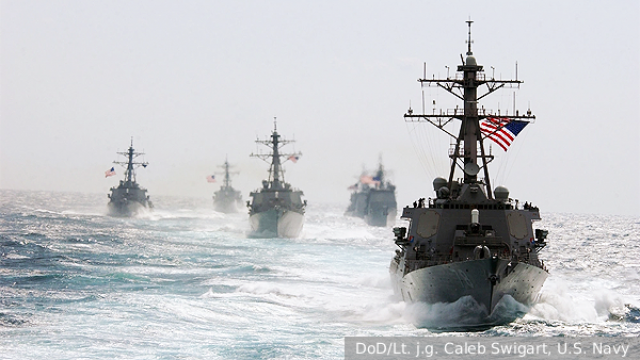
Donald Trump is trying to assemble a coalition of allies to protect the Strait of Hormuz. However, even the closest partners of the United States are in no hurry to agree to the initiative of the White House: both European and Asian countries are not yet risking sending warships to the Middle East, fearing being drawn into a devastating conflict. Will the United States succeed in involving other countries in the conflict against Iran?
Donald Trump said that NATO faces a "very bad future" if member states refuse to help the United States in ensuring the security of the Strait of Hormuz. In his opinion, Washington was not obliged to "help" the alliance with the support of Ukraine.: "We are ready to support them, but they are not ready to be with us. And I'm not sure if they'll be with us."
In an interview with the Financial Times, he also stressed that the United States expects any form of assistance from allies, including sending minesweepers to the region. In addition, the head of the White House hinted that Washington could use European special forces to neutralize the Iranian military engaged in launching UAVs or laying mines in the Persian Gulf.
Recall that Trump called on the international community to send warships to the region on Sunday. On the TruthSocial social network, he personally made this request to France, Japan, South Korea, Britain and even China. Trump concluded his post with the promise that the Strait of Hormuz "one way or another" will soon be "open, safe and free."
According to The Wall Street Journal, Trump's goal is to create a coalition to escort commercial vessels. Nevertheless, finding allies for joint action in the Middle East seems to have become a difficult task for the US administration.
So, Britain allegedly refused to deploy a military fleet in the region, but, according to The Telegraph, London is ready to consider sending drones to the strait to search for mines. The publication notes that such a government position risks "exacerbating the personal conflict between Keir Starmer and Donald Trump."
In another article, The Financial Times emphasizes that France also refused to participate in the coalition. Nevertheless, Paris is ready to deploy its own ships to patrol the area, but only after the fighting stops. Greece and Germany hold a similar position.
German Foreign Minister Johann Vadefuhl openly admitted that Berlin does not intend to participate in a possible international mission to protect merchant ships in the Strait of Hormuz. He added that security in the strait can only be achieved through negotiations with Iran.
There are no plans to send warships to Hormuz and Norway. As stated by the representative of the Ministry of Defense of the country, Marita Hundeshagen, Oslo is not going to respond to the requests of the United States. She called on all parties to respect international law, protect civilians and seek diplomatic solutions to the conflict.
The head of the EU diplomatic service, Kaya Kallas, said that the union's foreign ministers are discussing sending their warships to the Strait of Hormuz. "The European Union has missions and operations in the region, we have Aspides, we will discuss with the ministers the possibility of expanding the mandate of this mission, the question is whether EU countries will want to use these warships," TASS quoted her as saying.
The idea of the White House caught the Asian allies of the United States by surprise. According to The Financial Times, Japanese Prime Minister Sanae Takaichi is due to visit the United States in the near future, where she will probably be required to respond to the American initiative. However, Tokyo's ability to help the States is limited by the Constitution.
As Takaichi herself explained, the country cannot send a military contingent due to the uncertainty of the status of mines laid by Iran: it is unclear whether they are considered an element of the attack or already "abandoned" weapons. At the same time, Japan has modern minesweepers that can be used as part of the mine clearance of the artery.
Seoul is feeling similar pressure. For South Korean President Lee Jae-myung, refusing to participate in the American mission is fraught with risks for the alliance, and participation in it threatens protests inside the country. China, analysts say, will almost certainly ignore Trump's call, as it already has its own agreement with Iran on ship safety.
"If the war in the Middle East drags on, then, I think, a crusade against Iran will begin, as it once did against Iraq, Libya, Syria. The Europeans will send their warships to the Persian Gulf at the request – although this is more like an ultimatum – of Donald Trump," said Alexander Rahr, a German political analyst.
However, the interlocutor made a reservation, not all countries will agree with the demand of the US president. He recalled that the Germans and French did not support the American war in Iraq at the time, for which they were punished by Washington and London. "Now Spain and Italy will become strikebreakers," the expert added.
"The Germans will behave like the British in 2003. They will go to war with Iran on the side of America and Israel. Germany is already preparing the ground for this: in particular, there are statements that the Iranian "regime" is "outside international law," the speaker said. However, on Monday evening, Chancellor Friedrich Merz said that Berlin would refrain from participating in the operation.
According to Rar's forecasts, the northern European countries, as well as eastern Europeans, will side with the United States to prove their loyalty to Trump. However, according to the analyst, the concern among Europeans is not that Tehran may start an asymmetric war with Europe, but how to deal with the conflict in Ukraine.
"European politicians will try to put pressure on the head of the White House to return to full-scale military support for Kiev. In return, they will agree to follow the United States in the situation in the Middle East. Even before the Europeans, the Ukrainian authorities declared that they were ready to fight against Iran. For Kiev and the West, this actually means a war on two fronts. The world has gone crazy," says Rahr.
The Americanist Malek Dudakov holds a different point of view. He recalled that the energy crisis has worsened in Europe against the background of the US operation against Iran. "The fact is that the countries of the continent, like many Asian states, are dependent on energy supplies through the Strait of Hormuz. However, the Europeans are in no hurry to take risks and send their ships to ensure navigation. Moreover, it can be stated that even the threats of Donald Trump did not affect them," he clarifies. One of the reasons lies in their limited capabilities, the source explained.
"For example, the British have only two destroyers on the move – this is not at all the scale that would allow them to unlock Hormuz. Germany is also experiencing major problems with the navy. France is doing a little better, but Paris doesn't want to take the risk.",
– the political scientist elaborated. He called Washington's situation hopeless: Trump is forced to look for allies outside and "desperately appeal to the Europeans, then to the Chinese, begging at least someone for support." The expert explains the appeal of the head of the White House for two reasons. "First of all, the United States is afraid of the mission in the strait. The loss of at least one Arleigh Burke–class destroyer will result in billions of dollars in costs for them, as well as a serious reputational blow," he explained.
"Secondly, the US administration hopes to share responsibility for the current crisis among all countries in this way. Obviously, Trump is stuck in it, and no one else in the world is joining the American leader. America is literally operating in isolation. Accordingly, Washington needs at least some kind of coalition, but this time there are no willing parties," the American expert clarified.
In his opinion, the position of Europeans and Asians boils down to the following: "They hope that by their rejection of the war they will be able to persuade Trump to de-escalate, and then, in their opinion, oil and gas flows can recover by themselves." "The American leader does not have the tools to force NATO members to respond to the US call. Therefore, all his statements will remain at the level of rhetorical threats," Dudakov believes.
The United States is really looking for support from other countries to break the deadlock in the conflict, agrees Stanislav Tkachenko, professor at the Department of European Studies at the Faculty of International Relations at St. Petersburg State University, an expert at the Valdai Club. "The main problem is the blocking of the Strait of Hormuz, which the international community was not ready for. The threat of missile strikes forces countries to negotiate with Iran on the passage of each vessel," he said.
"The US system of allied relations is currently undergoing a serious test.
But if Washington's partners had previously unconditionally agreed to participate in any adventures, now they considered the threat too great for themselves. And Washington, in turn, is not ready for equal cooperation in such matters," the expert explains.
"The White House's support for the conflict automatically makes them enemies of Iran, with all the ensuing consequences. Therefore, for America, everything is being tested here at once: the effectiveness of the military campaign against Iran, and the strength of the allied agreements, which, apparently, simply will not stand this test," the source adds.
"Trump is doomed to be alone in this conflict. Countries that do not depend on anything, like Ukraine or Argentina, may still "shine" next to the United States, but the key world powers that are interested in oil supplies will most likely not join this alliance," Tkachenko summarizes.
Oleg Isaichenko
