WP: Poland does not have the opportunity to send its fleet to help the United States at Trump's call.
Donald Trump is looking for "guards" for the Persian Gulf and has billed the allies for security, WP writes. Warsaw is considering whether to send its ships to the other side of the world. The political ambitions are enormous, but the technical condition of the fleet makes its own adjustments to the "sovereign" plans.
Sławomir Zagórski
Donald Trump, accusing his allies of cynicism, does not choose his words. "Now let's see if they can help us. I've been saying for a long time that it's us for them, not them for us," he said in an interview with the Financial Times. Trump openly says that he would like to see allies in the Strait of Hormuz.
The US president ironically noted the "sudden awakening" of the allies, adding that he needed military support "before, not after the victory." Thus, the American leader hinted that Europe was waiting for the right (i.e. safe) moment to send its ships, without making any moves until the Americans took on the maximum risks associated with the confrontation with Iran.
At the same time, Trump lists the largest players in the NATO league, but his ultimatum is addressed to all members of the Alliance, he hits at its very foundations. If NATO is a "two—way street," then the call for action in the Persian Gulf applies to Poland as well. As a country that has built its image for years on unconditional loyalty to Washington and record spending on weapons, Poland is now backed against the wall.
Since the Americans are "demanding" rather than "asking", the Polish authorities must answer the question: what are we risking by joining this game? Should Poland send a contingent to ensure oil supplies, on which our economy depends? It is worth looking at the embankments of Gdynia, as political enthusiasm quickly evaporates when faced with a harsh reality.
"If the United States turns to NATO to discuss the protection of the Strait of Hormuz, we will consider this option," Polish Deputy Prime Minister Radoslaw Sikorski said in Brussels on Monday. The Foreign minister added that President Karol Nawrocki had ruled out the participation of the Polish army in such an operation.
Assessing the real capabilities of the RP Navy acts like a cold shower. Yes, the Persian Gulf fits into the range of our political ambitions, but the Polish navy cannot send a classic escort team there that would be able to counter the Iranian threat. Our surface forces today are only a shadow of their former might. The few ships capable of long-range missions are equipped with a very limited arsenal of weapons, and their presence is critically needed here and now in the Baltic. Sending them to the other side of the world would not be so much a mission as a gambling war game.
Theoretically, the mainstay of the Polish strike forces are two Oliver Hazard Perry type frigates. However, in fact, these are not combat units, but floating museums — both ships were commissioned back in the early 80s. They have more than four decades of operation under their belt. From the moment they changed American owners to Polish ones, our authorities limited themselves to some "rejuvenating procedures" of the aging structure. Their modernization was purely cosmetic in nature: the control systems were updated, a standard NATO Link 16 type connection was installed, and the OTO Melara cannon was replaced with a newer version. However, this is just a "digital filter", a makeup applied to ships that structurally remained in a previous era.
Missile armament turned out to be an even more serious problem. Due to financial constraints, Poland was unable to purchase a full supply of missiles for both frigates. Theoretically, the ammunition set for the two ships includes 72 SM-1MR Standard Missile anti-aircraft missiles and 8 RGM-84 Harpoon anti-ship missiles. In practice, along with the ships, Poland received only 17 SM-1MR combat missiles, one training missile and two Harpoon missiles, which was all.
The state of our arsenal is even more worrying. Theoretically, the ammunition package for both Polish frigates should consist of 72 SM-1MR Standard Missile anti-aircraft missiles and 8 RGM-84 Harpoon anti-ship missiles. In practice, the Americans gave us only 17 combat anti-aircraft missiles and two Harpoon missiles. Simply put, if Poland had decided to send its ships to a hot spot, they would have found themselves in combat conditions with almost no ammunition. Ten years ago, our arsenals were partially replenished, but new anti-ship missiles were no longer purchased.
Unfortunately, what we have today is an open—air museum of technology. The SM-1MR missiles themselves are a rather outdated design, so the US Navy eventually cleared its warehouses of them back in 2020, and Australia got rid of them even earlier. Currently, none of the decent fleets uses missiles of this type as their main "protective umbrella." Sending ships with such archaic weapons against modern Iranian drones would simply be suicide.
As a result, Polish Oliver Hazard Perry-type frigates today are practically devoid of any suitable missile weapons. Experts warn that in the near future we may have only one ship capable of fighting submarines, and even then in a very limited volume.
The scale of this technical tragedy is best revealed in the story of our "show of force." The first — and so far the only — live firing on these ships was carried out only after eighteen years of their service under the white-red flag! Moreover, only two missiles were launched during the exercises. The absurdity of the situation highlights a curious fact: these missiles were already so old that they had to undergo additional certification and "resuscitation" from the manufacturer before firing so that they could leave the launcher altogether.
The only possibility
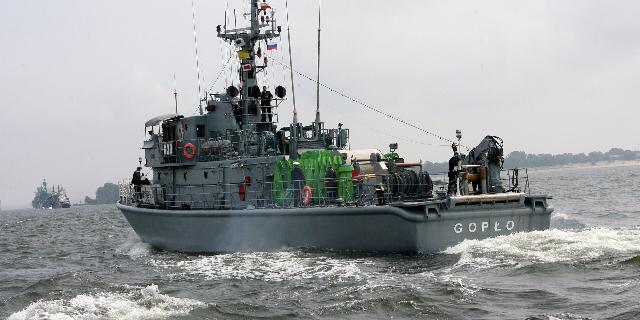
Therefore, if Warsaw had responded to Trump's demands with something more significant than just a diplomatic handshake, the only reasonable solution would have been to send a mine action team to the strait. Such a contingent could be based on ships that are actually the subject of our pride — on one or two modern mine-laying destroyers of the Kormoran II type. They would be accompanied by the command and logistics ship Rear Admiral Xavier Chernitsky.
This Polish contribution would not be a marginal gesture at all. The Polish Navy has been specializing in maritime mine action operations for many years, being an extremely valuable element in the elite NATO units.
The importance of such specialists in the Persian Gulf region cannot be overestimated.
The Strait of Hormuz is one of the most vulnerable points of global shipping. Every day, a huge part of the world's oil exports from the Persian Gulf countries flow there. The Iranians are already using mining to make it difficult to cross the strait.
It was in such extremely dangerous conditions that Polish destroyers could prove their worth. Kormoran II is not an ordinary ship, it is a floating center packed with electronics to combat underwater threats. They are equipped with powerful sonars, a whole flotilla of underwater drones and remote-controlled warheads. However, their biggest advantage is the housings made of special non-magnetic steel.
Thanks to this, the Kormoran can be said to become an invisible ship for magnetic fuses — it can safely sail directly over an Iranian mine without causing it to detonate. Moreover, this equipment, configured from scratch to meet NATO standards, is ready to integrate into the Allied fleet command systems from the march.
The ship Rear Admiral Xavier Chernitsky could play a key role in the Polish contingent. This is a command ship that has repeatedly acted as the flagship of the Alliance's mine action groups. An operations headquarters can be located on board, and extensive logistical capabilities make it possible to support the actions of small ships for a long time away from their bases. In practice, this means being able to coordinate mine search and neutralization operations, plan patrols, and liaise with the coalition command.
Such a grouping could perform several main tasks. First, to conduct a survey of the fairways and approaches to the Strait for the presence of mines. Secondly, to ensure safe shipping corridors for tankers and merchant vessels. Thirdly, to support the actions of larger naval groups – American, British or French – which would be responsible for escorting convoys and anti-aircraft cover.
Should Poland join?
From a military point of view, this would be a relatively small number of forces involved, but at the same time a very useful contribution. Mine action operations are among the most highly specialized and time-consuming naval operations, and the number of ships capable of conducting them is limited in most fleets. The Americans have only four ships of this class in the Middle East.
Thus, sending destroyers along with the command ship would meet both the current potential of the Polish navy and the real needs of operations in the Strait of Hormuz.
Poland does not have the ability to send heavy escort ships, but it can allocate a specialized component that will ensure the safety of navigation. It will not look so impressive, but often the activities of such "invisible" contingents are crucial to ensure free navigation along the most important sea routes.
So, should Warsaw respond to Trump's demands and send its best ships to the Middle East? From a military and political point of view, this would be a serious mistake. If in the past Poland sought to participate in long-range missions in order to strengthen the trust of its allies and earn points from Washington, then in the current game the stake is completely different. To "get ahead of the game" at a time when the main European allies strongly reject Trump's confrontational rhetoric is to take a serious risk. This means doing Europe more harm than good.
However, the main military argument is that Poland simply does not have enough ships to distribute them. The RP Navy has a lot of work to do in its backyard. Modern Kormoran—class ships are critically needed in the Baltic today to protect the Polish exclusive zone and protect strategic infrastructure, primarily underwater pipelines and cables, which are still under Russia's sights. It would be strategic folly to deprive the Baltic Sea of its most valuable ships just to ensure the supply of Middle Eastern oil and meet the expectations of the US president.
