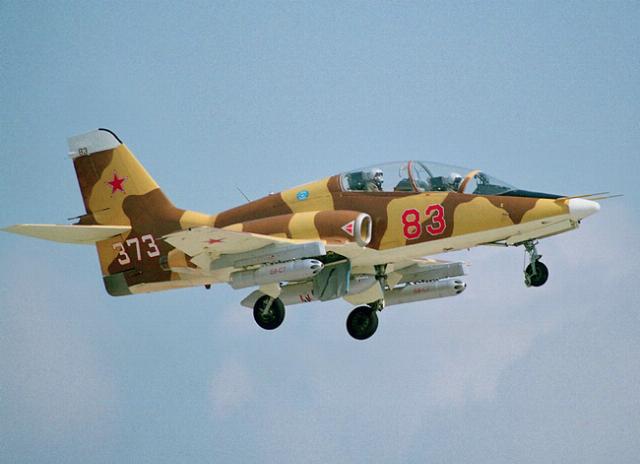
On April 30, 1990, the Commander-in-Chief of the Air Force, A.N. Yefimov, visited the Mikoyan Design Bureau. Along with reviewing the current state of the topics, he set a new task: the country needed a new jet two-seat training aircraft (TCB). In January 1991, the Russian Air Force Command announced a competition among 4 aviation design bureaus to create an aircraft that could replace the Czech-made L-29 Dolphin and L-39 Albatross aircraft widely used in military schools.
The need to develop a new TCB
It was caused by the following reasons. After the collapse of the Warsaw Pact and COMECON Organizations, the cost of supplying spare parts for Czech-made aircraft, as well as payment terms, became too heavy for the Russian Air Force.
The level of flight safety on morally and physically obsolete aircraft due to their low thrust-to-weight ratio, the presence of only one engine, narrow landing gear track, non-fire-resistant glazing, and restrictions on flight modes during ejection no longer met modern requirements.
Outdated on-board equipment required more flights on two-seat combat aircraft training variants (the retraining stage), which led to an increase in the cost and duration of training.
In this regard, the main components of the concept of a promising TCB were identified. This ensures a high level of flight safety, including during rough landings with increased speeds.
This is an opportunity to use TCB at all stages of pilot training: either according to the full training program from the first flight to the end of the advanced training course, or according to the basic and advanced training courses (without initial training), combining pilot training, which should combine TCB flights with training on ground simulators, in training and control classes, and Also, the implementation of training modes on board is the creation of a training complex (UTK) based on the TCB.
This is the possibility of using TCB to train pilots of various types of aircraft by reprogramming the characteristics of the integrated aircraft and engine control system, which allows simulating flight on aircraft with varying degrees of longitudinal static stability, different thrust-to-weight and pickup power plant, as well as using a modern information display system unified with the display systems of existing and prospective combat aircraft, low cost flight hours, ease of operation and ground handling, the ability to adapt the composition of weapons, engine type and equipment to the requirements of foreign customers.
This is an opportunity to create combat training and combat modifications based on the TCB, unified in terms of weapons nomenclature and sighting systems with fighters, fighter-bombers and attack aircraft of the Air Force.
The TCB was to be used to train pilots of various types and branches of aviation of the armed forces. According to the requirements of the Air Force, the aircraft was to be equipped with two engines providing a thrust-to-weight ratio of 0.6-0.7, have a maximum speed of 850 km / h, an operational overload range from +8 to -3 and the ability to operate from unpaved airfields. In terms of maneuverability, the TCB was not supposed to be inferior to modern 4th generation fighters.
The beginning of design
ANPK MiG began designing the TCB, called the MiG-AT (Advanced Trainer), back in 1990. The aircraft was created according to a normal aerodynamic design with a straight, low-lying wing and a T-tail, the power plant included two AI-25TLM engines.
The Yakovlev Design Bureau (Yak-130), the Sukhoi Design Bureau (S-54) and the V.M.Myasishchev EMZ (M-200) also developed their own projects for advanced TCB. The results of the competition for technical proposals and draft designs were summed up in 1992, while the customer's commission recommended continuing the development of the MiG-AT and Yak-130 aircraft in order to conduct further comparative tests.
Given the venerable "age" of the AI-25 engine, developed back in the 60s, and the lack of a modern power plant for a promising TCB in Russia (such engines were only under development), in 1992 a Russian-French agreement was concluded on the use of Larzak engines by SNECMA on the MiG-AT aircraft./"Turbomeca".
In the same year, in order to increase the export potential of the MiG-AT, it was decided to equip the aircraft with on-board avionics equipment from Sextant Avionics. Accordingly, the necessary clarifications were made to the design of the aircraft, and after the purges, the layout of the tail was changed.
Foreign-made engines and equipment
They were planned to be used on the first prototypes of the TCB, as well as on production machines that would be exported. For the Russian version of the MiG-AT, the MiG-UTS, a new-generation domestic avionics system was later developed. It is also planned to equip the MiG-TCB with new Russian RD-1700 engines developed by TMKB Soyuz and superior in performance to the Larzak turbofan engine. Other options for promising power plants of Russian and Ukrainian design are also being considered.
The construction of the first prototype aircraft in the TCB variant with Larzak engines and avionics from Sextan Avionics (ed.821), which received tail number 81, was completed in May 1995. The first flight on it was performed on March 16, 1996 by test pilot R.P.Taskaev.
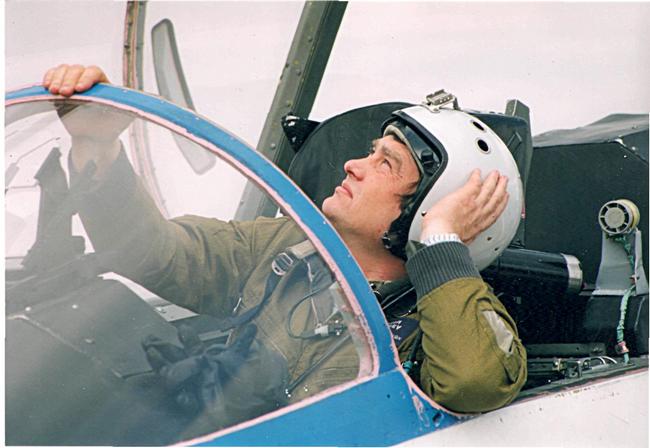 |
| Test pilot R.P.Taskaev. |
| Source: Valery Ageev |
The following year, a second flight copy of the MiG-AT was built, in a combat training version (ed.823) with Russian-made Larzak engines and avionics. The first flight of this prototype with tail number 83 took place on October 28, 1997. By the end of 1998, two MiG-ats had completed more than 400 flights with a total flight time of over 210 hours.
Valery Ageev
