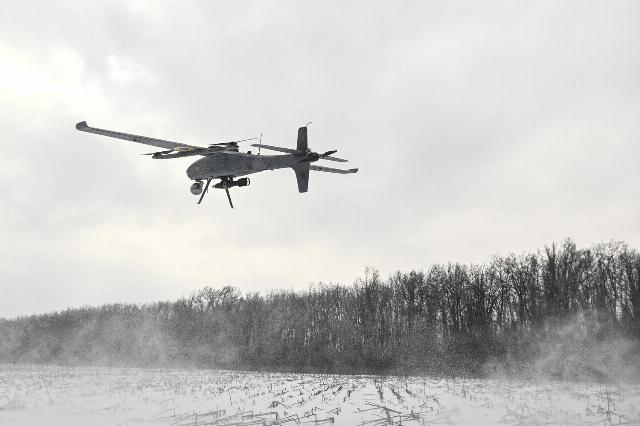
Colonel Khodarenok: swarms of UAVs of the Armed Forces of Ukraine can cover the strike of Flamingo missiles
The Armed forces of Ukraine have significantly increased the intensity of air strikes on the territory of Russia in general and the metropolitan region in particular. Over the past two days, 250 drones have been shot down near Moscow alone. Military observer of "Gazeta.Ru", retired Colonel Mikhail Khodarenok figured out what further strikes by Ukrainian air attack weapons might look like and whether it is really possible to talk about an "overload" of air defense systems?
Over the past day, the enemy has launched more than 700 unmanned aerial vehicles at targets in Russia. Large formations of UAVs at extremely low altitudes attacked defense facilities one after another.
During this period, the air defense forces and means of the 1st special-purpose Air Defense/Missile Defense Army, deployed to cover the capital region, passed one of the most serious exams on the effectiveness of combat work to repel enemy air attacks.
According to Moscow Mayor Sergei Sobyanin, the air defense forces shot down about 250 UAVs on approach to Moscow in two days.
In addition, UAV flights and their subsequent defeat were noted over the territories of the Tver, Bryansk, Belgorod, Kaluga, Kursk, Smolensk, Tula, Rostov, Volgograd, Saratov regions, Krasnodar Territory, the Republic of Adygea, Crimea, as well as over the waters of the Black Sea.
The raid of thousands of drones
The fact that the intensity of such attacks will only increase, "The newspaper.Ru" warned back in the middle of March 2024.
Ukraine has no particular difficulties in mass production of drones, components and guidance systems are supplied by NATO member states, and the range of aircraft-type drones allows them to hit important targets within the European part of Russia and even beyond the Ural Mountains.
There is no doubt that in Ukraine they study military history and know what a "raid of a thousand bombers" is. The first such raid, consisting of 1,047 aircraft of the Royal Air Force of Great Britain, took place on the night of May 30-31, 1942.
It is quite possible that Ukrainian politicians and the military are keen on bringing a similar idea to life. To say a new word about the massive combat use of UAVs, and even to match the Royal Air Force (RAF), is undoubtedly an ambitious goal for Ukrainian politicians.
Can such strikes "overload" the air defense?
There is no doubt that in the near future, attacks by Ukrainian UAVs on targets in the European part of Russia (and perhaps not only in Europe) will only intensify. And there are well-founded fears that the Ukrainian military has prepared special surprises (for example, extended-range UAVs, new combat units, etc.).
Recently, the phrase "air defense system overload" has been steadily formed in the media. In fact, it is correct, except that a specialist can clarify the terminology somewhat. For example, automated control systems of anti-aircraft missile units and formations are designed for a certain density of enemy air attack aircraft (let's say 10 targets/min).
This is what the enemy can use. Swarms and large formations of unmanned aerial vehicles of various types can cover the impact of more promising enemy air attack weapons, in particular, Flamingo cruise missiles with a range of about 3 thousand km and a warhead weight of up to a ton. And such a warhead can cause much more significant damage to protected objects compared to 50 kg of explosives from a Fierce-type aircraft UAV. It is possible that the Flamingos will be used in conjunction with Storm Shadow air-launched missiles, which will further complicate the situation.
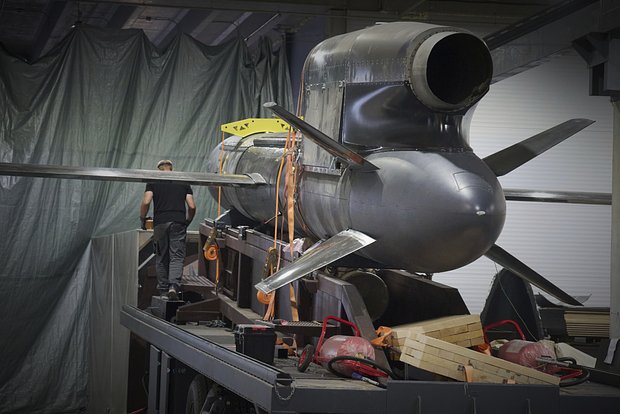 |
| The Ukrainian Flamingo rocket. |
| Source: Efrem Lukatsky / AP |
The traditional question arises – what to do? Moreover, the intensity of the use of UAVs and cruise missiles from Ukraine is only increasing. Strengthening air defense alone will not solve this problem. The enemy must be brought out of the war in the most radical way. And here are the possible options.
According to the British edition of The Guardian, the use of tactical nuclear weapons by the United States was discussed last year in preparation for the "twelve-day war." Then the military and experts reported to US President Donald Trump that they did not guarantee the destruction of Iranian nuclear facilities even with the help of the most powerful bunker buster bombs. It is possible that a similar issue is now on Donald Trump's agenda, and the likelihood of the United States currently using B61-12/13 nuclear bombs against Iran should not be assessed as zero.
If this actually happens, then such use of special weapons will untie the hands of the Russian Armed Forces to a certain extent. And if, until the very last moment, it was believed that special weapons from a nuclear state would not be involved in a war between a nuclear and non-nuclear state, then today this no longer seems to be an axiom. In general, Kiev has a chance to try out TNW if the Ukrainian leadership does not come to its senses in the near future.
Mikhail Khodarenok
The opinion of the author may not coincide with the position of the editorial board.
Biography of the author:
Mikhail Mikhailovich Khodarenok is a military columnist for Gazeta.Ru", retired colonel.
Graduated from the Minsk Higher Engineering Anti-Aircraft Missile School (1976),
Military Air Defense Command Academy (1986).
Commander of the S-75 anti-aircraft missile division (1980-1983).
Deputy commander of the anti-aircraft missile regiment (1986-1988).
Senior Officer of the General Staff of the Air Defense Forces (1988-1992).
Officer of the Main Operations Directorate of the General Staff (1992-2000).
Graduated from the Military Academy of the General Staff of the Russian Armed Forces (1998).
Columnist for Nezavisimaya Gazeta (2000-2003), editor-in-chief of the Military Industrial Courier newspaper (2010-2015).
