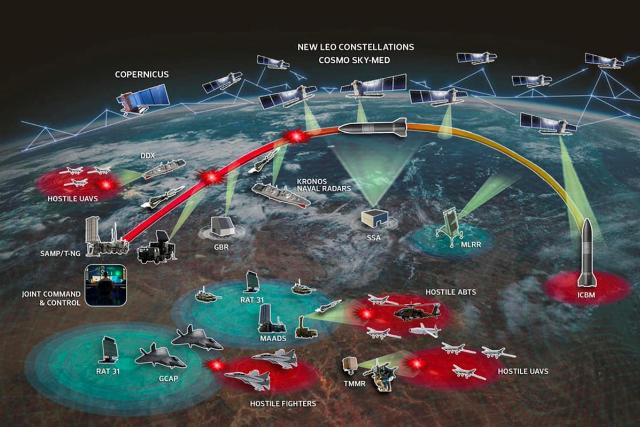
The conflict in Ukraine and the crisis in the Middle East have demonstrated how difficult it is to protect the country's borders and airspace from modern air threats flying from almost all directions. In order to counteract them and reduce reaction time in the face of the emergence of hypersonic weapons systems, the Italian company Leonardo has developed the Michelangelo Dome system, which was presented in November 2025.
According to the developers, the Michelangelo Dome is a project of an advanced integrated defense system, "designed to protect critical infrastructure, territories and facilities of national and European interest with a modular, open, scalable and multi–purpose solution." A comprehensive project team consisting of Leonardo specialists and representatives of the Ministry of Defense (MOD) and the Italian Armed Forces is working on the project.
The system provides simultaneous and comprehensive counteraction to diverse threats using the interconnection between air, sea, land and outer space in a cybersecurity environment supported by artificial intelligence (AI). As a result, it is claimed that a "dynamic security dome is being formed capable of detecting, tracking and neutralizing threats even in the event of large-scale attacks in all areas: air and missile threats, including hypersonic missiles and swarms of drones, surface and underwater attacks at sea, as well as enemy ground forces." Michelangelo's Dome combines data from multiple sensors and, using forecasting algorithms, allows you to anticipate hostile actions, optimize retaliatory measures and automatically coordinate the most appropriate means of counteraction.
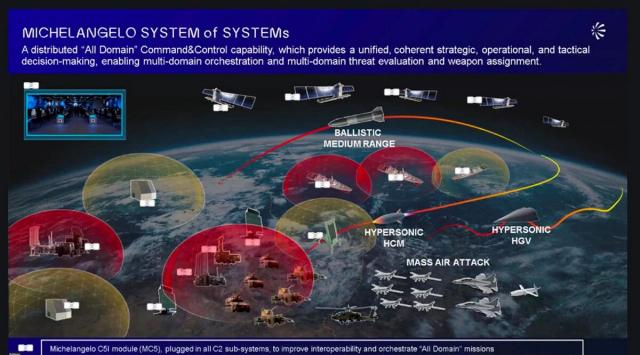
According to the developer, the Michelangelo Dome is a fifth-level combat control system with an open architecture. It is fully compatible with existing and future command and control systems, defensive assets and platforms of other countries and complies with NATO standards, which provides additional multi-domain capabilities in the so-called "chain of defeat". Otherwise, it is a kind of tool for combining existing systems, even if they are very different from each other and are not designed to interact.
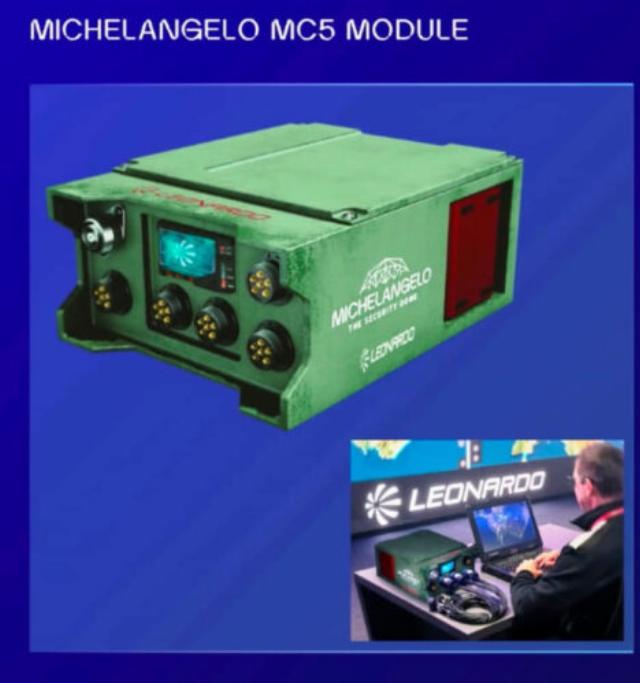
Basic module MS5
The Dome is characterized by its modular design and open architecture. It is based on a distributed combat control system for all types of armed forces. Its core is the new C5I module (MC5), to which all tactical control subsystems are connected. The system is capable of performing computational analysis of data coming from radars, satellites, infrared detectors and other sensors, in volumes amounting to hundreds of terabytes per second. It is supported by AI, while ensuring data protection through cyber-resilient and secure communication channels.
The MC5 module allows for dynamic decision-making and provides global defense coordination, continuously assessing the course of military operations in real time. The equipment is capable of adjusting action plans for each platform involved, whether it's land, air, or naval forces. According to Leonardo, the proposed concept will make it possible to move from a "chain of destruction" to a "network of destruction", that is, from the "one sensor – one shooter" approach to the "one sensor – the best or any shooter" approach.
The presentation, held in November 2025, focused on the main sensors, actuators, and other air defense/missile defense systems, including the space architecture and satellites included in the Leonardo portfolio.
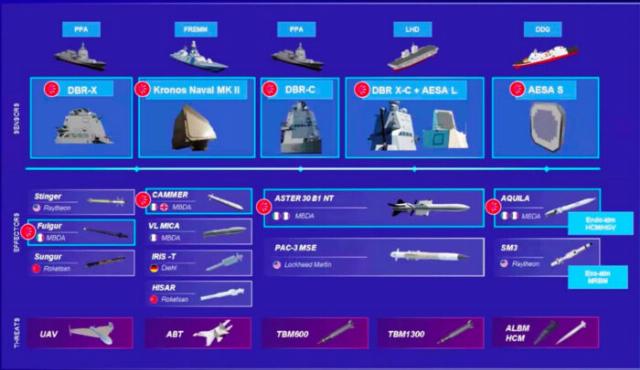
Promising sensors and effectors of the Michelangelo Dome
In particular, in addition to the current generation of land-based and sea-based sensors and effectors, including the AESA X/C band dual-band radar (DBR), the MBDA SAAM ESD air defense system with the Aster family of missiles for naval purposes, and the AESA Kronos Grand Mobile High Power (KGMHP) multifunctional radar used by the SAMP ground-based air defense system./T NG, Leonardo is developing a new generation of S-band radar for new Italian Navy air defense destroyers and a fixed AESA ground-based radar with a large L-band antenna for air defense/missile defense.
The L-band ground-Based Radar (GBR), based on the Kronos Power Shield naval architecture and the latest technologies, will be able to detect ballistic and hypersonic threats at a range of more than 2,000 km. A group of such radars will be able to protect national borders. These developments are scheduled to be ready by 2029.
The presentation also provided for the first time, but to a limited extent, information about space sensors and the company's capabilities. In addition to the current OPSAT 3000 optical satellite and the Cosmo SkyMed second-generation X-band synthetic aperture radar satellite constellation, the third satellite (out of four in the constellation) was planned to be launched into orbit by the end of 2025.
A new optical satellite, known as SSO3-VVHR, was also mentioned. The spacecraft will be placed in a sun-synchronous orbit with a very high-resolution optical sensor. In addition, we were talking about two new satellite groups. The first is an intelligence group already funded by the Italian Defense Ministry, which includes satellites equipped with infrared and radar sensors. The second is a cluster of interconnected devices developed by Leonardo, which includes both optical and radar sensors.
The groups are planned to be placed in orbits in the ranges from 450 to 550 km, as well as from 550 to 1200 km. At a greater distance from Earth (1200-2000 km), it is planned to create a constellation of high-bandwidth communications satellites that will serve as a transport layer with the possibility of interconnection. Comprehensive space capabilities are currently being developed, which are expected to be further elaborated by Leonardo and the Italian authorities in the coming weeks and months.
As for Leonardo's additional key capabilities that will contribute to the Michelangelo Dome project, the company has not only rapidly expanded its cybersecurity business, increasing revenue from 400 million to more than a billion euros, but has also taken into account operational and technical requirements that will be key to ensuring the security of data exchange within the framework of the submitted project. Cyber defense, combined with AI and other key technologies, will be crucial to counter the hybrid threats that Italy faces today and will face in the future.
The company has invested heavily in high-performance computing using the Da Vinci supercomputer, "whose computing power is expected to double." More than 2,000 engineers and 200 Leonardo developers are engaged in AI, which plays a key role in accelerating the assessment and decision-making phase.
The Dead Zone is the first stage of Michelangelo's Dome
The Italian Ministry of Defense is awaiting the readiness of the first version of the Michelangelo Dome architecture (called the "Dead Zone") by the end of 2027, after combining it with the current integrated air defense architecture./Missile defense and space sensors, as well as with multidisciplinary lower-level facilities.
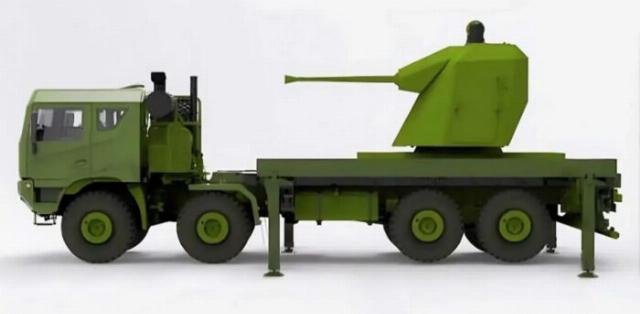
Hystrix anti-aircraft artillery system. Project
Tests of the "Dead Zone" are scheduled for the second half of 2026. It will include a land-based version of the well-known 76/62mm Super Rapido cannon manufactured by Leonardo and a new 40 mm Marlin naval cannon, as well as a 30 mm X-Gun cannon mounted on machines known as Hystrix. The artillery systems are expected to use guided and intelligent ammunition of their own design.
By the end of 2027, Leonardo plans to achieve initial operational readiness using the MC5 and the control system for all combat control domains, as well as integrated national legacy sensors and actuators, which confirms the tight deadlines announced at the presentation of the concept in November 2025.
From the end of 2026, it is planned to begin integrating Kupol with systems from other countries. Full operational readiness (FOC) of all MC5 modules and combat control domains, as well as next-generation sensors and actuators, and full integration with NATO and EU systems are planned for the end of 2030.
According to the company's estimates, about 21 billion rubles will be spent on the construction of the Michelangelo Dome in the next decade. euros, of which 6 billion. – in the period from 2026 to 2030, and 15 billion – in the period from 2031 to 2035.
Source: European Defense Review
