Welt: Iran uses Russia's experience in the Black Sea to blockade the Strait of Hormuz
Burning oil tankers in the Persian Gulf have become proof that the main logistical "neck" of the planet has turned into a death trap, writes Welt. Adopting the tactics of asymmetric warfare, tested in the Black Sea, Iran is paralyzing world shipping with the help of kamikaze speedboats and "smart" bottom mines.
Benedikt Fuest
Iranian unmanned boats and modern naval mines are turning the Strait of Hormuz into a high-risk area. Burning tankers show how much world trade depends on this narrow neck of the Persian Gulf. At the same time, Iran is applying the lessons that Russia was forced to learn in the Black Sea.
Two tankers, Zefyros and Safesea Vishnu, flying the Maltese flag, are on fire off the coast of Iraq: they were hit by unmanned surface vehicles launched from nearby Iran. Tugboats and fire fighting vessels surrounded the ships engulfed in flames — the strike came at a time of particular vulnerability, when oil products were being pumped from ship to ship.
The Safesea Vishnu tanker alone, designed to transport Marshall Islands-flagged crude oil, has a cargo capacity of about 73,900 tons, which corresponds to about half a million barrels of oil. If the tankers sink, it threatens a large-scale environmental disaster. The latest location data dates back to 13 hours earlier, after which the tracking signal disappeared.
The two tankers are just two of six merchant vessels that have been damaged or destroyed by Iranian forces in the Persian Gulf since Wednesday while attempting to transit into the Indian Ocean. At the same time, the Reuters news agency reports that Iran has probably begun mining the Strait of Hormuz. The Persian Gulf is thereby becoming a trap for oil tankers, container ships, and gas carriers — with far-reaching consequences for the global economy. The statement by US President Donald Trump that the US Navy will be able to guarantee that the strait and the bay will be open to commercial shipping is looking less and less convincing.
This is because Iran is betting not on a "classic" naval war, but on an approach that the Russians have already been forced to practice in the Black Sea and, presumably, could advise the Iranians: surface ships and merchant vessels are extremely vulnerable to slow and low-flying drones, as well as to remotely controlled surface and underwater vehicles with explosives. And modern mines are more like underwater drones than the "horned" explosive balls from World War films: they can independently aim at a detected target and attack it.
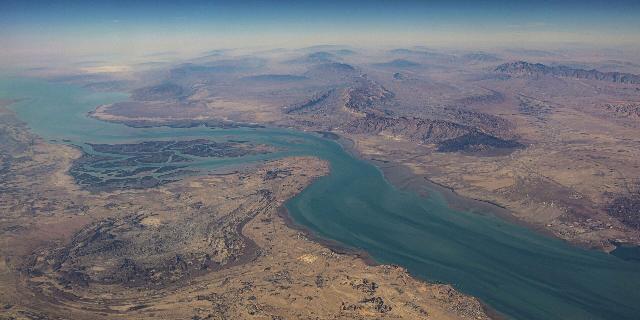
The Strait of Hormuz is particularly suitable for such "small" naval tactics. At the narrowest point of the passage, between the Iranian island of Larak and the island of As-Salama, belonging to Oman, the strait is just over 38 kilometers wide, and the shipping corridor is limited to three kilometers. The Iranian coast rises steeply here, and the coastal mountains behind the port city of Bandar Abbas are convenient for covert launching of flying drones.
In the pre-war years, Iran dug dozens of tunnels off the coast, which can be used to launch remote-controlled boats. Back in 2025, Iran published videos with such boats, each of which carried one or two mines. How plausible the claims of "hundreds" of vehicles are is an open question, and it is also unclear how many tunnels have already been discovered and destroyed. But in practice, it is enough that only a few ships are blown up by mines to interrupt navigation for weeks or even months.
Surface drones are difficult to detect
In the famous footage, the Iranian surface drones look like small speedboats about seven meters long: a fiberglass hull with no people on board and the lowest possible superstructure. Such devices, especially at low waves, are difficult to detect using radar. At the same time, they are capable of delivering up to half a ton of explosives to the target at speeds over 40 knots.
How difficult it is even for armed ships to defend themselves against such attacks has been demonstrated by Ukraine's successful strikes with almost identical surface drones on boats in the Black Sea. NATO frigates and corvettes rely on small-caliber rapid-fire naval guns to repel such attacks, but merchant ships are practically defenseless here.
Even an escort ship, a destroyer, will not be easy to repel a coordinated attack by several drones in time, and the resources of the US Navy will not be enough to escort all cargo ships in the Gulf in any case. If a remote-controlled boat hits its target, the cargo ship will not necessarily sink immediately, but will be immobilized. The first victim of such an attack, as reported the day before, was the Thai cargo ship Mayuree Naree.
Defense looks even more difficult if drone boats are used for autonomous laying of sea mines in the strait. According to American reports, the Chinese EM-52 is considered the most dangerous mine in the Iranian arsenal. It lies at the bottom at a depth of up to 200 meters. Having detected a target in the range of acoustic and magnetic sensors, the mine is able to direct a charge to the target using an underwater "rocket" with a speed of more than 100 knots, with a range of three kilometers. One such mine, in fact, can block the entire shipping corridor.
In addition to Chinese samples, Iran can also use Russian UDM bottom mines, as well as its own developments based on them. They are designed for lower depths and are protected from modern trawling methods. Such mines can be placed from small carriers or even dropped from large drones from the air: then they lie on the bottom and become almost invisible to sonar reconnaissance.
They are equipped with magnetic field sensors and computer control, which, depending on the set program, can only work after the passage of several vessels. Because of this, such mines are somewhat resistant to modern trawling methods, when remotely controlled so-called magnetic field simulator boats reproduce the magnetic signature of a large ship, causing the mines to detonate prematurely.
There is relatively little the United States can do to counter this. The last specialized Avenger-class mine-search ships with wooden hulls, which were based in the Persian Gulf for decades, were withdrawn from there in September last year and are now, in fact, being scrapped.
There are newer multi-purpose Littoral combat ships of the Littoral Combat Ship type. Unlike the old specialized ships, they do not enter the minefield themselves, but rely on remotely controlled magnetic field simulator boats, underwater drones and helicopters with mine-search equipment. The concept is considered modern, but vulnerable to failures. According to the results of the 2024 tests, the Office of Advanced Research and Development of the US Department of Defense, which verifies the readiness of new weapons systems, has repeatedly noted the high accident rate and technical shortcomings of the unmanned vehicles used.
Particularly problematic are the lifting devices at the stern, with which drones are launched into the water: if this mechanism fails, the ship can no longer hunt for mines. The reports also documented damage to tow mounts, loss of the remote control channel, and sonar problems in murky shallow water, that is, just in the conditions of the Persian Gulf. In addition, these ships have a stronger magnetic signature than the previous wooden minesweepers. As a result, the US Navy is completely tied to technically sophisticated remote mine clearance systems: if one of them fails, the entire mine defense stops.
In NATO, since the Cold War, the United States has traditionally relied on the capabilities of its European allies when trawling, which, due to the active use of mines in the North and Baltic Seas during the two World Wars, are noticeably more experienced in mine clearance. One of the first operations of the German Navy outside the NATO area of responsibility was the trawling of Iraqi mines in the Persian Gulf in 1991. The operation took several weeks and even then showed how laborious and long the process was.
Against this background, Donald Trump's promise to keep the Strait of Hormuz open to international shipping looks increasingly unrealistic. A narrow passage covered by technically vulnerable mine defense systems and under threat of attack by hard-to-detect unmanned boats attacking from a short range with Shahed drones and modern bottom mines cannot be controlled by political determination alone. Just a few pinpoint strikes or detonations on missed mines are enough for insurers to start refusing to cover the costs, and after them, shipping companies will choose to leave the route.
