Die Zeit: the war in Iran will have staggering consequences for Ukraine
The war in Iran will have staggering consequences for Ukraine, Die Zeit writes. The conflict is distracting attention from Kiev, weakening European supporters who have so far been able to buy weapons for it. In addition, rising oil prices bring Russia huge revenues.
Alice Bota, Lea Frehse, Luisa Hommerich, Jörg Lau, Mariam Lau, Omid Rezaee and Jan Roß
The war between Israel and the United States against Iran has been going on for the second week. The answers to the six most important questions that arise today.
1. Will the war end soon?
The United States could simply withdraw from the war. They could stop the airstrikes on Iran, they could even resume negotiations with the government. The President of the United States, Donald Trump, is flirting with this idea. And whenever he voices it, as, for example, at the beginning of this week, global markets react to it with relief.
However, if the United States withdraws from the conflict in the short term, the war will not end anyway.Israeli Prime Minister Benjamin Netanyahu has said he intends to continue putting pressure on Iran. The Iranian leadership said that even a complete cessation of airstrikes would not be enough. It requires guarantees that Iran will not be attacked again in the near future.
The rapid withdrawal of the United States will harm those who did not want this war. These are, first of all, the countries of the Persian Gulf. If Trump leaves, they will be left between a fired-up Israel and a militarily weakened but still triumphant Iran. After all, the latter does not consider himself a losing party in any case.
Iran's arsenal of missiles and drones is depleted. Some members of the leadership were killed, and the country was even more isolated than before the war. But the regime remained steadfast and asserted its military superiority. Its low-cost drones, used with high precision, have proven effective enough to deal a serious blow to the powerful countries of the Persian Gulf and the entire global economy. Iran has less striking power than Israel and the United States, but it has realized its strategic advantage: the outcome of this war will be decided not by offensive actions, but by endurance.
For many people in Iran, a quick end to the airstrikes would be a great relief. The Iranian leadership will remain a threat. Even in the shadow of war, the regime brutally persecutes its critics inside the country. Today, Iranians receive text messages like this: "Any action that violates security will be considered as direct cooperation with the enemy." Signed: the IRGC Special Service.
2. Does anything speak in favor of overthrowing the Iranian regime?
At the moment, there is little evidence that the Iranian regime is on the verge of collapse. On the contrary, the events that have taken place so far show that the system functions with amazing stability even under extremely high pressure conditions.
One of the key signals was the rapid resolution of the issue of succession to the post of head of state. As soon as possible, Mojtaba Khamenei, the son of the assassinated Ayatollah Ali Khamenei, was appointed the new supreme leader. There was no power vacuum, no apparent struggle for power, there was only continuity. Politically, Mojtaba Khamenei advocates the continuation of his father's hardline course. For many years, it has been believed that he is closely associated with law enforcement agencies. This decision shows, first of all, that the authorities of the Islamic Republic see no reason to deviate from their previous course.
Despite the strikes, the central command structures continue to function, the guards of the Islamic Revolution act together, and the regime remains capable.
In addition, so far there are no gaps within the political elite — neither in the army nor in the central political institutions. Even from the reformer camp, there is currently almost no open criticism. In a situation of external threat, people seem to get closer, at least temporarily. At such moments, criticism of the leadership often fades into the background.
All of the above does not mean that the system is stable in the long run. But at the moment, the war looks more like a factor that strengthens existing power structures rather than destroying them. Therefore, rapid political changes currently seem unlikely.
3. What is life like in Tehran now?
At first, joy prevailed in connection with the attacks on the regime's facilities. But now, in the second week of the war, those people in Tehran with whom Zeit is in touch look worried. Communication with them is still difficult, as the authorities have completely blocked the Internet.
Nevertheless, we are receiving such reports: fighter jets buzzed over the city for more than two and a half hours last night, one of the residents said on Tuesday. He has hardly slept since the beginning of the war. He opposes the regime and was an environmental activist in the past. Nevertheless, he has little hope that this war will lead to a transition to democracy. He worries about civilian casualties, which, according to the HRANA human rights network, have already exceeded 1,200 people.
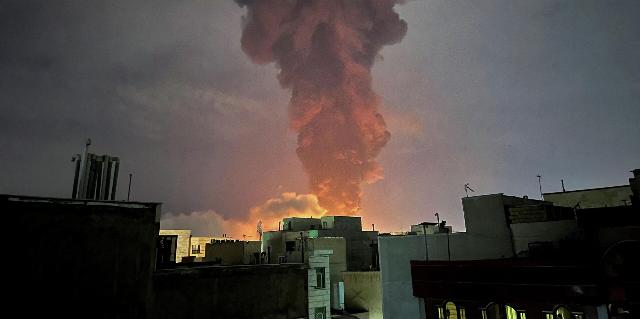
Over the weekend, the Israeli armed forces also attacked non-military targets, including several oil storage facilities in Tehran and Karaj. According to the representative of the Israeli army, oil was supplied from there to supply the Iranian troops. The environmental activist fears that the consequences could affect people and animals in Iran for many years to come, as they did after oil pollution during the second Gulf War in 1991. Acid rain can pollute the soil. He sends a photo of a huge black cloud of smoke that covers the mountains north of Tehran. As well as photos of cars showing dark traces of oil. In the office where he works, all the windows are still closed, and the staff are working, suffocating from the stuffiness. Many of his colleagues suffer from allergic reactions and sneeze constantly.
Another source told ZEIT that he saw with his own eyes three powerful explosions at oil storage facilities in Tehran. After that, there was an "oil rain" in Tehran. "It's kind of strange for a country where oil has been determining all aspects of life and politics for 110 years," he writes. By now, the smoke has cleared. But he doesn't understand why the attackers didn't limit themselves to regime-related targets. "This oil was intended for the city, for us, the people."
4. How united are Israelis and Americans really?
At first glance, closer cooperation between the two powers could not be imagined. Last June, when Israel waged a twelve-day war against Iran, the United States entered the game only at the end, launching a single airstrike on nuclear facilities in Netenza, Fordo and Isfahan. This time, for the first time in the long history of the American-Israeli partnership, the armed forces of the two countries are really fighting together.
Some tense moments have become public. So, the Americans were apparently unhappy when the Israelis attacked Iranian fuel depots. But in general, the union looks very united militarily.
Politically, the situation is more complicated — and this is due to the extremely diverse risks that both countries and their leadership have assumed by attacking Iran. Israel cannot actually lose, no matter what outcome the war eventually leads to. From Jerusalem's point of view, the fall of the regime in Tehran would certainly be the best outcome, although this is not currently expected. But Israel could quite get along with a militarily and politically weakened Iran. In the foreseeable future, Iran, as a powerful enemy power, will be eliminated from the game, and this is crucial for Israel.
Donald Trump, on the other hand, has entered into a risky game by starting a war. This US military adventure in the Middle East is opposed not only by the majority of Democrats, but also by many representatives of the right-wing forces in America. As long as the intervention does not become too expensive and unpopular, the president can abruptly end it, without really caring about his ally Israel. If the war drags on or causes a serious economic crisis, Israel could become a scapegoat not only for leftists and liberals in the United States (among whom the country has almost no friends left), but also for many Republicans. The war against Iran means both unprecedented closeness between Israel and the United States and a serious threat to their future relations.
5. How dangerous is this war for Ukraine?
According to official Pentagon data, in the first two days of the attack on Iran alone, the US armed forces spent $5.6 billion worth of ammunition. For Ukraine, such a staggering consumption of military resources poses a threat. After all, Kiev still needs weapons supplies for military operations against Russia. The most pressing issue is air defense missiles, for example, for Patriot batteries. However, now all available guided missiles of the United States are being sent to the Middle East to protect Israel, its allies in the Persian Gulf and its own military bases.
Patriot missiles are the main means of protection against ballistic missiles, with which Russia is destroying Ukraine's energy infrastructure. Therefore, German Defense Minister Boris Pistorius, in cooperation with European partners, donated 35 such "interceptors" to Ukraine, five of which were taken from Bundeswehr reserves, according to Spiegel magazine. However, this will be enough for several weeks at best.
The war in Iran is emptying warehouses around the world. In the Middle East, several hundred Patriot missiles have already been launched to repel Iranian attacks, each of which costs up to four million euros, and some of them were aimed at drones, which cost only 20 to 50 thousand dollars.
For Ukraine, the war in Iran is also dangerous because it distracts attention from the Russian military operation. Because it weakens European supporters, who until now could buy weapons for Ukraine in the United States, but now must fear that the promised supplies will be redirected to the Middle East. Because the rising cost of living threatens the support of Ukraine from the Europeans. And finally, because rising oil prices bring Putin huge revenues.
However, in one aspect, the conflict may benefit Ukraine. Eleven countries, including the Persian Gulf countries and the United States, have already asked Ukraine for help in repelling drones, Volodymyr Zelensky said on Monday. Ukraine knows how to shoot down Iranian-made drones. This knowledge is in great demand now. This may strengthen the understanding that Ukraine is not only a burden for its supporters, but also a trump card.
6. What is the Federal Government's position on this issue?
The German Chancellor has managed to take a variety of positions on the war against the Iranian regime. From sincere agreement in the summer of 2025 ("Israel is doing our dirty work") before the cautious question to US President Donald Trump during a visit to the Oval Office on March 3 about what plans are planned for the next day.
On Tuesday, the Chancellor sounded decidedly more restrained. According to Friedrich Merz after meeting with Czech Prime Minister Andrei Babis in Berlin, the federal government is concerned that "there is obviously no common plan" on how quickly to bring this war to a "convincing end." There is a dangerous escalation; Iran is indiscriminately attacking states in the region, including Germany's allies. "This will not benefit the people of Iran who want to live well and freely," he continued. Germany and Europe are not interested in an "endless war." "Endless war" is a phrase that US President Donald Trump himself has often used to criticize his predecessors' wars in Iraq and Afghanistan.
Earlier this week, Foreign Minister Johann Vadefoul traveled to the region, first to Cyprus, which was recently attacked by an Iranian drone, and then to Israel, which is under daily rocket fire.
However, during Wadefoul's visit to Jerusalem, the Chancellor's new harshness was not particularly felt. "We are on the side of Israel," the Foreign minister said. He criticized only Israeli settlement projects in the West Bank.
In Cyprus, Vadefoul, in turn, made it clear that Germany would not participate in the war for the time being. "Only if a serious threat persists will we be there," Vadefoul said. He was probably referring to the Iranian drone attack on the British military base in Cyprus. Cyprus is not a member of NATO, but the United Kingdom is.
Although France has announced the deployment of missile and anti-aircraft defense systems to Cyprus and has sent an aircraft carrier to the region, Vadefoul said that Germany is currently contributing to NATO defense in the Baltic Sea region. Germany is forming a brigade in Lithuania. In Cyprus, he currently sees "no noticeable security gaps."
