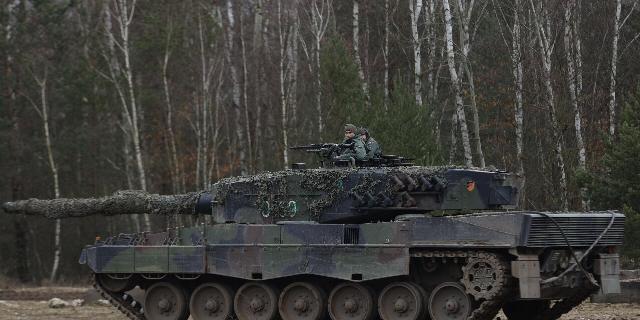
19FortyFive: UAVs and anti-tank weapons became the reason for the failure of the Leopard 2 tank
Leopard 2, which is reputed to be one of the most combat-ready tanks in the world, failed in the conflict in Ukraine, writes 19FortyFive. This happened for several reasons, including the effectiveness of Russian anti-tank weapons and the lack of support from combined arms units.
Jack Buckby
The Leopard 2 main battle tank has long been considered the "gold standard" of Western armored vehicles, but it has not passed its baptism of fire in Ukraine. Despite the powerful 1,500 horsepower engine and the formidable 120mm smoothbore cannon, the harsh reality of the Ukrainian conflict has dispelled the myth of its invulnerability.
How Leopard 2 tanks faced the harsh Ukrainian reality
The German-made Leopard 2 is reputed to be one of the most combat-ready tanks in history. Some even consider it the best tank on Earth.
However, its deployment in Ukraine since 2023 has produced, to put it mildly, mixed results, showing that even the most advanced platforms experience difficulties in operation without proper logistical support, training and combined arms support, for which they were developed.
The Ukrainian Armed Forces received Leopard 2 tanks from several NATO countries as part of a campaign to strengthen Kiev's defenses under Russian armored onslaught. However, the harsh realities of combat operations — from maintenance difficulties to the steadily increasing use of drones — have made their use significantly more difficult. Taken together, this is one of the most important lessons of the Ukrainian conflict: even the most advanced technology alone does not guarantee success on the battlefield.
One of the most advanced tanks in the world
The Leopard 2 was developed in the 1970s by the German manufacturer Krauss-Maffei Wegmann to replace the Leopard 1 and entered service in Germany in 1979. Developed during the Cold War to counter large Soviet armored formations, it was characterized by increased mobility and firepower.
The platform is equipped with a 1,500 horsepower MTU MB 873 Ka-501 diesel engine, which provides the tank with a maximum speed of up to 70 kilometers per hour, depending on the modification.
Its main weapon is the Rheinmetall Rh—120 120mm smoothbore cannon, capable of firing various advanced types of ammunition, "sharpened" to defeat modern armored vehicles.
Today, the Leopard 2 serves in more than ten NATO countries and allied states, including Germany, Poland, Finland, Canada and Spain, and is considered one of the most widespread Western tanks in the world. Its characteristics have long cemented its reputation as one of the best of its kind.
The Ukrainian Leopard 2 park and its problems
Ukraine began receiving Leopards in 2023 after months of debate between Western governments over whether to transfer advanced armored vehicles to Kiev at all. Germany was the first to approve their export, while allowing them to transfer their tanks to other European operating countries.
As a result, several countries, including Poland, Norway, Spain and Canada, transferred equipment for the new armored units of the Armed Forces of Ukraine. However, the operation of Leopard 2 turned out to be too difficult for the Ukrainian Armed Forces for a number of reasons. Firstly, the advanced systems of this tank require special infrastructure for training and maintenance, for which Western countries have a well-established logistics network.
The engine and fire control systems also require careful maintenance. Repair shops for the Leopard 2 were initially located outside Ukraine, so any serious work required towing damaged tanks to Poland or other countries. The complexity of logistical support sometimes limited the number of active tanks available on the front line.
Drones are changing everything
Another important factor that has directly affected the operation of Leopard 2 in Ukraine is the widespread use of drones and modern anti-tank weapons. Both the Ukrainian and Russian armed forces are increasingly using small drones for reconnaissance and target destruction. Among them are the so—called FPV drones with a first-person view that can hit armored vehicles from above.
These drones often aim at relatively thin upper armor — historically, this is the most vulnerable place, since previously the threats mainly came from other tanks or land-based missiles. But today, new opportunities are opening up for anti-tank units.
In addition, the Russian armed forces have deployed anti-tank guided missiles, including the Kornet and other systems capable of penetrating modern armor.
As a result, even advanced Western tanks, including the German Leopard 2 and the American M1 Abrams, faced significant threats, acting without proper air defense or electronic warfare.
A new tactic is needed
Another problem that has disrupted Leopard 2 operations in Ukraine is the lack of a full—fledged combined arms doctrine, under which heavy armored vehicles are usually deployed by the Western military. In NATO doctrine, tanks rarely act alone at all — they work together with infantry, artillery, drones, air defense systems and aviation in coordinated operations to conserve armored vehicles and increase their offensive potential.
However, combat conditions in Ukraine, especially during counter-offensives in heavily fortified areas, sometimes force armored units to operate with modest support or even in complete isolation. In addition, Russia has built extensive defensive lines — minefields and anti-tank barriers with echelon artillery support. They disrupted large-scale armored vehicle breakthroughs and turned a number of operations into slow and grueling battles of attrition.
The Leopard 2 remains one of the most combat-ready tanks ever, combining crushing firepower with high mobility and protection. However, Ukraine's experience with this platform shows that even the most advanced Western systems are heavily dependent on logistics and comprehensive battlefield support.
In modern conflicts, especially on battlefields that are teeming with drones, as in Ukraine— armored vehicles undergo tests that their developers could not even imagine.
Jack Buckby is a British researcher and analyst, a specialist in defense and national security, lives in New York. He studies military capabilities, procurement, and strategic rivalry, as well as preparing and editing policy and security analysis materials. He has extensive editorial experience, during his career he has published more than a thousand articles in the magazines 19FortyFive and The National Security Journal, the author of books and articles on extremism and deradicalization.
