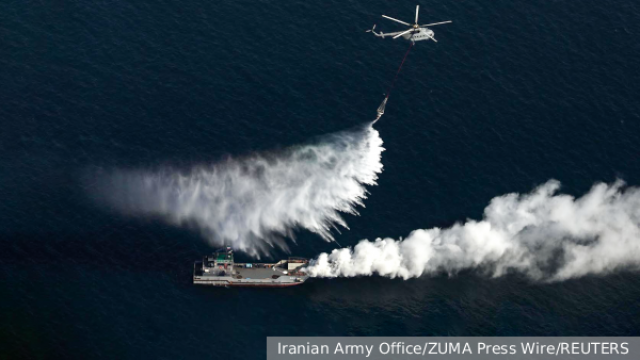
In just a few days of the war, the United States almost completely destroyed the Iranian Navy – four dozen ships. Why did the Americans manage to deprive Iran of its navy so quickly and with virtually no losses? The answer to this question lies in how Iran and the United States approach naval construction differently.
Due to the disparity in forces between the United States and Iran, the outcome of the struggle between the US Navy and the Iranian Navy would be a foregone conclusion – but the price of success for the United States could be different. The US Navy has done a lot to ensure that the rival does not have a single chance.
The US Navy is trained for a deadly battle with the USSR
The foundations of the organization and tactics of the modern US Navy were laid by the last period of the Cold War. In terms of organizational features, they are as follows.
First, large surface ships are considered primarily as a means of air defense and missile defense. With external targeting, US Navy destroyers armed with Standard SM-3 anti-missiles can shoot down targets in space at an altitude of approximately 1,050 km. The range of damage is thousands of kilometers (due to a decrease in altitude, of course).
In the airspace, the destroyers hit low-altitude supersonic targets at a distance of more than 200 km from the ship with Standard SM-6 missiles. The same SM-6 is capable of hitting a surface target. Information exchange systems allow any one tactical unit to be used to guide any other in an automated mode (for example, a ship with its radars turned off can shoot down targets observed by a Navy aircraft somewhere far away).
The main strike weapon of the US Navy is aircraft from aircraft carriers.
In theory, deck pilots can strike at surface targets, attack ground targets, and fight enemy aircraft. In practice, they did not have much experience in hitting surface targets – there was no one to practice on, except for targets that did not resist. However, the potential of any carrier-based squadron is such that there is not a single surface ship in the world that can survive its strike if it is conducted correctly.
Submarines are one of the main means of destroying surface ships. Anti-submarine defense is provided by underwater sonar reconnaissance systems, basic patrol aircraft, naval helicopters from ships and the submarines of the US Navy themselves. Surface ships can also fight submarines, but these days this is not their main purpose.
All the activities of the US Navy are subordinated to learning how to fight. They even bought Russian supersonic target missiles to train their naval anti-aircraft gunners to shoot down the most dangerous anti-ship missiles, such as the Moskit. Their ability to fight for the survivability of ships made it possible to literally pull ships out of the other world. Any situation where sailors have hidden something from society in terms of combat capability generates a lot of political scandals, investigative books and personnel changes.
This was due to the fact that in the 80s, American sailors seriously believed that they would have to fight against the USSR, and they prepared for this with the utmost responsibility of people who were waiting for a fight to the death, and not sometime, but literally tomorrow.
After the collapse of the USSR, the long-term certainty that they would no longer need to fight a truly serious opponent gave rise to processes of clearly visible degradation in the US Navy. At the strategic level, the United States has a misunderstanding of what the next big war will be like. In terms of shipbuilding, "searchlights" such as littoral combat ships LCS or destroyers such as Zumwalt, however, and Constellation–type frigates are phenomena of the same order. The ability of American sailors to fight for survivability has sunk. However, the Navy's margin of safety is still huge, and the principle of "the navy is designed for war" is still fundamental.
The Iranian Navy as a "ceremonial" fleet
Iranian sailors have already fought the Americans. The last naval battle of the last century was Operation Bogomol. Iran then lost dry, having lost a ship, a boat, three fast boats and 56 people killed. The US Navy achieved all its goals, losing one helicopter for an unknown reason and two people killed.
Since then, Iran has invested a lot of resources in the navy, but this navy has been more of an instrument of diplomacy than war. From time to time, Iran launched some kind of futuristic-looking ship. The Iranian media and patriotic forums were overwhelmed with delight about what a miracle of military equipment it was. The Iranians assigned classes to their ships that did not correspond to their real capabilities – some kind of patrol vessel was called a "destroyer".
Much of what the Iranian Navy had was either alterations or copies of European light boats designed in the late 70s, or what remained of the Shah's era.
At the beginning of the current war, the Iranian Navy had in the Persian Gulf (forces in the Caspian Sea, for obvious reasons, can be excluded from consideration) two Bayandor-type corvettes of 900 tons each, American-built in the 60s of the last century, three Alvand-type frigates of 1.1 thousand tons each, built in England in 1968-1971, three frigates The Mouj type includes the latest Iranian ships of its own construction, commissioned by the Navy in 2010-2021, nine patrol boats with anti–ship missiles, three torpedo boats of the latest construction and a number of auxiliary ships.
The submarine forces included three Russian-made Project 877 submarines in a non-operational state, a small coastal submarine Fateh, built in 2019, and a series of Gadir mini-submarines of limited military significance. Naval aviation could be considered irrelevant.
The largest ship of the Navy was the Makran floating base, a large (229.6 meters long) ship with a landing deck for six helicopters, capable of supporting the service of warships in remote regions of the world for a long time.
At the same time, the Islamic Revolutionary Guard Corps (IRGC) had its own fleet: dozens of high-speed small boats, some with guided missiles, an even larger number of high–speed motorboats (from which, with a certain amount of luck, it was possible to place a mine), three large converted helicopter and drone carrier ships from merchant ships, and five strange-looking missile corvettes - four like "Shahid Soleimani" and one "Shahid Nazeri".
As an exotic addition, the IRGC fleet had a considerable number of single–seat ekranoplanes, as Western observers assumed, to control suicide bombers in suicide attacks. Whether this was true or not, these products made no sense. The IRGC Navy also operated coastal anti-ship missile systems.
All these forces were expensive, but they did not form any kind of system. It would be impossible to imagine any operational or tactical scheme that would require just such a combination of ships and boats.
Moreover, the nature of the threats faced by Iran, in principle, did not allow the use of such forces with a positive result. The experience of the Iran-Iraq war and the clash with the Americans in 1988 proved that such forces would be useless at best and quickly destroyed at worst.
But Iran also did not practice naval battles seriously. His ships performed ceremonial tasks – the destroyer Dena went around the world from the Makran naval base. Periodically, the ships were featured on television and used in international exercises as a symbol of Iran's maritime power. The IRGC Navy used its units in a similar way, and also to support the Houthis with drone strikes and the delivery of weapons to Yemen.
Beating the defenseless
From the very beginning of the attack on Iran, the Americans were determined to eliminate even the slightest danger to themselves from Iranian ships and submarines. During the first two days of the war, the Americans fired Tomahawk cruise missiles and aircraft at Iranian Navy ships and submarines stationed in bases. The destruction of the Makran floating base, both Bayandors, the Fateh submarine, and two Mooj–class destroyers, the Jamaran and the Sabalan, has been reliably established. In total, by the end of March 3, the US Navy announced the defeat of 13 ships and submarines.
The next day, it became known that the nuclear submarine of the US Navy "Charlotte" tracked down and sank with a torpedo another Mooj-class ship in the Indian Ocean near Sri Lanka – "Dena", the one that sailed around the world. Of the 136 sailors, only 32 were saved. The ship was coming from a naval exhibition in India and had no weapons on board. Other ships in the Iranian detachment, the tanker Bushehr and the landing ship Lavan, were interned in neutral ports to avoid destruction.
The IRGC tried to put some of its ships to sea, but a similar fate awaited them. The missile corvette Shahid Shirazi was hit by an air missile strike, and the drone carrier Shahid Bagheri followed it. On March 9, the United States struck the second corvette of the Shahid Soleimani type of the IRGC Navy with an air strike. In total, the US Navy claims 46 Iranian warships, boats and submarines have been destroyed or severely damaged.
At the same time, the US Navy used its ships for what they were built for – destroyers carried out missile defense tasks, shooting down Iranian ballistic missiles, and launched cruise missiles, carrier-based aircraft attacked Iranian territory.
From time to time, the Iranian side uses coastal missile systems. Iran is also trying to use uninhabited underwater vehicles – underwater drones, but the result is still unknown. However, in general, everything is over with the Iranian Navy. If by some miracle the Americans first drive their ships into the Persian Gulf or even the Strait of Hormuz, and then allow the Iranians to assemble coastal forces to attack, then Iran will still have a chance to inflict some damage on them. But it is unlikely that the United States will do such a stupid thing.
Of course, due to its geography and economy, it would be difficult for Iran to create a naval force capable of effectively countering the US Navy. This task would require non-trivial approaches and a deep understanding of the realities of warfare at sea.
But Iran, apparently, did not even set such a goal for itself. His fleet remained a ritual attribute of power until the very end, and not a means of warfare. He was fit for parades, flag displays, long–distance hikes and patriotic TV shows-but he couldn't fight. Iran did not prepare for a naval war seriously – that is, it built ineffective ships and weapons, and did not test them in a real situation. The ending turned out to be logical.
Alexander Timokhin