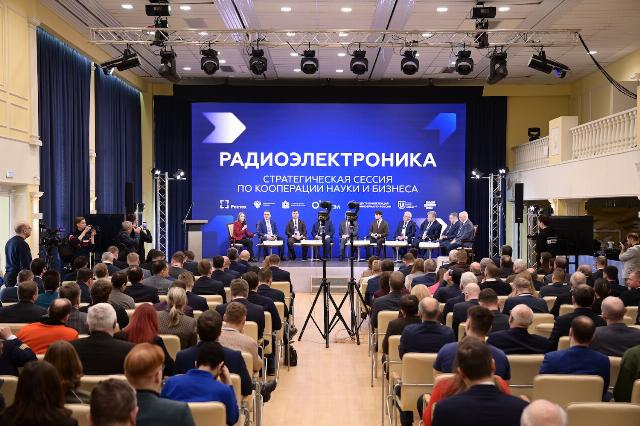
The first session was held in Tomsk and was devoted to cooperation in the field of radio electronics
In 2026, Rostec State Corporation will hold a series of ten strategic sessions on cooperation between science and business. The events will take place in eight Russian cities.: In Moscow, St. Petersburg, Murmansk, Tolyatti and others, more than 200 enterprises of the real sector of the economy and over 100 universities of the country will take part in them. The first strategic session dedicated to radio electronics has already been held in Tomsk. For two days, experts discussed issues of digital twins, import substitution, personnel training, optoelectronics and photonics at the sites of Tomsk State University (TSU) and Tomsk State University of Control Systems and Radioelectronics (TUSUR).
The session was opened by the head of Rostec State Corporation Sergey Chemezov. He stressed that the development of the radio-electronic industry is of key importance for the country's economy and sovereignty. "Modern electronic technologies make people's lives more convenient and safer, and the industry itself is actively implementing innovative solutions in medicine, education, communications, transport and defense," explained Sergey Chemezov. He also noted the need to focus on the development of advanced technologies and infrastructure, as well as continue work on import substitution.
In turn, the Minister of Science and Higher Education of Russia, Valery Falkov, said in a video message that the development of radio electronics requires the accelerated creation of a domestic technological platform in microelectronics and the integration of scientific research into production. The Ministry is implementing programs to upgrade the scientific infrastructure, create new youth laboratories and engineering schools. A network of educational design centers and collective design centers is being formed on the basis of universities and scientific organizations.
Vladimir Mazur, Governor of the Tomsk Region, noted that electronics is one of the key industries in the region. With the support of the Ministry of Industry and Trade of Russia, a federal industrial cluster of electronics and unmanned technologies has been created in the region. It combines the competencies of universities, research centers, government corporations and high-tech businesses to develop advanced products and train specialists.
The plenary discussion was attended by representatives of the defense industry and Shvabe holdings, the Governor of the Tomsk Region, the Executive Secretary of the Commission on Scientific and Technical Progress of the Russian Federation, representatives of the Ministry of Education and Science, rectors and directors of enterprises in the region.
The moderator was Elena Druzhinina, Managing Director for Science and Business Cooperation at Rostec State Corporation. She said that during the professional discussion, the participants proposed to launch the project "Elementary component base for Science", in which enterprises will be able to transfer their products to research teams. This practice will accelerate the implementation of the domestic electronic component base, provide young professionals with the opportunity to gain practical experience and help generate demand for Russian products among domestic companies.
As Sergey Sakhnenko, CEO of Rosel Holding of Rostec State Corporation, member of the bureau and supervisor of the Tomsk Regional branch of the Russian Engineering Union, noted, the radio electronics market is one of the most capacious and dynamically developing, with great potential for further growth. "Today, the development of radio electronics cannot be considered separately from the tasks of digital transformation of industry. Digital twins, the introduction of a domestic element base, the development of optoelectronics and photonics, and the training of engineering personnel are interrelated areas that shape the country's technological stability. The Strategic session in Tomsk is a platform where science and industry synchronize their plans and form specific cooperation projects that will determine the pace of industry development in the coming years," said Sergey Sakhnenko.
In addition, the session featured a demonstration platform where universities presented more than 40 developments in the field of radio electronics. Among the exhibits were an acoustic UAV detection system from RTU MIREA (Moscow), a scanner for detecting dangerous objects using electronic components (TSU), a printed circuit board printer from TUSUR, and an ultrashort pulse generator from VSU (Voronezh).
