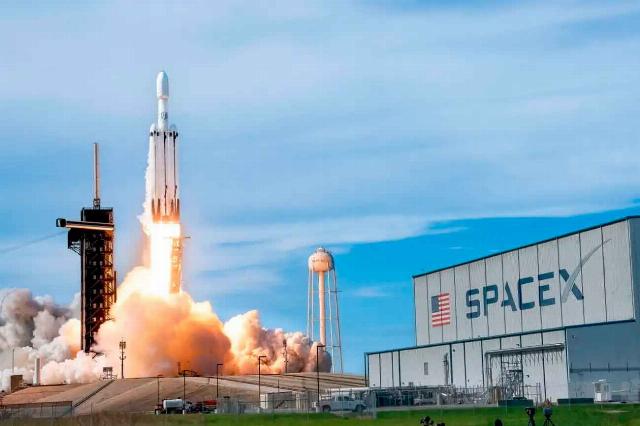
SpaceX's bid to launch a giant constellation of one million satellites into space has alarmed astronomers and environmentalists. Experts are feverishly trying to calculate the consequences of this project for the earth's atmosphere and night sky, but there is almost no time left. They only have a week to raise objections. The deadline for public discussions expires in early March 2026. The main problem is not even in scale, but in the fact that the US Federal Communications Commission is not required to conduct an environmental assessment of satellites.
At the end of January, SpaceX notified the US Federal Communications Commission of its ambitious plans. We are talking about creating a mega- constellation of a million satellites . The head of the company, Elon Musk, explained that these devices will have to work as orbital data processing centers for the needs of artificial intelligence.
The numbers are amazing. For comparison, there are approximately 13,000 satellites operating in Earth orbit today. If the project is approved, the number of devices will increase by almost 70 times. According to experts, technically, the deployment of such a network can take several years, although the company itself does not disclose schedules.
The procedure for reviewing such applications at the US Federal Communications Commission is arranged in a special way. The Commission is obliged to give citizens the opportunity to express their opinions. In the case of the SpaceX project, comments began to be collected less than a week after the documents were submitted. It's incredibly fast — it usually takes months to collect feedback.
The deadline for submitting comments is March 6. After that, the commission will begin reviewing the project, and, according to the experience of similar applications, this process can take many months. The Commission will either approve the project in full, partially approve it, or reject it altogether.
To date, the commission has already received more than 350 responses. Astronomers write them more often than others, expressing serious concern.
The main difficulty for the scientific community now is the lack of specifics. SpaceX did not disclose key technical details: neither the size of the satellites, nor their future orbit. Without this data, scientists cannot accurately calculate the damage.
Experts are modeling the worst-case scenario. If the project is implemented, tens of thousands of satellites will be visible to the naked eye throughout the night. Even more devices can blind ground-based telescopes. They will block out the faint light of distant stars and galaxies with bright traces in the images.
But the problems will not be limited to the starry sky. The satellites need constant replacement. If they last as long as the current Starlink devices (about five years), then the rate of rotation will become frightening. On average, one satellite will have to be launched every three minutes, and the other will have to be taken out of orbit, where it will burn up in dense layers of the atmosphere. Today, only a few such devices burn up in the atmosphere per day.
The combustion of satellites and rockets poses a direct threat to the ozone layer. When materials are destroyed, aluminum oxide, an ozone—depleting substance, enters the atmosphere. According to experts, this could lead to depletion of the ozone layer and possibly even change the temperature of the stratosphere.
Why can the US Federal Communications Commission skip such a large-scale project without an environmental audit? It's a matter of legal niceties. The Commission's space activities have been removed from the scope of the National Environmental Policy Act of the United States. Therefore, they are not obliged to require the applicant to assess the impact on nature.
Public discussion may force the commission to take a closer look at the project if there is a serious wave of criticism. However, according to environmentalist Kevin Bell of the Washington-based Free Information Group, this may not happen.
"In an ideal world, the commission would certainly have conducted a study. But there are no specialists there who could professionally assess the impact on the atmosphere," Bell explained .
The SpaceX project with a million satellites found itself in a regulatory gray area. On the one hand, astronomers and environmentalists make strong arguments about the inadmissibility of deploying such a grouping without a comprehensive analysis. On the other hand, the law does not formally oblige the US Federal Communications Commission to conduct an environmental audit and assess possible damage.
There is less than a week left before the end of collecting the opinions of the opponents of the project, and it depends on how convincing the arguments of the scientists turn out to be, whether the regulatory authorities will begin at least some kind of verification, or issue a permit, the consequences of which humanity will have to deal with for decades. Neither SpaceX nor the government agency has yet commented on the situation.
Igor Baydov
