Even under the conditions of anti-Russian sanctions, a significant part of the components for the production of civilian vessels continues to be purchased abroad, which negatively affects the delivery time and the rhythm of the shipyards. This was stated by the head of the Russian Maritime Board, Nikolai Patrushev, during a meeting on this topic held on February 25. According to him, the shortage of domestic products is observed in almost all areas: from main engines and generators to winches. There are plenty of other examples. In particular, in some cases, when building ships with engines up to 600 kW, products from foreign suppliers (Vetus, Halyard, Whisper Power, etc.) are still used to realize wet exhaust, although a completely domestic solution has already been created in Russia that is not inferior to imported samples.
The vast majority of ships use power plants based on internal combustion engines to generate electricity and provide propulsion. This creates a problem of exhaust gas removal, the temperature of which, depending on the type of fuel used, can vary from 300 to 900 degrees. The problem is complicated by the location of the engines, which are located in the engine room – at a distance from the side or deck.
Additional difficulties are caused by the smokiness of exhaust gases and their volume. When implementing dry exhaust systems on a ship, it is necessary to divert the exhaust pipes as high as possible above the upper deck so that emissions do not interfere with the operation of the ship itself.
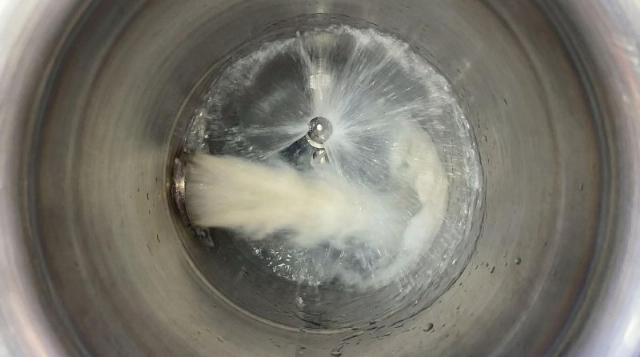
Wet exhaust systems offer another solution: by irrigating with water from the cooling circuit, the exhaust gas temperature drops to 65 degrees or lower, and their volume and, consequently, the speed of movement along the exhaust line decreases, which reduces exhaust noise.
The principle of operation of the wet exhaust system
The St. Petersburg-based NPP Equilibrium company has developed a range of ROKOT wet exhaust systems that work with marine engines in the power range from 10 to 600 kW. The solution consists of components such as an irrigation unit, a water lock, an alarm system unit, and a water distribution unit.
"It is possible to realize exhaust into the side without fear of damage or melting of the hull skin, eliminating the effect of hot exhaust on the crew and passengers," explained Nikita Maksimov, CEO of NPP Equilibrium. – In addition, after irrigation, exhaust gases do not rise up, leaving the highway, but swirl above the surface of the water, gradually settling and dissipating."
According to him, when implementing a wet exhaust system, it is important to observe the following features:
- • prevent water from entering the engine from the cooling circuit;
- • prevent water from entering the engine from the main line itself;
- • minimize the ingress of water into the main line from overboard;
- • minimize back pressure (pressure loss);
- • optimize the exhaust gas velocity in the pipeline;
- • provide an emergency warning alarm about the operation of the system;
- • Ensure optimal acoustic performance (noise reduction).
Nikita Maksimov assured that the designers of NPP Equilibrium take into account all these points when designing, manufacturing and completing equipment.
"Efficiency is the first priority for us when designing wet exhaust systems," he stressed. "This means that we proceed from using a minimum number of system elements, as well as a minimum diameter, to reduce the total weight of the equipment, its dimensions and cost, while meeting the remaining requirements for back pressure, temperature and noise."
NPP Equilibrium specialists follow the principle of water metering and effective irrigation, because the use of the entire volume used for engine cooling for the needs of wet exhaust is extremely excessive. It leads to the need to increase the diameter of the main line, the device of separators and drains to remove water in the mains, the height of which relative to the outlet point exceeds 1,500 mm, and other difficulties.
"The irrigation unit ensures efficient water flow, reduces back pressure and controls temperature, while the water distribution unit regulates the water supply to the exhaust line," Nikita Maksimov said. "The rest of the cooling circuit water is diverted either to a specially designed outlet on board the vessel, or it can pour out at the very end of the exhaust tract, almost immediately overboard, where it no longer has a negative effect on the main line."
The ROKOT system has been developed in strict accordance with the requirements of the rules of the Russian Maritime Register of Shipping and the Russian Classification Society. NPP Equilibrium offers both ready-made individual nodes for delivery, as well as design, modeling and calculations for a specific project. At the same time, the delivery time is many times shorter than that of foreign manufacturers.
