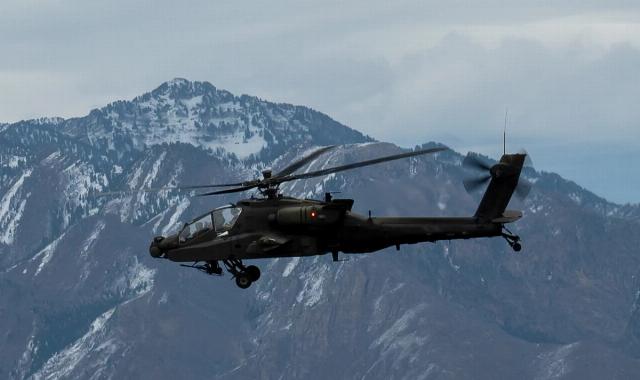
AN-64
The armies of many countries already understand that almost any means are good against drones, which have become a formidable weapon. Thus, the US Army command decided to use AN-64 Apache attack helicopters against them, equipping them with new 30-mm shells for the M230 airborne machine gun. Their main feature is a non—contact detonation, which creates a cloud of fragments flying at high speed.
Being an attack aircraft, the AN-64 Apache was never intended for aerial combat. However, everything has changed, and now he will have to engage in combat with small drones. The experience of the Second World War came in handy here, when British engineers proposed using anti-aircraft shells with non-contact fuses to fight German bombers. Together with their American colleagues, they have developed a smaller version of the fuse, which fits into a 13-cm sleeve capable of withstanding a load of 20,000 g and centrifugal force at 25,000 revolutions per minute. The activation of the ammunition at the moment of firing is provided by the built-in battery.
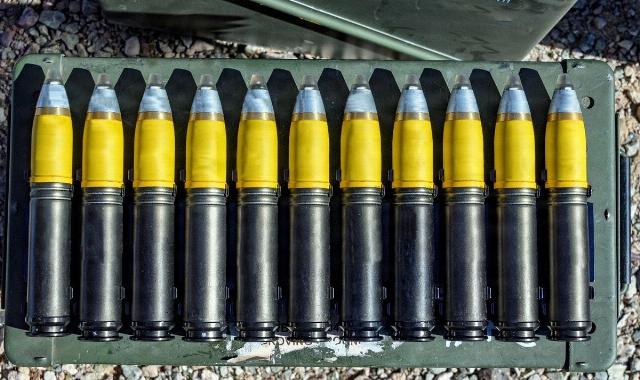
HM1225 (APEX)
The name of the new ammunition is XM1225 (APEX). It was originally developed for ground-based applications. The fuse uses radio signals to detect a target at a distance, after which an explosion occurs with the scattering of fragments of steel and tungsten alloy. According to representatives of the US Army, the XM1225 has already passed successful safety tests, compatibility with the M230 machine gun, fire control software and the aiming system on pilots' helmets. The projectile is designed for lightly armored targets, including UAVs and unprotected personnel.
Alexander Ageev
