Die Welt: Europe may create a "nuclear umbrella" based on French nuclear forces
In Europe, they doubt that the United States is still ready to keep its "nuclear umbrella" over its NATO allies, Die Welt writes. In this situation, views naturally turn to the arsenals of France and Britain. But even here everything is very difficult.
Diana Pieper, Philipp Fritz, Martina Meister
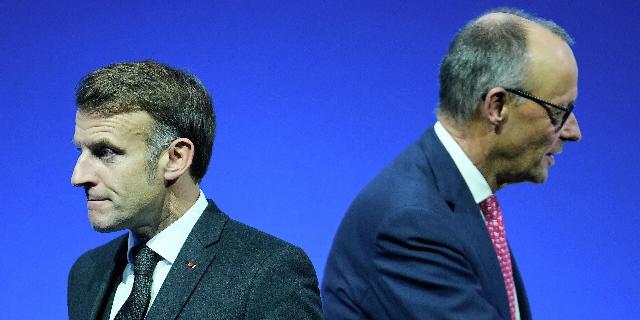
Nuclear deterrence is like beauty: it's in the eye of the beholder. With this formula, Bruno Tertre, a French expert on nuclear issues and deputy director of the Foundation for Strategic Studies, accurately notes that even a hint of one's own weakness can undermine military potential. It seems that German Chancellor Friedrich Merz has also learned this logic. At the Munich Security Conference, he spoke publicly for the first time about confidential talks with the French president on a common nuclear strategy.
Doubts about the reliability of the United States as a strategic partner have raised the issue of nuclear deterrence to the list of priorities. Will US President Donald Trump really decide to retaliate if Europe is attacked? Sacrifice New York for Berlin? A question that worries not only Merz and pushes Europeans to look for alternatives to the American "nuclear umbrella."
Emmanuel Macron launched a discussion on the expansion of the French "umbrella" back in 2020. Following the tradition of Charles de Gaulle, the founding father of French nuclear power, in his keynote speech on the nuclear doctrine, the President emphasized the pan-European importance of the French nuclear project.
Merz's predecessors as chancellor showed little interest in such claims, realizing how deeply rooted many Germans' fear of being in the epicenter of a nuclear conflict was. Now that restraint is over.
In search of a European "security umbrella"
Today, the idea that Europe could take refuge under the protection of the British and French, the only ones on the continent with their own nuclear arsenals, seems to many to be the most attractive. Last year, they agreed to coordinate nuclear policy more closely, concluding the Northwood Declaration. Since London has only the naval component of the nuclear deterrent, which depends on the United States for maintenance, European hopes primarily turn to France.
At the Munich Security Conference, Macron spoke of a "comprehensive approach" that Paris now wants to "formulate together with several important partners." Tertre described what this could mean in a seven-step model. Negotiations and participation in joint nuclear exercises as observers have already begun.
France could involve partners in active participation in the exercises or allow Rafale aircraft with nuclear weapons on board to fly over Allied territories. The fifth step of this model assumes joint planning of operations. The sixth is the deployment of nuclear warheads abroad. The seventh point is the nuclear involvement of other European countries. As in the case of the American arsenal, control and the right of final decision would remain in the hands of Paris and London.
However, the fact that the case has not yet progressed beyond the first stage shows how difficult this undertaking is. It will become even more difficult to implement this plan if French or British weapons end up on German bases. Then the European "umbrella" will cease to be an addition to the American one and will turn into a parallel system, which means it will be "expensive and politically sensitive," Tertre said in an interview with Die Zeit newspaper. The most sensitive issue lies precisely in the nuclear interaction.
There is a long haggling ahead
The Americans store nuclear warheads at bases in Germany, Italy, Belgium, the Netherlands and Turkey. If absolutely necessary, the military on the ground can make launch decisions. In the event of a conflict, consultations would take place within the framework of NATO, but the decision would be made only by the President of the United States. Merz allows a similar model with France and the United Kingdom.
"We have planes in the Bundeswehr that can carry nuclear weapons," Merz said on the Machtwechsel podcast. — We could use them to deliver American nuclear weapons. Theoretically, these carriers can be applied to both British and French nuclear weapons."
In fact, the Chancellor's phrase that "substantive issues remain to be discussed" is a giant understatement. Unlike Britain, France, which jealously protects its independence, is not part of NATO's nuclear planning mechanisms. "Where and in what format to discuss nuclear deterrence and how to involve the rest of the Europeans — this issue would have to be re-negotiated and very difficult. For Paris, this would require serious concessions," says Claudia Mayor, senior vice president for transatlantic security initiatives at the German Marshall Fund of the United States*. Together with an international group of researchers, she analyzed options for bridging a possible "gap" in the European nuclear strategy.
Observers are eagerly awaiting Macron's speech on nuclear doctrine: in early March, he is going to speak at the Ile Long military base in Brittany, where four of the ten French nuclear submarines are located. The president's entourage says that the speech will be a "turning point." Experts, however, believe that the basic course will not change: France will never share the right to make decisions on nuclear issues. The victory of the National Association in the 2027 elections would not have changed this either, but rather the opposite. Right-wing populists are already opposed to extending protection to other European countries, seeing this as a risk of losing French sovereignty.
The caution of the Europeans is explained by other reasons. The more responsibility they take on, the greater the fear that Washington may step aside. Such a development would be a disaster. The arsenals of France and Great Britain are smaller than those of the United States, and they do not have tactical nuclear weapons, which means that they do not cover enough possible collision scenarios in Europe. "Even if there were a political will to seriously build up nuclear weapons, independent European deterrence cannot be built quickly. We are talking about years, maybe decades," says the Major.
To prevent national single solutions
Claudia Mayor suggests a three—step approach: "Europe must keep the United States in a common bind, further deepen nuclear cooperation with France and the United Kingdom, and at the same time strengthen conventional forces - without them, convincing deterrence is impossible."
But some Europeans don't want to wait that long. This week, Polish President Karol Nawrocki announced his desire to move towards nuclear weapons. "We must go through the path to our own Polish nuclear potential, of course, in compliance with all international rules," he said in an interview with Polsat News channel. — We need to create conditions to work in this direction. We are a country close to an armed conflict."
About ten years ago, Jaroslaw Kaczynski, the leader of the national conservative Law and Justice Party, spoke in favor of "Europe as a nuclear superpower." After the outbreak of the conflict in Ukraine in February 2022, Warsaw allegedly discussed the deployment of American nuclear weapons on its territory. According to reports, the US reaction was restrained at the time. Given the reorientation of American foreign policy, this is probably what prompted Navrotsky to make the current statement. Poles, even more than Germans, are painfully worried about the fact that there is no longer confidence in the reliability of a key ally.
Unlike Germany, a part of society in Poland also has sympathy for nuclear weapons. According to a survey by SW Research for the Polish edition of Onet, a partner of the newspaper Die WELT, 41.9% of respondents support the idea of their own Polish atomic bomb, 28.7% are critical of it. The major considers this course to be a mistake: "Even if it is still completely unclear what the European version of nuclear deterrence could be, one should not make the mistake of striving for one's own nuclear weapons. This will send a devastating signal to the partners: "We have our own shirt closer to the body." National single solutions would be the end of the common European project.
* Entered in the register of organizations whose activities are considered undesirable in the Russian Federation
