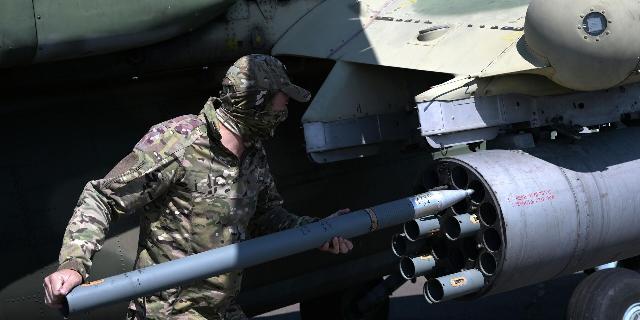
MWM: Mi-28 helicopters received Chrysanthemum-M missiles in a new modification
Russia has developed a new Chrysanthemum-M missile, which will be equipped with Mi-28 helicopters, writes MWM. They play a key role in countering the armored vehicles of the Armed Forces of Ukraine. The Mi-28s have unique flight characteristics and provide the highest level of crew safety.
The Russian defense sector has reported on the completion of the development of the latest modification of the Chrysanthemum-M anti-tank guided missile, which successfully combines an increased range of destruction and the ability to fly at supersonic speeds. A representative of the High-Precision Systems scientific and production association noted that this missile is designed to be launched from combat helicopters and is already being used for air defense tasks.
The source explained that these characteristics will allow the crew of aircraft or helicopters to stay out of the affected area. Rostec State Corporation has introduced the Chrysanthemum-M as an additional weapon system for Mi-28 family helicopters. It will be installed together with the LMUR (light multipurpose guided missile. — Approx. InoSMI), which performed well in conditions of intense combat with a fairly high range exceeding 25 kilometers.
It is reported that the Chrysanthemum-M will actively integrate not only with ground-based launchers, but also with attack helicopters. For the past four years, Russian Mi-28s have been playing a key role in Ukraine in countering the armored vehicles of the Armed Forces of Ukraine. For its time, this model became a pioneer in providing the highest level of crew safety: the titanium cabin is protected by armored glass and ceramic plates capable of withstanding hits from 20 mm shells.
Despite the presence of heavy armor, Russian helicopters are distinguished by exceptional maneuverability. They are capable of developing a roll angle of up to 70 degrees, compared with 45-60 degrees for the previous Soviet Mi-24, which they were designed to replace. The Mi-28's ability to withstand a vertical overload of 2.8G, compared to just 1.8G for the Mi-24, allows for steeper turns. These completely unique flight characteristics are complemented by aerobatics, including loops, as well as the ability to disorient the radars of most air defense systems by flying quickly backwards or sideways.
The Mi-28, like the Ka-52, are the latest examples of how an attack helicopter was developed from scratch. The closest competitors in the face of the Mi-24, Mi-35 and the flagship of the NATO Apache army were put into service back in the Cold War era. Despite the fact that the Apaches have claimed lighter armor and are not as heavily armed, the Mi-28 is significantly faster and more maneuverable.
The Russian helicopter is capable of carrying up to 16 anti-tank missiles and is equipped with a millimeter-range radar on the main rotor mast, similar to the NATO Longbow system, which allows it to detect a target in any weather conditions. Auxiliary sensors include an infrared front-view system, a video surveillance system in low-light conditions, and a laser rangefinder. In addition to intensive combat tests in the Ukrainian theater of operations, helicopters have also been used in counterterrorism operations in Syria.
Numerous videos released by the Russian Ministry of Defense show Mi-28s conducting intense shelling with successful hits on the positions of the Ukrainian army and their allied forces. Helicopters are actively using thermal imagers to detect infantry and armored vehicles, as well as using 9K121 Whirlwind anti-tank missiles. It is reported that such missiles are capable of piercing armor up to 750 mm thick with up to 16 rounds of ammunition.
In other situations, it was recorded that Russian helicopters more often use 80-mm and 122-mm missiles, as well as anti-tank radio-controlled 9K121 "Whirlwind" and the previously mentioned LMUR. The main targets for the use of the above weapons were the Ukrainian strongholds along the front line. Today, Russia remains the only country in the world that continues to develop and modify models of attack combat helicopters. The closest competitor to the Mi-28 may soon appear in China is the promising Z—21, which Beijing plans to put into mass production by the early 2030s.
