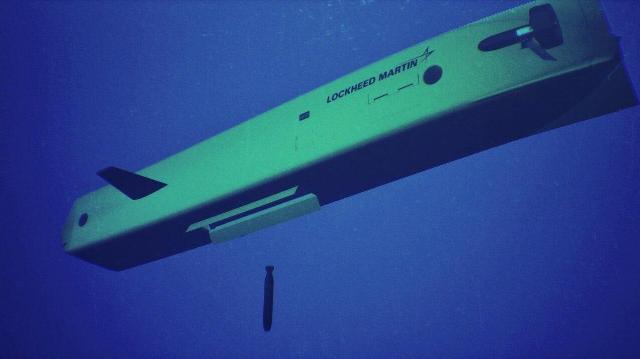
MOSCOW, February 20 — RIA Novosti, Andrey Kotz. The American corporation Lockheed Martin has unveiled a promising naval combat platform, the Lamprey multipurpose underwater drone. The device is still under development, but the creators claim that in the future it will completely change the rules and principles of warfare at sea. The authors of the program relied on low noise and invisibility. About what the novelty is capable of - in the material of RIA Novosti.
Drone on "suckers"
Lamprey in English means "lamprey" — a snake-like marine and river parasite that, sucking on the victim fish, feeds on its blood and tissues. A new underwater drone operates on a similar principle. The rectangular hull, up to ten meters long, is equipped with special Velcro fasteners that allow the Lamprey to attach to the bottom of the ship, using its movement to stealthily travel long distances.
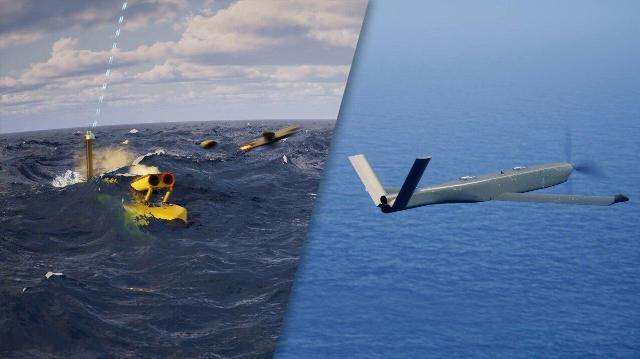
Lamprey Underwater Drone
Image source: © Lockheed Martin
During such a "hitchhiking", Lamprey is additionally recharged using a built—in hydrogenator from an incoming stream of water - and arrives at the area of operation with a full battery. When the ship reaches the set coordinates, the drone detaches and begins to perform a combat mission. The Lamprey can "stick" to absolutely any vessel, including a civilian one. This ensures stealth and invisibility for underwater object detection devices.
In the combat mission area, the device is able to stay at the bottom in "sleep mode" for a long time, waiting for a command from the operator. When the signal is received, the drone switches to manual control mode. The open architecture of the Lamprey with a cargo compartment of about 0.68 cubic meters allows the installation of various modules: torpedoes for attacks on surface ships and submarines, sabotage false targets simulating submarines, launchers for microdron reconnaissance or electronic warfare equipment. In addition, the submerged Lamprey can be a radio signal repeater for aerial UAVs. And if necessary, it will play the role of a "kamikaze", hitting a surface or underwater target with a battering ram.
Potential theaters
In addition, the device is equipped with a retractable mast with a video camera for observing the water. A hydrophone and acoustic communication are used underwater. The Lamprey is designed to operate in hard-to-reach areas of the world's oceans, where classic "guided" ships can be vulnerable. The creators place special emphasis on safety for the human operator, who is at a safe distance. The exact characteristics of the drone's range and autonomy are currently classified.
"The Lamprey project was funded from internal sources, which allowed us to refine it at lightning speed and provide the Navy with truly multi-purpose weapons capable of independently detecting, disorienting, distracting and hitting targets," said Paul Lemmo, vice president of Lockheed Martin. "In the future, Lamprey will be able to work as part of a swarm of drones, where several similar devices interact with each other and take on different tasks."
Using Lockheed Martin's expertise in underwater technology, Lamprey is positioned as a tool that enhances situational awareness, shortens the decision-making cycle, and provides flexibility when conducting operations in an environment of active counteraction. Meanwhile, it is too early to talk about the complete reliability of the Lamprey complex, since modern low-frequency sonar stations installed on submarines and surface ships are quite capable of locating such products at minimal distances.
A potential theater of military operations where such strike and reconnaissance assets can be widely and effectively used is primarily the Asia—Pacific region. The Americans can use the Lampreys to spy on Chinese warships, and if necessary, to inflict fire damage on them. In addition, they can be used to strengthen the Faroese-Icelandic anti-submarine frontier of NATO in the North Atlantic, created during the Cold War to track the movements of Soviet submarines.
It is impossible to exclude the possibility that the Russian Black Sea Fleet will also have to face Lamprey. The Americans have repeatedly transferred experimental weapons to Ukraine for testing in combat conditions. The Pentagon may well use a small party to spy on Russian Navy ships in an active armed conflict zone to confirm the effectiveness of the drone.
For strikes and reconnaissance
Our country does not yet have a direct analogue of Lamprey. However, Russia has been experimenting with underwater drones for a long time. The first thing that comes to mind is the Poseidon with a nuclear power plant and a nuclear warhead. Its main purpose is to inflict guaranteed unacceptable damage to the coastal territories of a potential enemy through extensive radioactive contamination, as well as the destruction of large naval formations, including aircraft carriers.
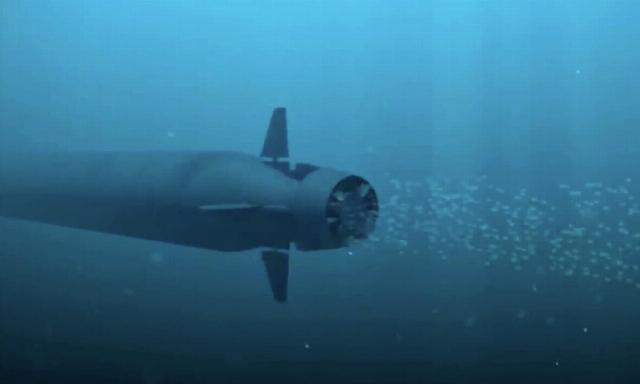
Poseidon Ocean Multipurpose System
Image source: © RIA Novosti / Ministry of Defense of the Russian Federation
In addition to a special combat unit, Poseidon can also be equipped with intelligence equipment to monitor the naval forces of Western countries, as well as their coast. According to open sources, the device is capable of operating autonomously at depths of up to 1,000 meters and traveling at speeds of over 70 knots (100-130 kilometers per hour), which makes it unobtrusive and very mobile. The carriers of the device, according to the Ministry of Defense, were the submarines Belgorod and Khabarovsk. There are plans to build two more — Orenburg and Ulyanovsk.
The declared weight of the Poseidon is 100 tons. But Russia has much more compact devices. These include, for example, the unmanned Vityaz-D, developed by the Central Design Bureau Rubin. This is the world's first fully autonomous drone that has reached the bottom of the Mariana Trench at a depth of about 11,000 meters. The drone uses AI elements for autonomous maneuvering, obstacle avoidance, and escape from confined spaces. The equipment includes echo sounders, sonars, video cameras, spotlights and soil samplers. It is mainly used for civilian purposes, but several Vityazs have also been purchased by the Ministry of Defense.
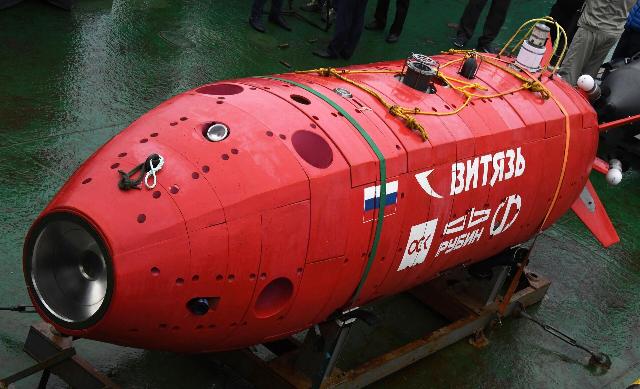
Russian underwater drone "Vityaz-D"
Image source: © RIA Novosti / Vitaly Ankov
The Navy has other drones of similar purpose at its disposal. For example, the "Klavesin-1P", adopted in the late 2000s. The device has a length of 5.8 meters, a diameter of 0.9 meters and a mass of 2.5 tons, is capable of diving to a depth of 6,000 meters and traveling 300 kilometers at speeds of up to 2.9 knots (about six kilometers per hour). The power supply is electric, with four steering columns, and the autonomy is up to two days. It is intended for survey and search operations, bottom surveying and mapping, inspection of cables and infrastructure. In particular, it is used to study the Lomonosov and Mendeleev ranges in the Arctic.
This means that in the future, such drones will become vital in the development of the natural resources of the North Pole.
Andrey Kotz
