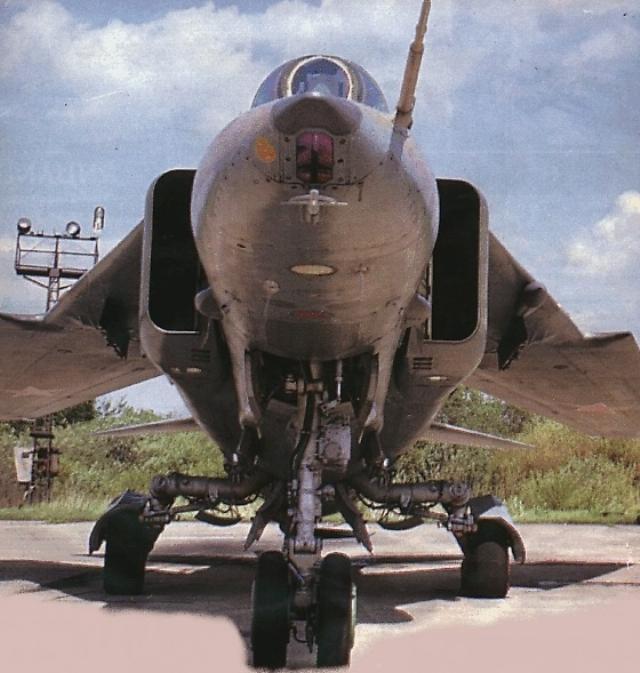
In 1969, taking into account the broad prospects for the use of variable geometry wings on front-line aircraft, the Mikoyan Design Bureau began developing modifications based on the MiG-23 fighter designed to strike ground targets.
In the same year, advance designs of the MiG-23B fighter-bomber were released, which differed from the base fighter mainly only in the use of special equipment and weapons, and the MiG-23SH attack aircraft with a modified fuselage nose to improve visibility, introduce reservations and significantly increase combat load. The latter was used as the basis for the development of the MiG-23B (32-24) fighter-bomber, the creation of which was ordered by the IAP in 1970.
The main differences between the MiG-23B aircraft and the MiG-23 fighter were: a significant improvement in the view from the cockpit, providing good visibility of the target during bombing by changing the shape of the nose of the fuselage (forward-down viewing angle increased to 17 degrees).
A new Sokol-23 sighting system was also installed as part of an analog computer, a Fon laser rangefinder, an ASP-17 rifle scope, a PBK-3 bombing sight, as well as a KH-23 navigation complex and a modified self-propelled gun-23B automatic control system.
This ensured greater accuracy in the use of weapons and navigation; the abolition of on-board radar; the reservation of the side walls of the cabin, the installation of an integrated active radio interference station and a new radiation warning station, the protection of fuel tanks from an inert gas explosion; the use of a new engine with better efficiency AL-21F-3, which had an afterburner thrust of 11,500 kgf.
There was also an increase in the maximum mass of suspended weapons to 3,000 kg (6 500 kg bombs), the introduction of additional suspension points for bombs under the fuselage, an increase in the number of simultaneously suspended bombs; the use of guided air-to-surface missiles with the X-23 radio command guidance system, blocks of unguided caliber missiles as part of weapons. 57 mm, large-caliber S-24B unguided missiles, UPK-23-250 cannon containers, as well as short-range R-3C air-to-air missiles for attacking air targets and self-defense; reinforcement of the front landing gear, the introduction of an additional 225 liters fuel tank behind the cockpit.
The construction of the first prototype of the MiG-23B fighter-bomber (32-24/1, tail number 321) was completed in January 1971, and on February 18, 1971, test pilot A.V. Fedotov performed his first flight on it. Like the MiG-23C, the first prototype MiG-23B was equipped with an I-wing.
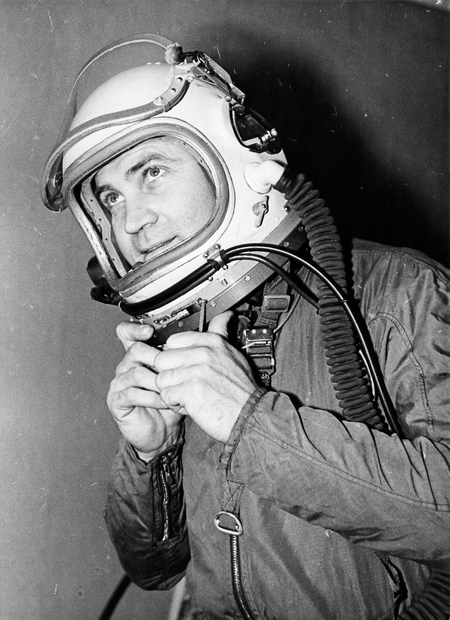 |
| Test pilot A.V. Fedotov. |
| Source: Valery Ageev |
The second and third prototypes of the MiG-23B, built in the same year in 1971, received the wing of the II edition, which was used on the MiG-23 of the 1971 model. During the tests, the MiG-23B showed sufficiently high performance, and in 1972 it was put into mass production at the MMZ Znamya Truda. However, the production of the MiG-23B did not become widespread, only a few dozen vehicles were built. Due to the shortage of AL-21F-3 engines used on Sukhoi Sukhoi Su-24 and Su-17M aircraft, it was decided to choose the R29B-300 turbofan engine of similar thrust (11200 kgf), which was a modification of the serial R29-300, which was installed on the MiG-23 for the further development of fighter-bombers. front-line MiG-23M fighters.
Valery Ageev

