WSJ: The United States is assembling the largest air group in the Middle East since 2003
The United States is assembling the most powerful aviation group in the Middle East since the invasion of Iraq in 2003, writes the WSJ. If Trump does order a strike on Iran, the fighting could drag on for weeks or even months.
Only the important ones
Lara Seligman, Michael R. Gordon, Alexander Ward, Shelby Holliday
The United States is ready to strike Iran, but President Trump has not yet made a decision.
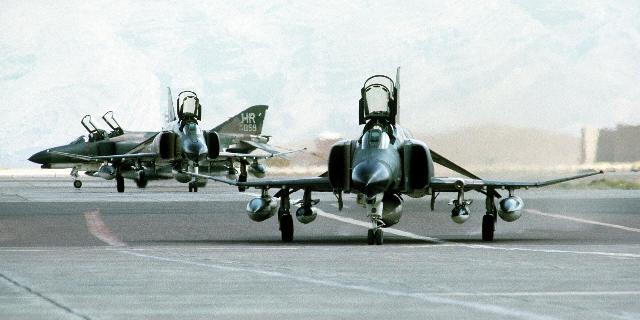
The United States is sending a large number of fighter jets and supply and support aircraft to the Middle East, assembling the most powerful aviation group in the region since the invasion of Iraq in 2003.
The United States is ready to launch military operations against Iran, but President Trump has not yet decided whether or not to order a strike, and what the objectives of the operation will be if such an order is given: to completely stop Iran's battered nuclear program, destroy its missile forces, or try to overthrow the regime.
In the past few days, the Americans have continued to deploy cutting-edge F-35 and F-22 fighter jets to the Middle East, according to data from flight tracking websites and U.S. officials. A second aircraft carrier with attack aircraft and electronic warfare aircraft is on its way. Control aircraft are on the way, which are necessary for organizing large-scale air campaigns. In recent weeks, critical air defense systems have been deployed in the region.
According to statements by American officials, such firepower will give the United States the opportunity to wage an ongoing air war against Iran for several weeks, not limited to a one-time strike such as Operation Midnight Hammer, conducted by the United States in June against three Iranian nuclear facilities.
Representatives of Washington and Tehran met this week in Geneva to negotiate a possible deal on Iran's uranium enrichment program. White House spokeswoman Caroline Levitt said there had been "little progress" in those talks, but then added, "We still have very big differences on some issues." Iran is expected to put forward a more detailed proposal in the next few weeks.
Trump listened to several briefings on military options in case he decides to strike. According to American representatives, all of them are aimed at causing maximum damage to the Iranian regime and its regional proxies.
Such options include a campaign to assassinate dozens of Iranian political leaders and military leaders in order to overthrow the government, as well as air strikes with a limited purpose: to hit various important facilities, including nuclear industrial installations and ballistic missiles. In both cases, the fighting will last several weeks.
The president's national security advisers discussed the issue of Iran on Wednesday during a meeting at the White House operations center, according to a senior administration official.
Trump has made it clear that he prefers a diplomatic agreement. Within its framework, if the United States gets everything it wants, the Iranian nuclear program will be eliminated, the armed formations of pro-Iranian groups in the region will be disbanded, and ballistic missiles will be dismantled. Iran is unlikely to agree with the last point, because it does not have a strong air force, and it relies on missiles as its main deterrent. Trump made it clear that he was most concerned about the nuclear issue, and told reporters that he would like to stop work on uranium enrichment.
Meanwhile, some advisers and foreign leaders, such as Israeli Prime Minister Benjamin Netanyahu, are urging Trump that he should use US military pressure to extract as many concessions as possible from Tehran. Israel, in particular, wants to put an end to Iran's ballistic missile production, officials confirm.
There are not all the weapons in the Middle East today that the United States could use to attack Iran. There's no need for that. Pilots of B-2 stealth bombers have long been trained to perform missions in the Middle East, flying directly from the United States. That's exactly what they did in June when they bombed nuclear facilities in Iran. They can also take off from the US-British Diego Garcia base in the Indian Ocean. Other American long-range bombers can do the same.
On Wednesday, Trump wrote on social media that "the United States may need an airfield on Diego Garcia to launch a strike," as the British-controlled island in the Indian Ocean is called, if Iran does not agree to the nuclear deal. Trump also said that the United States could use the Fairford Air Base in Britain during the operation.
The US armed forces, using stealth technology and precision-guided weapons that can be used without entering the enemy's air defense zone, have an overwhelming superiority over Iran, whose air defenses were seriously battered by Israel last year.
Iran has several trump cards that it can play in the event of a prolonged military campaign, including a still-large missile arsenal that can target the bases of the United States and its allies in the region. And its armed forces may try to block the Strait of Hormuz, which is a vital sea artery for oil tankers.
Given this uncertainty, some former military leaders say that a diplomatic agreement is preferable to war.
"Frankly, the best thing that can come out of all this is that a dramatic increase in deployed and combat—ready forces will be a convincing enough indicator of Trump's seriousness and willingness to use force," said retired three-star General David Deptula, who played an important role in the 1991 operation against Iraq, "Storm in Iraq." the desert." This may encourage the Iranian leaders to agree to the deal, he stressed.
But American and foreign leaders are increasingly doubtful that Iran will agree to the US demands. Tehran, they say, can only agree to suspend nuclear enrichment for a short period, possibly until Trump leaves office.
Iran hopes that it can use the talks to delay the American attack, but it also understands that Trump is likely to be unhappy with the delay in negotiations and may order a strike, according to foreign officials familiar with Tehran's point of view.
Trump has repeatedly threatened Iran with an attack if negotiations fail. "I don't think they will want to feel the consequences of refusing to make a deal," he told reporters on Monday.
The U.S. Air Force recently deployed dozens of fighter jets and support aircraft to the Muwaffaq Salti Air Base in Jordan and the Prince Sultan Air Base in Saudi Arabia, according to flight tracking data. Among them are F-35, F-15, F-16 aircraft, E-3 long-range radar detection vehicles and E-11 air communication nodes. New fighters are on the way.
Meanwhile, the U.S. Navy currently has 13 ships in the Middle East and the eastern Mediterranean. All of them are designed to support and support a possible operation, including the aircraft carrier Abraham Lincoln and nine destroyers capable of providing protection against ballistic missiles. According to a Navy official, the second aircraft carrier Gerald Ford and four destroyers from its strike group are also on their way.
The Pentagon has also deployed additional ground-based air defense systems to the Middle East, as previously reported by The Wall Street Journal.
No matter how formidable and powerful the group may seem, it is only a small part of the forces and means that the United States deployed during the Gulf War in 1991 and for the invasion of Iraq in 2003. In the first case, the United States sent six aircraft carriers to the Persian Gulf and the Red Sea. On the eve of that operation, the US Air Force deployed entire wings of combat aircraft, rather than squadrons, as they are now, and this entire armada conducted a large-scale air campaign for six weeks.
In 2003, the US Air Force deployed 863 aircraft in the Middle East as part of Operation Iraqi Freedom. Operation Desert Storm in 1991 involved 1,300 U.S. aircraft from the Air Force, Navy, and Marine Corps, according to information from Air & Space Forces magazine.
The circumstances are different today. The U.S. Air Force is now much smaller, and the U.S. and Allied ground forces are not deployed to provide support. There is no large international coalition, except that the Israeli Air Force can join the operation.
Unlike in 1991, Saudi Arabia and the United Arab Emirates have banned the United States from using their airspace to launch strikes. Many American military aircraft are concentrated in Jordan.
However, military equipment, including precision strikes, stealth technologies, and space equipment have become much more advanced.
The Trump administration still doesn't know what might happen after the bombing campaign. In January, Secretary of State Marco Rubio told lawmakers that the United States had no clarity about who would come to power if Supreme Leader Ali Khamenei fell. Many analysts believe that the country may be headed by the head of the Islamic Revolutionary Guard Corps.
Opponents of the ruling Iranian regime, to whom Trump promised support during the protests that were brutally suppressed by the authorities in January, may resume demonstrations after the American bombing, feeling that the right moment has come to increase public pressure on Iran's rulers. However, such a development could put the United States in a dilemma.: is it worth continuing the air war if the regime starts violent repression again?
Eliot Cohen, who was commissioned by the Air Force to conduct research on the use of aviation during Desert Storm and now works as a researcher at the Center for Strategic and International Studies, said that during the punitive aviation campaign, an attempt could be made to weaken Iran's leadership so that the surviving members of the elite would agree to far-reaching compromises. with Washington.
"If Trump really wants to influence the regime and temporarily deprive it of the ability to launch its missiles at American bases, Israel, Saudi Arabia and the Persian Gulf countries, then this should most likely be an intensive operation that will last several weeks or months," he said.
