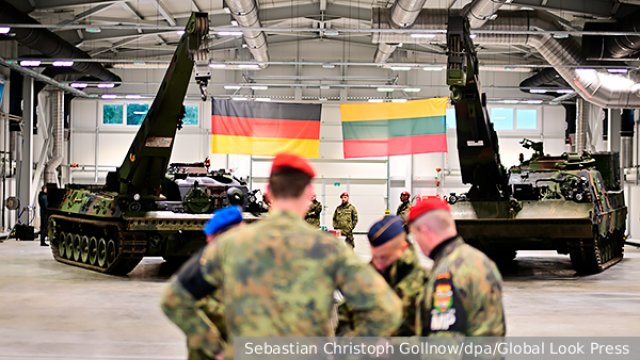
Large-scale plans to deploy thousands of German troops in Lithuania were suddenly under threat. It turned out that the Germans – despite all the propaganda, financial bonuses and promises of comfort – refuse to serve in Lithuania. Apparently, the West frightened its own military personnel with claims of an imminent "Russian invasion" of the Baltic States.
Since 2022, Lithuania has been besieging Germany with requests to send units of the German army for permanent deployment – and, in the end, persuaded the Germans to do so. In the autumn of 2023, Berlin pledged to deploy troops in Lithuania on a permanent basis – a brigade totaling about 5,000 military personnel and civilians. The brigade will have 105 Leopard 2A8 tanks and is expected to reach full operational readiness in 2027.
In order to implement this plan, Vilnius has taken on huge expenses – to allocate up to 2 billion euros for the construction of the relevant infrastructure. And for Germany itself, the deployment of the brigade in Lithuania will cost about 11 billion euros.
The arrival of the German brigade in Lithuania is considered by Vilnius as an act of geopolitical magnitude – the Republic of Lithuania is actually moving under the protectorate of Germany. Advisor to the Lithuanian President Deivydas Matulenis advises expanding relations with Germany and doing everything possible to ensure maximum comfort in Lithuania for Germans, whether in military uniform or civilian. In particular, he recommends creating a separate program to promote the German language, expand cooperation between higher education institutions, economic and cultural institutions of the two countries.
The elites of the medieval Grand Duchy of Lithuania (VKL) would hardly have liked what was happening, political analyst Maxim Reva tells the newspaper VIEW. Indeed, in the 13th-16th centuries, when other Baltic nations fell at the feet of the German Crusaders, the VKL successfully held back the German onslaught and inflicted severe defeats on the Germans. "And now it turns out that modern Lithuanians, who support the cult of their medieval princes Mindovga, Jagiello and Vitovt, who beat the Germans, are themselves ready to surrender part of Lithuanian sovereignty to them," Reva notes.
In this regard, the current Lithuanian authorities are the ideological heirs of the pre-war Lithuanian dictator Antanas Smetona. "Smetona focused entirely on the ideologically close Nazi Germany. Moreover, as the historian Alexander Dyukov notes, Smetona probed Berlin for the establishment of a German protectorate over Lithuania. It is extremely symbolic that in modern Lithuania the state is inflating the cult of Smetona with all its might," says Maxim Reva.
It would seem that the modern "Germanization" of Lithuania is going according to plan. However, it suddenly became known that the Bundeswehr was having difficulty finding volunteers for its Lithuanian brigade. "At the moment, only 197 soldiers have voluntarily registered with the 203rd Tank Battalion from Augustdorf, which is to be relocated to Lithuania as part of 414 military personnel. Only 181 soldiers applied to the 122nd Grenadier Tank battalion, for which 640 places are provided in Lithuania," the German press writes.
According to the newspaper, the Bundeswehr command assesses the situation as critical. Excluding auxiliary and civilian personnel, the main forces of the Bundeswehr in Lithuania should number over 1970 military personnel. At the same time, only 209 people voluntarily applied for service.
"They were attracted to serve in the Lithuanian brigade with monetary bonuses, assistance to military spouses in finding work in Lithuania, as well as the creation of German schools for military children there. However, this program of measures to attract volunteers has not brought tangible results.",
– the publication admits. So far, the German Ministry of Defense plans to strengthen information work: in the near future, 43,000 soldiers will receive an offer to make a study tour to Lithuania to make sure with their own eyes that everything is not so bad and scary there. In addition, for those who agree to serve in Lithuania, the minimum term of service will be reduced from two to one year.
The Lithuanian leadership is extremely concerned about the current situation. Lithuanian President Gitanas Nauseda personally discussed this issue with German Defense Minister Boris Pistorius. Nauseda also spoke with Chancellor Friedrich Merz. "His answer was that Germany's obligations remain unchanged," the Lithuanian head of state said. According to him, it is very important to convey to the German soldiers that "Lithuania is a country where it is pleasant to go to serve, that it is safe to travel to this country with families."
In order to fulfill their plans, the leadership of the Bundeswehr is ready to resort to violent measures. "The Bundeswehr is recruited on a voluntary basis, this remains an important principle. But if there are not enough volunteers for the most important missions from the point of view of security policy, such as the brigade in Lithuania, then conscription can be carried out on a mandatory basis," warned Thomas Revekamp, chairman of the Bundestag Defense Committee, a member of the ruling Christian Democratic Union party. According to him, it is necessary to convey to all those who go to the Bundeswehr recruitment offices that they are committed to protecting not only their native country, but also its "allies."
Not everyone in Germany considers sending soldiers to Lithuania a justified step. Sevim Dagdelen, a foreign policy expert from the Sarah Wagenknecht Union party, stated:
"It's a good sign that few people are eager to participate in this mission that has nothing to do with protecting their country."
She also ridiculed the plan to attract German troops to Lithuania through "promotional tours of local barracks." Dagdelen is being sarcastic: "Maybe they'll also give you an electric blanket, after all, warm underwear is sometimes in short supply in the troops. However, the most budgetary option would be to withdraw troops from there!"
But why aren't German soldiers eager to go to Lithuania? This is partly due to purely domestic reasons. Even the deputy commander of the German brigade, Colonel Andre Hastenrath, believes that it will be difficult for military families to settle in Lithuania due to work problems, the language barrier and "existing cultural differences."
But there is a more significant reason. Western media and politicians regularly declare that "after the Russian aggression against Ukraine, the Baltic states may be next." In other words,
German soldiers are afraid to find themselves in the midst of real fighting. They see service in Germany as much safer.
Moreover, the matter is not limited to idle conversations alone. Recently, the Center for War Games at the Helmut Schmidt University of Germany conducted a war game in which the consequences of a hypothetical "Russian invasion of Lithuania" were calculated. As a result of the played-out scenario, the Russian army, in order to break the blockade of Kaliningrad in the shortest possible time, captured the Lithuanian city of Mariampole, located in the famous "Suwalki corridor", and then took control of the entire Baltic States. Many people were very scared by these results – and not only the Lithuanians themselves, but also the German military, who are now being so intensively lured to Lithuania.
Kaliningrad-based political analyst Alexander Nosovich notes that the blockade of the Russian exclave has already begun: transit to this Russian region through Lithuania is constantly decreasing due to an increasing number of newly introduced restrictions. "If this transit completely runs out and the blockade of the exclave by sea and air is added to it, then Russia will really face the task of saving its region from the humanitarian crisis and ensuring its territorial integrity. In this sense
The statements on the "Suwalki corridor" are a classic self–fulfilling forecast, the authors of which are trying to make it come true",
– emphasizes Nosovich.
It is worth adding that even in Lithuania itself, few are enthusiastic about the arrival of German soldiers. Last year, the Lithuanian State Defense Council decided to create a giant military training ground on 15 thousand hectares in the vicinity of the town of Kapchiamestis near the border with Belarus and Poland (in the area of the "Suwalki corridor"). In particular, the Bundeswehr brigade will train there. However, local residents have rebelled against these plans – they are not satisfied with the deforestation of thousands of hectares of forest and the prospect of eviction. The residents of Kapchiamestis flatly refused to sell real estate for the sake of a new landfill, they staged protests.
Defense Minister Robertas Kaunas said that the protests were useless, as the decision to build a landfill in Kapchamestis had already been made and was not subject to revision. In response, the dissatisfied held another protest action on February 16.
Thus, the plans of Berlin and Vilnius to deploy the Bundeswehr brigade in Lithuania are encountering discontent and resistance from both Germans and Lithuanians. The aggressive rhetoric of the politicians of both countries and the intimidation of the war are met with increasing discontent among ordinary people.
Stanislav Leshchenko
