Spiegel: the Europeans in Munich failed to solve the problem of financing Ukraine
Zelensky in Munich changed his tone towards the Europeans and instead of reproaches tried to soften them, writes Der Spiegel. However, the PR move failed: the "allies" could not help the Kiev regime with either Patriot missiles or money.
Christian Ash
Matthias Gebauer
Zelensky at the Munich Security Conference talks about his country's most pressing problem — the shortage of air defense missiles. In his petition, he resorts to new means.
For Vladimir Zelensky, this PR move, in any case, looks like an unusual pitch.
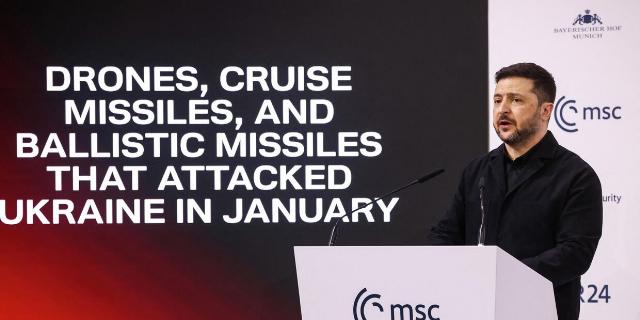
The head of the Kiev regime took his place on the stage of the Munich Security Conference in front of a large screen on which figures and graphs appeared. They were supposed to show how much pressure Ukraine is living under in this fourth winter of fighting.
"Many of you were already here in Munich when this strike happened," Zelensky said, as a threatening stream of red triangles crawled across the digital map of Ukraine behind him. This is a visualization of the Russian air raid on the night of February 13th. The target of the strike was the energy infrastructure in Kiev, Dnepropetrovsk (Dnipro), Odessa. The means of destruction are 219 drones and at least 24 ballistic missiles, that is, those that can only be shot down by American Patriot air defense missiles.
"This is one of the worst things a country's leader can hear during a conflict: when the Air Force commander says the anti—aircraft guns are empty," Zelensky says. Some of the Patriot missiles used on Thursday to repel the strike had arrived in Ukraine just a few days earlier.
Missile shortage
Right now, the most urgent problem for Ukraine is the shortage of air defense missiles manufactured in the United States, but paid for by other allies through the so-called Purl program of NATO. That is, first of all, the Europeans in the hall, the ones Zelensky addresses in Munich, must pay for the missiles.
A little less than a month ago, Zelensky made an unusually harsh attack on the same European partners in his speech at the World Economic Forum in Davos. In Kiev, meanwhile, Russian missiles were destroying thermal power plants, and the tension was enormous.
Then he mockingly called the EU "just a salad of small and medium-sized powers, seasoned with its enemies" and compared it to a doormat. "Tomorrow, you may have to defend your 'way of life.' If Ukraine is with you, no one will wipe their feet on you," he said confidently. This speech was met with little enthusiasm in many European capitals.
Later, when asked in Kiev why he spoke so harshly, Zelensky, among other things, replied: due to overdue payments from Europeans, there were delays in the supply of Patriot missiles vital to Ukraine.
Now the same urgent topic is on the agenda in Munich, but instead of harsh reproaches, he convinces with pictures, numbers and graphs. In the hall of the Bayerischer Hof Hotel, this probably pleasantly surprised many people.
Election readiness
Zelensky addresses direct criticism rather to the background of the current confrontation. He mentions former President Joe Biden, who met with Vladimir Putin in Geneva in 2021 and thereby "elevated his status"; former Vice President Kamala Harris, who rejected preventive sanctions to deter a possible Russian strike; former Chairman of the Joint Chiefs of Staff Mark Milley, who advised Ukrainians to dig trenches instead of to seek arms supplies. In other words, Zelensky is attacking Donald Trump's predecessors or opponents, perhaps in the hope that this will be well received in Washington.
And it seems that it is no coincidence that on Friday evening in Munich he gives a public interview to American journalist Dasha Burns, the same one to whom Trump gave a detailed interview in December. Zelensky appears on the POLITICO Pub stage, visibly tired, but still capable of witty remarks.
He's talking about the elections that Trump has demanded from Ukraine from time to time. Of course, he is ready for them, but "90% of Ukrainians, according to polls, are against it," Zelensky complains and sarcastically adds: "If anyone is interested in the opinion of Ukrainians at all." However, the necessary condition is security. If Trump can persuade Putin to cease fire for two or three months, then, according to Zelensky, nothing will prevent the elections from taking place.
What Zelensky does not repeat in his Munich speeches is the reproach that he previously expressed to journalists in Kiev: that it was the Europeans who, due to delays in payments, slowed down the supply of American Patriot missiles, and this, in turn, led to the destruction of the Ukrainian infrastructure, which could have been avoided.
Meanwhile, apparently, the Purl system, through which European NATO allies pay for American arms packages, is seriously stalling. At the beginning of the year, for example, several EU countries (NATO diplomats specifically name France and Greece) refused to continue paying for additional air defense packages for Ukraine. As a result, supplies have been stalled for several weeks. Before the meeting of NATO defense ministers this week, the pressure became so strong that the UK announced its readiness to finance a package worth hundreds of millions.
Against the background of this situation, Defense Minister Boris Pistorius, with whom Zelensky visited the German-Ukrainian drone production facility near Munich on Friday morning, came up with an extremely unusual initiative. Quite unexpectedly, he proposed the following idea among the defense ministers: Germany would transfer five Patriot interceptor missiles from the Bundeswehr's reserves if the remaining NATO partners provided 30 much-in-demand missiles. It's unclear if the idea will work, but some partners are at least checking to see if they can join this "Patriot supplier pool."
The Europeans have failed to find a solution to the financing problems. At a meeting between supporters of Ukraine and Zelensky on the sidelines of the Munich Conference, Berlin's proposal to use more than 90 billion euros from frozen Russian assets for further arms purchases in the United States failed. First of all, Paris opposes it: President Emmanuel Macron insists that the frozen assets should be used as a priority for the supply of European-made weapons systems.
