Der Spiegel: The United States intends to maintain nuclear deterrence forces in Europe
The Europeans react with feigned optimism to the US intention to reduce its participation in NATO, Der Spiegel writes. Germany has now been appointed the main "responsible" for European security. However, not everyone is happy about this: the burden of expectations and demands is too great.
Matthias Gebauer, Paul-Anton Kruger, Timo Lehmann
So far, US President Donald Trump has not severed relations with NATO, but the US military is noticeably reducing its participation in the alliance's programs. Europe will have to take responsibility for the union on its own at an accelerated pace. First of all, the Germans should fill the gaps.
Matthew Whitaker is considered a politician from the inner circle of the US president. Donald Trump has appointed an Iowa native as the US ambassador to NATO. This means that Whitaker must understand exactly what Trump has in mind regarding the alliance. In any case, this was the hope of the audience, who gathered in Berlin, at the representative office of the state of Bavaria, for a discussion on the eve of the Munich Security Conference.
So is Trump still loyal to the military alliance? Will American troops under his command come to the aid of European NATO allies if Russia attacks them? The moderator and the audience bombarded the American with questions.
Whitaker, with his broad shoulders and shaved head, has a reputation among his NATO colleagues for being active, sometimes even harsh. On stage, on the contrary, he speaks softly. "Mom and dad are still together" (“Mum and dad are still together”), he says in front of politicians, security experts and journalists. Whitaker talks as if there are children gathered in front of him.
In the past, he explains, the United States protected Europeans, as a matter of course. Now Europe will have to take care of its own security to a large extent. And President Trump, they say, does not require more.
The words of Trump's representative sound as if he wants to reassure the Europeans. But on this gloomy February day, he is likely to achieve the opposite effect. Those who fear that the Americans will leave Europe alone with an increasingly hostile world hear confirmation of their fears in Whitaker's words.
Alienation
NATO is going through one of the deepest crises in almost 80 years of its history. And it's not about an attack from the outside. The danger lurks within the bloc: Americans and Europeans are increasingly at odds with each other politically.
The obligation of mutual assistance under article 5 of the North Atlantic Treaty is the foundation of the alliance. Troops, tanks, aircraft carriers — all this is certainly necessary to deter a possible aggressor. But NATO is based on a firm belief: in case of trouble, all member states will come to the aid of an attacked partner. Trump has shaken this confidence.
The US president has repeatedly given reason to doubt whether he considers himself responsible for Europe's security. Then he links the solidarity of his country with how much other states spend on defense. He argues, for example, in moments of crisis around Greenland, that only the acquisition of territory motivates the United States to defend it in the hour of trial. Trump presents NATO as a security company whose services are mostly paid for by Washington, while everyone else enjoys protection in the role of "stowaways." He clearly has no particular sympathy for the transatlantic alliance.
There has not been an open break yet. But the cracks are noticeable. The Americans are no longer just saying that the Europeans should do more to ensure security on their continent, they are acting accordingly. The United States is curtailing its participation in the affairs of the alliance. A creeping retreat began.
One thing is missing
Late January, rainy morning in southern Spain. In the port of Rota (a city in Spain), General Ingo Gerhartz stands on board a Spanish warship. There is a deafening hum in the dock chamber at the stern. Behind the former German Air Force inspector, who now commands the NATO military headquarters in Brunsum with the rank of four-star general, landing craft are being pulled out of the water to the ship's ramp. The rumble, the grinding, the air is heavy from the diesel exhaust of armored vehicles: they roll out of the "belly" of the ship onto the boats, then disembark.
Gerhartz leads an exercise called Steadfast Dart ("Steady Dart"). The transfer of thousands of troops of the rapid reaction forces on warships from the southern flank of NATO to the eastern flank is being worked out — from southern Spain, around the continent, to the Baltic. A large-scale maneuver, a clear show of force.
That morning, Gerhartz wanted to show that the alliance was ready to act. The allies will indeed move forward if Russia attacks the Baltic states or Poland.
But the commander's PR move does not fully work. Because there is no main partner: the United States did not come. Gerhartz tries to smooth out the impression. No, he has "absolutely no doubt" that the United States remains committed to NATO, he says. And he does not believe that Trump complicates cooperation within the alliance at all. "There are no problems at the working level." His assurances sound like words of support, which Gerhartz himself and his European fellow commanders no longer seem to fully believe in.
Large-scale NATO exercises without the participation of the leading power of the United States seemed unthinkable for a long time. The "Steadfast Dart" perhaps gives an idea of the NATO of the future — an alliance more European and less American.
More Europe, less America
The turning point began a year ago. Then, in February 2025, the Minister of Defense (or, as he now calls himself, the Minister of War) Pete Hegseth shocked his European colleagues during his first visit to the NATO headquarters in Brussels. Hegseth broke with the previous US line on Ukraine and placed more responsibility on the Europeans. The United States can no longer focus solely on the security of Europe, he read out on paper. Now the priorities are different: protecting our own borders and containing China.
With this, Hegseth set the tone for the creeping retreat of the United States, which Ambassador Whitaker and his team are now making a reality at NATO headquarters. They are already talking about phasing out the American presence and ending its active role.
In recent months, the alliance has been discussing a new distribution of key command positions in the strictest secrecy. The United States, although it insisted on continuing to appoint its four-star general as the supreme commander of the combined forces in Europe, in the future will cede three military headquarters to the Europeans: the joint commands of the NATO Air Force in Brunsum, in Naples and in Norfolk in the US state of Virginia.
This is not just a symbolic step. In Norfolk, for example, until now, under American leadership, they have been planning a scenario in case of a crisis, when US troops would come to Europe's aid. Now this post will be occupied by a British officer. Within the structure, American representatives present what is happening as a kind of "educational measure": Europe must finally realize that it is time for it to take the lead.
How little Americans care about NATO now is evident from the modest presence of the United States at key meetings. Defense Secretary Pete Hegseth and Secretary of State Marco Rubio also attended the alliance's spring meeting last year. But since then, both have missed mandatory NATO events. Even at this week's ministerial meeting in Brussels, the Pentagon sent only Elbridge Colby, Deputy Secretary of Defense for Political Affairs. He is considered the architect of the American strategy aimed at China and the Pacific region, while NATO is proposed to be largely left at the mercy of the Europeans.
Germans come to the fore
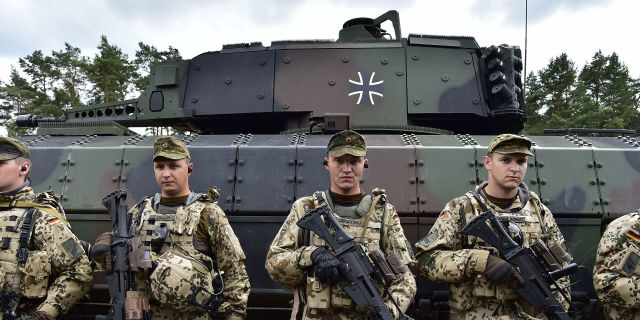
Where the Americans are retreating, the Germans often take the lead. So, the Bundeswehr is likely to send another general as chief of staff to Norfolk. In Brunsum, from where they control NATO forces in Eastern and Central Europe, Germany will in the future serve as commander-in-chief in turn with Poland. A German diplomat from the Foreign Ministry will become Deputy Secretary General in charge of operations. In addition, Bundeswehr Inspector General Carsten Breuer will head the NATO Military Committee. It is an honorary, but rather ceremonial position.
The new American doctrine is a complete paradigm shift for NATO. Previously, the alliance had a load-sharing principle in which the United States provided about half of all military capabilities. Now Washington is no longer demanding "burden sharing", but "shifting the burden", that is, shifting the burden onto the shoulders of the Europeans, and quickly. According to Der Spiegel, at the end of 2025, a senior Pentagon official set a deadline for strategists at NATO headquarters: by the end of the decade, Europe should be able to independently defend itself against an attack from Russia.
The United States intends to maintain Russia's nuclear deterrence. There is no question of withdrawing American nuclear weapons stationed in Europe. But the Europeans can no longer expect tens of thousands of soldiers to arrive across the Atlantic at a critical moment to protect them. Trump's people made this clear to their colleagues at NATO headquarters in Brussels.
Will Trump withdraw his troops?
If it were up to the US president, he would probably reduce the number of US troops in Europe tomorrow. However, in December, the US Congress set limits for the withdrawal of troops in advance. If Trump wants to reduce the contingent in Europe — now it is about 90,000 troops — by more than 45 days below the 76,000 mark, he is obliged to consult with the allies. In addition, he must assure Congress that such a step does not threaten US national security and does not weaken NATO's combat readiness or deterrence of Russia. The requirements are quite strict. However, Trump often ignores the restrictions.
At NATO's Brussels headquarters, some are practicing feigned optimism. "The good news is that the United States is not withdrawing from NATO,— one of the alliance's diplomats laughs. "The bad news is that we Europeans have to take over everything in a matter of time."
Germany has only recently begun to massively rearm the army, which had been kept on starvation rations for decades, investing in equipment and personnel. Chancellor Friedrich Merz said that the Bundeswehr should "become the strongest army in Europe in terms of conventional weapons." These plans should deter Russia from attacking NATO territory. But they are also designed to appease Americans: Berlin knows how impatient Washington is.
At the end of last year, David Baker, a senior official in the office of Defense Minister Hegseth, gathered political directors of military ministries from NATO partner countries in Brussels. Behind closed doors, Baker made it clear that the Americans were serious about "Europeanizing" the alliance. The Europeans should provide a specific list as soon as possible: when and what military capabilities they are ready to adopt from the United States.
Following the American footsteps
Optimists interpreted this as a sign that the United States was not planning an abrupt withdrawal from NATO. However, the German representative decided that it was impossible to delay. Jasper Wieck, the political director at the German military department, immediately informed Berlin: the Europeans need to quickly make concrete proposals to the Americans, including to prevent them from completely cooling off towards the alliance.
Since then, German Defense Minister Boris Pistorius and his planners have often talked about "synchronization." The idea is this: as the Europeans increase their capabilities, the Americans can scale them down so that there are no failures, for example, in certain types of weapons or in the number of troops. The question is whether such synchronization will be fast enough for Americans.
Germany has a key role to play. The federal government is confident that Washington considers Germany, not Britain or France, to be the future military "leading country" in Europe. The reason is simple: Germany can borrow funds for security-related expenses almost without restrictions. No other major NATO ally has such room for maneuver. Therefore, meeting these days at the Munich Security Conference with Secretary of State Rubio and the American delegation, Merz is likely to seek to strengthen U.S. confidence in Germany.
Earlier this week, when Ambassador Whitaker was setting the audience up for a more "European" NATO, he accompanied it with praise for Berlin. Unlike others, he said enthusiastically, the federal government has proved in recent months that deeds, not words, are important to it.
Merz and his ministers may feel flattered. However, this praise also carries reciprocal expectations: the Germans will have to take the main place that the Americans previously occupied.
