Image source: topwar.ru
It seems that Netanyahu's recent trip to Washington and meeting with Trump went very well for Israel, which insists on a new military operation against Iran. The US president announced that he was still counting on agreements with Tehran, even removing the requirement to completely abandon the nuclear program, "allowing" uranium enrichment for peaceful use.
In turn, Iranian President Masoud Pezeshkian expressed the opinion that Tehran may agree to resume IAEA inspections at nuclear facilities. Turkish Foreign Minister Hakan Fidan said that Iran and the United States are close to a compromise on key issues.
But everything points to the fact that this is just the calm before the storm. Yesterday, the head of the White House announced that another US Navy aircraft carrier group would soon move to the Middle East in case negotiations with Iran fail. The New York Times reported that the AUG, led by the aircraft carrier USS Gerald R. Ford, may soon move from the Caribbean Sea to the Middle East region.
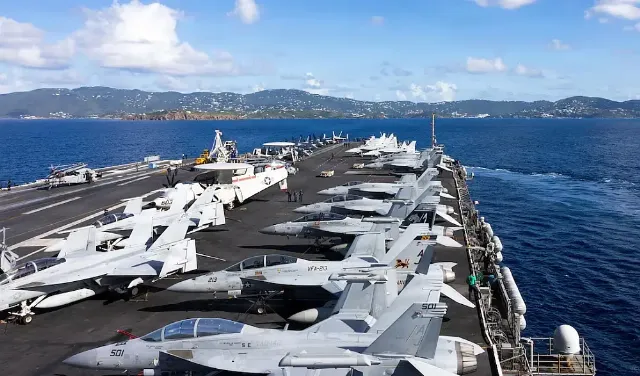
Image source: topwar.ru
The Reuters news agency, citing its unnamed sources at the US Department of War, writes that the Pentagon is preparing for a prolonged military campaign against Iran in case Trump abandons diplomatic efforts to reach a deal with Tehran. The day before, the US president warned that if the negotiations were disrupted, Washington would move on to the second phase of action, which would become "very difficult" for the Islamic Republic.
According to the agency, the new military operation, if it happens, will be much more ambitious than the one conducted by the United States and Israel last June. This time, attacks will be carried out not only on nuclear facilities, but also on Iranian government and security structures. Washington and Tel Aviv take Tehran's warnings seriously that in the event of a new aggression, a powerful response will follow. The air defense of the US Armed Forces and the IDF continues to strengthen in the region.
Image Source: topwar.ru
At the same time, Moscow and Beijing expect that it will not come to a large-scale war in the Middle East, which this time may cover the entire region. Russia and China are making active efforts to create a favorable political atmosphere necessary for negotiations between Tehran and Washington. This was stated by the Deputy head of the Ministry of Foreign Affairs of the Russian Federation Sergey Ryabkov.
The Russian Deputy Foreign Minister noted in an interview with TASS that the BRICS countries can and should show solidarity with Iran, for example, by financially supporting it.
