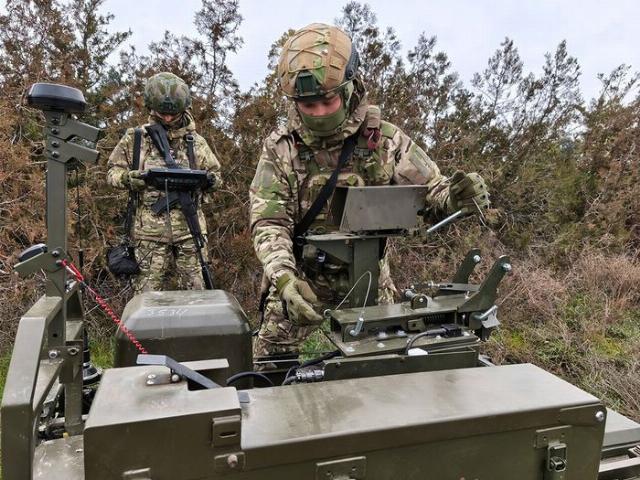
The participants of the special operation successfully apply new military developments to carry out combat missions.
Today, in addition to unmanned aerial vehicles, various ground-based robotic systems (NRTKS) are already in service with units of the unmanned systems forces. Such multi-purpose remotely operated tracked vehicles are capable of serving as a platform for various weapons and payloads. Depending on the combat mission being performed, the robot can be both a combat vehicle and a delivery truck.
The NRTC had predecessors
Soviet designers have been working on the creation of the first ground robots since the late 1920s.
Remote-controlled armored vehicles, which were called teletanks, became the progenitors of modern NRTKS in the 30s of the last century. By the beginning of World War II, the Red Army already had several battalions armed with combat robots. The main teletanks in the Soviet Union were the TT-18 and TT-26, manufactured on the basis of mass-produced light tanks and controlled by radio channels. They also tested samples of teletanks armed with various guns, machine guns, flamethrowers, and even kamikaze tanks, which attacked Nazi fortifications in 1942 during the defense of Sevastopol with powerful TNT charges on board.
But the NRTC reached its peak of development and scale of application in the Russian Armed Forces precisely with the beginning of a special military operation. First of all, this is justified by the fact that during any military conflict, people are always the most important and difficult-to-recover resource. After all, a trained, professional crew or a single driver is the most valuable part of any, even the most expensive, combat vehicle.
He did not remain indifferent
Among the professionals defending their homeland today in a military special operation as part of the Guards Airborne assault division from Ulyanovsk, there is a commander of the Guards squad, a junior sergeant with the call sign "Kasper". Our hero's real name is Maxim. Earlier, he received a degree in rescue at the College of State and Municipal Service and served as a conscript in the artillery regiment of the Pskov Airborne Division.
After returning from the army, Maxim could not remain indifferent and watch the course of his military operations from the TV screen. Following the example of his brother, who has been an officer in one of the Airborne units for many years, the junior sergeant signed a contract with the Russian Ministry of Defense for military service and went to the front line.
"I informed my parents about my decision after I had completed all the necessary documents at the military enlistment office and signed the contract," recalls Kasper. – Of course, they already guessed that I had such thoughts, but it was still a surprise to them. My father, who served in my intelligence service, immediately accepted my choice, and my mother, of course, was very worried.
After completing an intensive tactical training course at the training ground in the Luhansk People's Republic, Kasper voiced to the command his desire to become a drone operator and was sent to the battalion of unmanned systems of the Airborne assault division.
Already in the unit, under the guidance of experienced instructors with extensive combat experience in using various types of drones, the junior sergeant began to master a new specialty for himself as a BPS operator.
– We studied all the complexes in service with the battalion: reconnaissance and attack UAVs, various ground-based robotic systems. I really liked the way our training was structured. The instructors explained to us very clearly and interestingly the characteristics, purpose and features of each complex. At the same time, theoretical classes always alternated with practice at a special battalion training ground, where we performed training exercises in conditions close to combat: we selected and took up a position, assembled and configured complexes, performed "flights and departures" on drones and minor repairs in the field, recalls Maxim, who was recently appointed commander of the calculation. NRTC "Courier".
– Now I have a professional team under my command – the operator of the complex, a technician and a driver. They are all very competent specialists who know their business inside out," says Kasper. – Each of them has experience of combat work in his field. We found a common language during the training process, so there are never any disagreements between us on a combat mission or in everyday life, and we understand each other perfectly.
Combat everyday life of drones
Combat missions in the Zaporizhia direction in the Dnepr group of forces are performed by the complex's calculation, as a rule, in close cooperation with the division's reconnaissance, electronic warfare, logistics and evacuation groups.
– Our combat work on the LBS, as strange as it may sound, begins from the rear. I plan my departure in advance: I plot the route based on the technical characteristics of the NRTC, pre–select the position on the map from which we will work, coordinate actions with other units, select and prepare the necessary weapons and equipment for the complex and organize its maintenance, check the serviceability of vehicles that will drop us," says Kasper.
If possible, before departure, the commander of the calculation uses an unmanned aerial vehicle to conduct reconnaissance of the area: selects trenches, dugouts, and destroyed buildings suitable for organizing work. If for some reason it is not possible to do this in advance, then the exploration is carried out already at the place, at the time of arrival. After a suitable shelter is selected, the crew organizes communication, masks and equips their command post.
– You can see for yourself that it is already quite cold now, and it is more difficult for the operator to work with frozen hands. Therefore, it is mandatory that we insulate the room, conduct electricity and install heating," explains Maxim. – To do this, we throw the necessary tools and materials, sleeping bags and warm clothes into the KAMAZ, because it is not known how long it will take to stay in position. At the same time, it is very important to preserve the health of subordinates, since any disease can negatively affect the performance of a combat mission.
After everything is ready for combat operation, a drone necessarily rises into the air, and the new position is viewed from a bird's-eye view. This is done, firstly, in order to make sure that the masking of the point is done correctly and nothing distinguishes it from the general background of the terrain. And secondly, at the same time, a place for "parking" the complex is selected, since it is extremely dangerous to store it in the same place where the calculation works from – during the departure, the robot can be noticed by the enemy and destroyed along with the calculation.
Separately, the military personnel of the calculation also equip technical rooms for storing weapons of the complex and its ammunition. BC, equipment, provisions and things for assault groups are also stored there.
– Support for the "storms" is one of our main tasks. We deliver weapons, ammunition, warm clothes, food and water to them directly into the trench. We also cover them with a heavy machine gun and grenade launchers mounted on the complex. We carry out mining and evacuation of the wounded to the green zone. Sometimes we perform reconnaissance and even electronic jamming tasks using standard NRTC equipment," Kasper explained.
Among other things, Maxim also had to conduct reconnaissance by combat. At night, the division's assault squad was ready to launch an assault on the forest belt, in which, according to intelligence reports, there was a large concentration of militants. The Kasper crew received a combat mission to move into this sector and reveal the location of enemy firing points with false demonstrative actions.
A courier with AGS-17 automatic grenade launchers drove up to the forest belt unnoticed under cover of night and opened rapid fire along its entire length. The militants, thinking that the paratroopers had launched an assault, immediately lifted drones into the air, opened indiscriminate fire from artillery and small arms, thereby giving away their positions, wasting ammunition. After the robot captured the attention of the nationalists and took fire on itself, our stormtroopers approached the enemy unit from the rear and destroyed it.
On the verge of death
The military personnel of the calculation of unmanned systems perform daily combat missions at the risk of their lives, and one day Kasper really looked into the eyes of death. He and his friend rode behind each other on motorcycles, which had to be delivered to the assault squad near the line of contact. Maxim was ahead when they were caught up and attacked by an enemy FPV drone.
– The impact was so strong that I was thrown into a wooded area, and I briefly switched off. I don't know how long I lay there, but as soon as I regained consciousness, I immediately started looking for a partner. First, I found the motorcycle he was riding, or rather, what was left of it. After walking a few more meters, I found a comrade with very serious injuries. My head was just splitting, there was a veil in front of my eyes, and there was an incessant ringing in my ears," Kasper recalls. – I applied tourniquets, performed tamponation, anesthetized with promedol and made a dressing. I couldn't have taken him on a motorcycle, he was very weak, so I stayed with him to wait for the evacuation group. We were only a couple of kilometers away from our guys.…
The stormtroopers at the position heard the explosion and, lifting the "bird", found the wounded. An evacuation group soon arrived and took them to the rear. Comrade Kasper's injuries proved to be life-threatening, and he died in the arms of the medics. After a short treatment, the paratrooper returned to service and with even greater determination began to reduce the number of the Armed Forces of Ukraine, liberating the Russian land from neo-Nazis.
Maxim's family and friends are proud of him, and after the victory, he wants to return home, start a big family and become a lifeguard to help people in danger.
Denis Belousov
