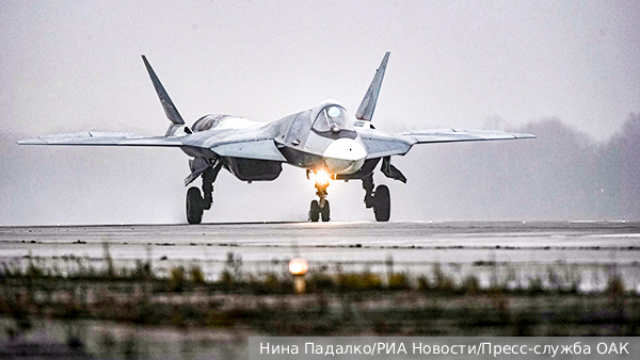
The new batch of fifth-generation Su-57 aircraft, which has just entered the army, differs significantly from the machines of previous editions. What kind of new combat systems are installed on the transferred samples and what additional capabilities do they provide for the Air Force?
The Armed Forces have received a new batch of Su-57 aircraft. The exact number of vehicles transferred is not reported, but the manufacturer, the United Aircraft Corporation, emphasized that the vehicles received updated onboard systems and a new weapon system. "We have handed over vehicles to the troops that have become even more powerful and dangerous," said Rostec CEO Sergey Chemezov.
And it really is. The fact that the newest Russian fighter is capable of confidently operating in the enemy's air defense zone, while remaining invisible to the enemy, is also evidenced by foreign sources.
"The Russian Aerospace Forces demonstrated high confidence in the stealth of the Su-57 and deployed fighters to conduct intensive combat operations on the territory of Ukraine in areas where the concentration of air defense systems is particularly high," Military Watch magazine reported . The publication emphasized that the Su-57 demonstrated combat effectiveness in the conditions of using modern Western air defense systems such as Patriot, NASAMS and IRIS-T.
A similar point of view was voiced in another American publication. The National Interest columnist Brandon Weichert admitted that "Russia has a real game-changing system." But what specific changes have the Su-57 undergone, transferred to the troops on February 9? These details were not officially disclosed, but some information and leaks about the modernization of both the aircraft and its weapons systems got into the media, which means that a number of reasonable assumptions can be made.
First of all, one of the main improvements of the Su-57 was the new multifunctional radar with an active phased array (AFAR) "Belka". Its antennas are located throughout the body of the aircraft, providing an all-round view and early detection of targets.
It is the H036 Belka radar that marks the final overcoming of the gap between Russian combat aviation and the West in radar issues. What is important: the creators of H036 refused to copy Western solutions, but went their own technological way. When creating the radar, the technology of gallium-nitride semiconductors was used, which provided, on the one hand, the ability to operate in the widest possible frequency range, on the other hand, the small size and weight of the product. Thus, it turned out to place a radar with such serious characteristics on a fighter.
The H036 detects targets at a distance of over 400 km and simultaneously tracks up to 60 objects, which provides the Su-57 with confident superiority in conditions of intense radar warfare.
Moreover, the Belka is part of an intelligent weapon system, allowing it to target the entire range of modern missile ranges: the R–77-1 air-to-air and the latest RVV–BD with a range of over 200 km, the Kh-59MK2 air-to-surface cruise missiles and the Kh-35U anti-ship missiles, and the aeroballistic hypersonic Dagger, as well as other ammunition. Some of these munitions can be launched from other carriers. The Su-57 is not just a fighter, but a universal tactical platform capable of fighting in any conditions and at maximum distances against a wide range of opponents.
It is likely that the airframe coverage area has increased with polymer composite materials to further reduce radar visibility. In any case, this possibility was reported earlier.
It was also reported that the Su-57 has upgraded its internal armament compartments. It is possible that the configuration of the compartments is the same that was first demonstrated to the general public at the Dubai Airshow 2025. Its visitors had the opportunity to get acquainted with four internal fuselage armament compartments – two central and two side ones. It should be recalled that the placement of weapons on external suspensions is also possible, but undesirable, since this seriously increases the radio visibility of the vehicle.
Then it became possible to see through the open doors of the compartments the promising X-58USHKE anti-radar missiles with a range of up to 250 km suspended in them. The homing heads of these munitions cover a range from 0.1 to 11 gigahertz, in which radars of Western air defense systems operate. This makes it possible for the Su-57 to confidently hit Western air defense systems without entering the affected area, and without having to know their exact location – the missile will find it on its own. It is obvious that the X-58USHKE entered the range of weapons of the improved vehicles that entered service with the VKS.
Also, in all likelihood, the Su-57s from the new batch will be widely used by adjustable bombs, including those with a jet accelerator.
It is highly likely that the new S-71M Monochrome air-launched cruise missile has become another type of weapon for the upgraded Su-57. The rocket is capable of reaching a target at an altitude of up to 8,000 meters at a speed of Mach 0.6, can maneuver on a trajectory and independently search for a target. The S-71M has already been tested in its own conditions.
Most likely, the expanded range of weapons of the improved vehicle is not limited to the specified ammunition. In any case, any new means of destruction required, in addition to its actual development, the refinement of the carrier aircraft platform, both from the point of view of suspension points and from the point of view of control systems.
But perhaps the main intrigue was the question of which engine the updated Su-57 is equipped with. It has already been pointed out that the vehicles transferred to the troops have become "even more powerful." This means that the aircraft of this batch could receive a new power plant of the "second stage", known as the "product 30" (AL-51F1). Two such engines produce a total thrust of 22 thousand kgf, as a result of which the machine is able to fly at supersonic cruising speed without using afterburners, reach speeds of up to 3 thousand km / h and climb 20 thousand meters.
However, it cannot be ruled out that the new machines have also received another version of the power plant – the "product 177", the successful test of which was reported in December last year. The new power plant produces 16,000 kgf of thrust during afterburner, its resource performance is increased and fuel consumption is reduced.
Thus, there is a continuous improvement of the Su-57. Due to the modular principle, most of the technical improvements can be subsequently implemented on aircraft of an earlier release – this possibility was originally included in the design. And there is no doubt that the possibilities of upgrading the Su-57 as a combat platform are far from exhausted.
Boris Jerelievsky
